Investment Banking Recruiting Timeline: A Complete Freshman-to-Junior Year Guide to Planning, Applications, and Interviews
Author note: Alex Chen (pseudonym) has eight years of investment banking experience at a bulge bracket bank in New York. He has mentored more than 200 students through investment banking recruiting, with those students collectively receiving 250+ offers across leading investment banks and other finance roles. His coaching focuses on recruiting strategy, networking, technical and behavioral interview preparation, and helping students navigate the full recruiting timeline from early preparation through final-round interviews.
Published on
October 9, 2026
5
min read

What Is the Investment Banking Recruiting Timeline?
For most college students targeting investment banking, preparation should begin during freshman year, while junior summer internship recruiting can become serious during sophomore year—well over a year before the internship itself.
A simple way to think about the timeline is:
Freshman year: explore finance, protect your GPA, join relevant organizations, build foundational technical skills, find your first internship, and begin networking.
Sophomore year: develop a clear bank and office target list, deepen networking, become interview-ready, and recruit for the junior summer analyst position.
Junior year: finish any remaining recruiting, prepare for the internship, and use the junior summer to earn a full-time return offer.
The biggest mistake is not simply “starting late.” It is reaching sophomore recruiting with several unfinished pieces at once: no relevant experience, weak technicals, limited networking, an unclear story, and no idea which banks are already recruiting.
This guide explains what to prioritize at each stage—and what can safely wait.
One of the first questions students ask when they become interested in Wall Street is:
“When am I actually supposed to start investment banking recruiting?”
The answer surprises many freshmen.
Not junior year. Not even the end of sophomore year.
For competitive U.S. investment banking roles, the recruiting process has moved progressively earlier. A student targeting a junior summer analyst internship may begin serious networking and preparation during freshman year and encounter applications or interviews during sophomore year.
That creates an unusual recruiting environment. You can be interviewing for the internship that may lead to your first full-time job before you have completed half of college.
At OSG, this is also one of the most common problems we see when students first begin preparing. Some students arrive extremely early but have spent months doing the wrong things. Others have strong grades and experiences but discover the recruiting calendar only after applications have begun opening. The students who navigate the process most effectively are rarely the ones who simply do the most work; they understand what needs to happen first, what can happen later, and how each stage builds into the next.
OSG has worked with undergraduate candidates across finance recruiting since 2018, including students recruiting for bulge bracket banks, elite boutiques, middle-market firms, private equity, hedge funds, and related roles. Bloomberg News has also interviewed OSG and students who worked with the firm while reporting on the increasingly competitive market for finance careers.
The purpose of this article, however, is not to convince every freshman that they need career coaching. It is to make the recruiting timeline understandable enough that you can build a sensible plan—whether you prepare independently, through your university, with older students, or with professional support.
1. When Does Investment Banking Recruiting Start for College Students?
Investment banking recruiting begins earlier than the internship date suggests. For students targeting a junior summer analyst role, freshman year is typically the preparation stage and sophomore year is often the main recruiting stage.
There is no single date on which “investment banking recruiting starts.”
That is because firms, offices, and even groups within the same bank can move on different schedules. One bank may open applications while another is already conducting interviews. A San Francisco technology team may move at a different pace from a New York generalist program. Early programs can also operate on separate calendars from the standard junior summer analyst process.
For that reason, students should think about investment banking recruiting as a multi-year process rather than an application deadline.
A typical undergraduate investment banking recruiting timeline
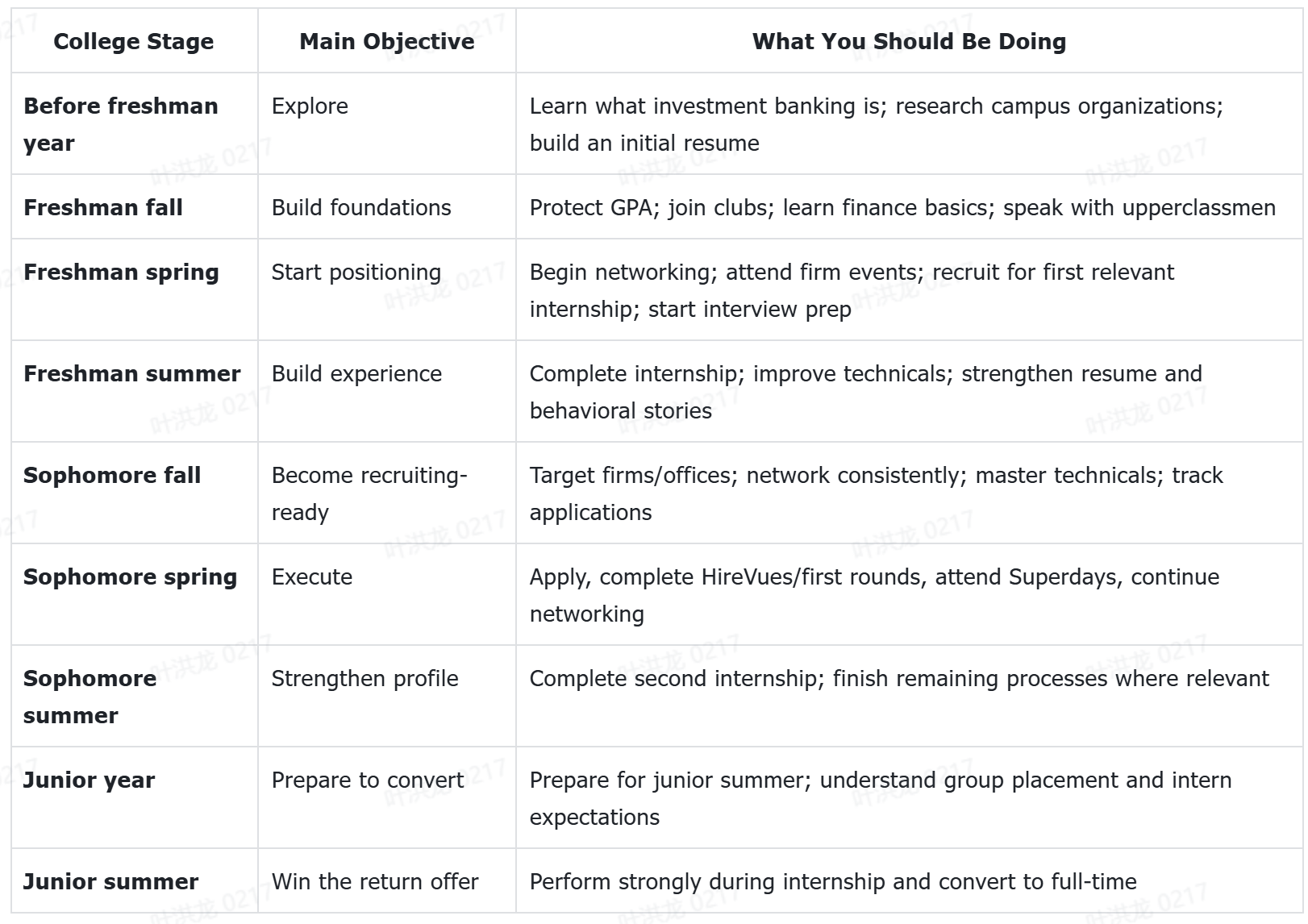
This table is deliberately broad. Recruiting calendars change from year to year, so copying the exact dates from an older student's recruiting process is risky.
What remains remarkably consistent is the sequence.
Students need enough knowledge to choose the path. They then need enough experience to look credible, enough networking to understand and access opportunities, and enough interview preparation to convert those opportunities.
Skipping one stage tends to make the next one harder.
Why does investment banking recruit students so far in advance?
The junior summer internship is not simply a summer job. At many banks, it is one of the most important pipelines into the full-time analyst class.
A bank can interview a student during sophomore year, bring that student in as a summer analyst after junior year, evaluate them for roughly ten weeks, and then decide whether to extend a return offer for after graduation.
From the bank's perspective, this is much more informative than hiring someone after a handful of senior-year interviews.
During the internship, the team gets to see whether an intern can actually:
produce accurate work;
respond to feedback;
manage deadlines;
communicate professionally;
learn financial analysis and modeling;
operate under pressure;
work effectively with analysts, associates, and senior bankers; and
remain dependable when the workload becomes unpredictable.
That is why the junior summer analyst role carries disproportionate importance.
For students, the practical implication is simple: do not work backward from graduation. Work backward from junior summer recruiting.
How early is “early” in investment banking recruiting?
The frustrating answer is that it depends.
Students often want a clean rule such as:
“Applications open on February 1 of sophomore year.”
Real recruiting is messier than that.
Different banks recruit on different schedules. Certain opportunities are reviewed on a rolling basis. Some processes accelerate suddenly. Some offices may be largely filled while another office at the same institution remains active.
This is why experienced candidates build a recruiting tracker instead of relying on memory.
At minimum, track:
Bank
Program
Office
Group or division
Application opening date
Application deadline
Rolling or non-rolling process
People you have spoken with
Last networking interaction
HireVue status
First-round status
Superday status
Next follow-up
A simple spreadsheet is enough.
What matters is that you know where each process stands before everyone in your group chat starts saying, “Wait, this already opened?”
The first rule of the investment banking timeline: prepare before the opening date
One recurring mistake in IBD recruiting is treating the application opening as the beginning of preparation.
It should be closer to the beginning of execution.
When an application opens, you do not want to be simultaneously:
learning what investment banking is;
rebuilding your resume;
figuring out whom to network with;
learning accounting;
writing your “Why Investment Banking?” answer;
researching the firm's industry groups; and
practicing your first technical interview.
That is seven problems instead of one.
By the time serious junior summer recruiting begins, much of your basic preparation should already be done.
2. What Should Freshmen Do for Investment Banking Recruiting?
Freshman year should be used to create a strong foundation—not to imitate a sophomore already in Superday season. Your priorities are GPA, career exploration, campus involvement, finance fundamentals, early networking, and a credible first internship.
There is a growing tendency for freshmen interested in finance to feel behind almost immediately after arriving on campus.
Someone in their dorm already knows what restructuring banking is. Someone else has a stock pitch ready. A third student has joined three finance clubs and changed their LinkedIn headline to “Incoming Investment Banking Summer Analyst” before taking a college economics course.
None of that tells you who will actually recruit well eighteen months later.
The most productive freshman year is usually much less dramatic.
What should you prioritize during freshman fall?
Freshman fall should answer two questions:
Do I genuinely want to explore investment banking?
Can I build a strong enough foundation to keep that option open?
The first priority is academic performance.
Investment banks do not all use the same GPA standard, and GPA is only one part of the application. But strong grades are useful because they remove a possible objection before the interview begins.
A freshman who sacrifices academics to spend every night preparing for banking interviews is solving the wrong problem.
Once academics are stable, start learning the industry.
You should understand, at a basic level, how investment banking differs from:
private equity;
public-markets investing;
sales & trading;
asset management;
consulting;
corporate finance;
corporate development; and
quantitative finance.
This is not just “career exploration” in the abstract. It eventually makes your interview story much stronger.
Compare these two answers:
“I chose investment banking because it offers a steep learning curve and exposure to transactions.”
and:
“I initially explored both public-markets investing and banking. I enjoyed researching companies, but I found myself more interested in the transactions that changed those companies—how an acquisition gets financed, why a buyer is willing to pay a premium, and how advisers position the deal. That is what pushed me toward banking.”
The second answer sounds better because the student has actually compared paths.
Do finance clubs matter for investment banking recruiting?
They can help a great deal, but they are not a prerequisite.
Good student organizations provide three things that freshmen otherwise have difficulty accessing:
structured technical education;
older students who recently recruited; and
a peer group going through the same process.
That can accelerate learning substantially.
But students often confuse the prestige of a club with the value of the experience.
If you are rejected from the most competitive investment banking organization at your university, you have not been rejected from investment banking.
Join another organization. Learn independently. Build an investment thesis. Participate in a case competition. Work on a student fund. Ask an older student for guidance.
The objective is to develop substance.
By sophomore recruiting, an interviewer cares much more about whether you can discuss what you have done than whether your club had a 7% acceptance rate.
What technical skills should freshmen learn?
Start with concepts that make the rest of finance understandable.
By the end of freshman year, a student seriously pursuing banking should ideally be comfortable with:
the income statement;
balance sheet;
cash flow statement;
how the three statements connect;
enterprise value versus equity value;
market capitalization;
debt and cash;
EBITDA;
the main valuation methodologies;
the intuition behind a DCF;
basic M&A concepts; and
the basic logic of an LBO.
Notice the wording: the intuition behind.
A freshman who can explain why enterprise value includes debt is in a better position than someone who has memorized an enterprise-value formula but cannot explain it.
The goal is not to accumulate technical questions like Pokémon cards.
It is to build a framework that later questions fit into.
When should freshmen start networking?
Freshman spring is generally a sensible time to begin networking more consistently.
Your first conversations should be low-pressure.
Start with:
upperclassmen who recruited recently;
alumni from your university;
analysts one or two years out of school;
professionals at smaller firms;
speakers at finance events; and
people connected to organizations you already belong to.
At this stage, you are not trying to manufacture a referral from every conversation.
You are learning how professionals describe their work and how different firms actually differ.
Useful freshman questions include:
What made you choose banking over other finance careers?
What did you misunderstand about the job while you were in college?
What should you have done earlier?
What differentiated your group from the others you considered?
Which freshman experiences helped most later?
What do students over-prepare for?
What do they usually under-prepare for?
Take notes.
Six months later, those notes become useful when your conversations become more targeted.
What should your freshman summer internship look like?
For most freshmen, relevance matters more than prestige.
An ideal first internship gives you exposure to companies, markets, transactions, research, or financial analysis.
Possible options include:
boutique investment banking;
search funds;
small private equity firms;
venture capital;
wealth or asset management;
transaction advisory;
corporate finance;
corporate strategy;
startup finance;
equity research; or
business-related research.
A student sometimes asks whether a ten-person boutique is “good enough.”
That is the wrong question.
Ask instead:
Will I work on something substantive?
Will I learn how companies are analyzed?
Can I explain my contribution afterward?
Will someone be able to speak to the quality of my work?
Does this experience help me take the next step?
A small firm where you actually research buyers, analyze financials, or assist with transaction materials can provide far better interview material than a recognizable company where you did work unrelated to finance.
A practical freshman-year investment banking checklist
By the end of freshman year, aim to have:
A strong GPA
At least one substantive campus activity
A clean one-page resume
Basic accounting and valuation knowledge
Several genuine conversations with finance professionals
A relevant freshman summer experience
A more specific reason for pursuing banking than “learning opportunities”
You do not need every item to be perfect.
The purpose of freshman year is to make sure that when sophomore year begins, you are building from a foundation rather than starting from zero.
3. What Should Sophomores Do Before Junior Summer Investment Banking Recruiting?
Sophomore year is usually the most important year in the investment banking recruiting timeline. By this point, your focus should shift from exploration to execution: targeting firms, building relationships, mastering interviews, and monitoring applications closely.
A common sophomore-year mistake is thinking:
“I still have two years until graduation.”
For banking recruiting, that is not the relevant clock.
The relevant clock is how long you have until junior summer interviews.
That might be measured in months.

What should you have ready by sophomore fall?
By sophomore fall, you should ideally know your answers to five questions:
Why investment banking?
Which types of banks interest you?
Which offices or industries are most relevant to you?
What experiences support that interest?
Where are the gaps in your interview preparation?
This is also the stage when your target list should become much more specific.
Do not make a list consisting only of Goldman Sachs, Morgan Stanley, J.P. Morgan, Evercore, and Centerview.
Build a real recruiting universe.
Bulge bracket banks
Depending on the recruiting cycle and how firms are categorized, commonly targeted global banks include:
Goldman Sachs
J.P. Morgan
Morgan Stanley
Bank of America
Citi
Barclays
UBS
Deutsche Bank
Elite boutiques and advisory-focused firms
Students frequently consider firms such as:
Evercore
PJT Partners
Lazard
Centerview Partners
Moelis
Perella Weinberg Partners
Houlihan Lokey
Rothschild & Co.
Middle-market and other investment banks
A broader list may also include:
Jefferies
William Blair
Piper Sandler
Baird
Lincoln International
Harris Williams
Guggenheim Securities
DC Advisory
and other strong sector-focused or regional franchises.
The point is not which category label belongs beside every logo.
The point is to avoid turning IBD recruiting into a five-bank lottery.
Should you target specific investment banking offices or industry groups?
Yes—when you have a credible reason.
Banking becomes easier to understand once you stop treating “investment banking” as one homogeneous job.
Location often shapes industry exposure.
For example, students may associate:
San Francisco / Silicon Valley with technology and growth-oriented sectors;
Houston with energy;
New York with the broadest collection of coverage and product groups;
Chicago with significant industrials and diversified coverage;
Los Angeles with a mixture of media, consumer, healthcare, technology, and other sector teams depending on the firm.
You do not need to pretend you have known since age twelve that you wanted to advise semiconductor companies.
But if your prior experiences create a real connection, use it.
One recent OSG student began with a long-standing interest in cars and engineering. Instead of discarding that background when he moved toward finance, he used it to explore industrials, technology, financing, and eventually credit investing. Over four months, he completed close to 70 coffee chats while building a much clearer understanding of where his interests fit. He ultimately received offers spanning credit investing and investment banking.
The useful lesson is not “do 70 coffee chats.”
It is that a personal interest becomes valuable when it helps narrow your path and makes your conversations more specific.
How should sophomore networking differ from freshman networking?
Freshman networking is mostly exploratory.
Sophomore networking should increasingly be firm-, office-, and group-specific.
You should know:
why you contacted this person;
what you already understand about their group;
which previous conversations you have had at the firm;
which questions remain unanswered; and
how this firm fits your recruiting strategy.
That creates much better conversations.
Instead of:
“Can you tell me about your experience at Bank X?”
you might ask:
“I spoke with someone on the West Coast technology team who described how analysts get fairly early exposure to software clients. I was curious whether that is similar in your M&A group in New York, or whether the analyst experience is structured differently.”
Now you are having a conversation rather than running through a questionnaire.
How many coffee chats do you need for investment banking?
There is no target number that guarantees an interview.
This is worth emphasizing because students can become strangely obsessed with volume.
We have seen successful candidates with very different networking styles. Some maintain a smaller set of deep relationships. Others, especially when recruiting outside their school's strongest pipelines, conduct dozens of conversations over several months.
Track quality and coverage, not only count.
Ask yourself:
Do I understand the firms on my target list?
Have I spoken with people in my priority offices?
Do any contacts know me beyond one fifteen-minute call?
Have I followed up naturally?
Can I explain why each firm is on my list?
Fifty generic calls are not automatically better than fifteen thoughtful ones.
When should you finish investment banking technical prep?
Before the interview invitation arrives.
This seems obvious. In practice, many students do the opposite.
The invitation appears, and only then do they begin studying.
That puts enormous pressure on the final few days.
By sophomore recruiting, your core investment banking interview prep should cover:
Accounting
Three-statement relationships
Enterprise value and equity value
Trading comparables
Precedent transactions
DCF
M&A mechanics
Accretion and dilution
LBO fundamentals
Industry knowledge
Recent transactions
Relevant market developments
More advanced interviews may go beyond this list.
The standard you should aim for is not “I have seen the question.”
It is:
“I understand the concept well enough to answer the follow-up.”
One OSG student preparing for elite boutique recruiting took this idea unusually far. In the final six days before a key interview stretch, she completed roughly 30 targeted mock sessions. Importantly, those sessions were not simply repetitions of the same technical guide. As the interview approached, the focus moved toward industry trends, specific companies, transactions, and the reasoning behind her views.
That distinction matters.
At some point, another hour memorizing definitions has lower value than learning to think aloud like someone genuinely interested in the industry.
4. When Do Investment Banking Applications, HireVues, and Superdays Happen?
Junior summer applications can open during sophomore year, and the process can move quickly from application to interview. Because dates vary by bank and office, students should monitor individual opportunities rather than rely on one industry-wide deadline.
This is the stage where the timeline becomes less predictable.
A typical process might include:
Online application
Resume screening
Online assessment or HireVue
First-round interview
Additional interviews, depending on the firm
Superday
Offer
Not every bank uses every stage.
Some processes move quickly. Others leave candidates waiting for weeks. Networking may occur before, during, and after the formal application.
What matters is that the candidate is ready for the next stage before it arrives.
When should you submit your investment banking application?
If a firm reviews candidates on a rolling basis, there is generally little benefit to deliberately waiting until the last day.
But “apply early” does not mean “submit a poor application fifteen minutes after the portal opens.”
Before submitting, make sure:
your resume is final;
dates and formatting are correct;
your graduation year is accurate;
your location preferences make sense;
required written responses are polished; and
you understand what you are applying for.
The ideal candidate is both early enough and ready enough.
What should be finished before applications open?
By the time your priority recruiting processes become active, try to have the following completed:
Resume
Your resume should be concise, accurate, and easy to defend.
Every bullet is fair game in an interview.
Personal story
You should be able to answer:
Walk me through your resume.
Why investment banking?
Why this firm?
Why this office?
Why this group, if relevant?
without sounding as though you memorized a paragraph from an interview guide.
Technical foundation
Accounting, valuation, DCF, M&A, and basic LBO knowledge should not be new material.
Networking
You should already have relationships in progress rather than cold-emailing thirty bankers the night after you receive a first round.
Industry and transaction knowledge
Have at least a few sectors, companies, or transactions you can discuss intelligently.
Interview practice
Your first mock interview should not be the real interview.
What happens during an investment banking Superday?
A Superday usually consists of multiple interviews with professionals across different seniority levels.
The exact format varies, but candidates may face a mixture of:
behavioral questions;
technical questions;
resume questions;
market discussions;
transaction questions;
industry questions;
judgment-based follow-ups; and
informal conversation.
The difficulty is not simply that there are more questions.
It is that you need to remain consistent across interviewers.
Your “Why Banking?” answer should not become a different life story in the third interview. Your explanation of an internship should withstand follow-up questions. Your technical reasoning needs to remain clear even after a difficult prior round.
That is one reason realistic mock interviews are useful. They test not only knowledge but delivery under pressure.
OSG's recent internal training methodology has emphasized repeated, interviewer-style mocks rather than treating interview preparation as a one-time technical course. In practice, the most useful feedback often involves small things: an answer that takes three minutes instead of ninety seconds, a technical explanation that is technically correct but poorly structured, or a candidate who knows a sector well but cannot explain why it matters to the firm interviewing them.
Those are difficult issues to diagnose from a question bank alone.
5. How Do Internships, Networking, and Interview Prep Fit Into One Recruiting Plan?
The strongest investment banking recruiting plans do not treat internships, networking, and interviews as separate checkboxes. Each one should make the others stronger.
This is where a good recruiting timeline becomes more than a calendar.
Consider the following progression:
Freshman internship → better understanding of finance → stronger resume → more substantive networking conversations → better sophomore internship → stronger behavioral stories → more interviews → better interview performance
That is a recruiting flywheel.
The opposite can happen as well.
A student collects three internships but cannot explain what they did. Their resume looks strong, but networking conversations remain generic. Their interview story sounds disconnected, so the experiences do not convert into offers.
Simply accumulating credentials is not the goal.

How should an internship help your investment banking story?
After each experience, you should be able to explain:
What did the organization do?
What was your responsibility?
What did you actually analyze or produce?
What did you learn about companies, transactions, or investing?
What did you enjoy?
What did you dislike?
How did the experience change your career direction?
The final question is especially useful.
Recruiting stories feel more believable when they contain development.
For example:
“After working at a small investment firm, I realized I enjoyed analyzing businesses but wanted more transaction exposure and more interaction with management teams. That made investment banking a much more concrete interest.”
That is much more persuasive than pretending every experience was planned from childhood.
How should networking help your interviews?
Networking is not simply about receiving referrals.
Good networking improves your answers.
After speaking with several employees, you should have a clearer understanding of:
how the firm staffs deals;
what distinguishes the office;
what analysts actually work on;
which sectors are active;
what the culture feels like;
how junior bankers develop; and
why people choose the firm over alternatives.
That allows you to replace generic “Why Firm?” answers with specific observations.
The information itself is valuable even when nobody explicitly refers you.
How should interview prep improve your networking?
This relationship also works in reverse.
As your technical and industry knowledge improves, you can ask better questions.
You stop asking bankers:
“What is M&A like?”
and start asking about:
recent transaction dynamics;
industry-specific valuation issues;
how financing conditions have affected clients;
why an acquirer chose one structure over another; or
how their group differs from competitors.
This is why students who prepare systematically often improve at networking even before they receive interviews.
They finally have something interesting to talk about.
6. What Happens During Junior Year and the Junior Summer Internship?
Once you have secured the junior summer internship, the recruiting objective changes: you are no longer trying to win access to the bank; you are trying to prove that the bank should hire you full-time.
Many students mentally treat the offer as the finish line.
It is not.
The junior summer internship can be one of the most consequential stages of the entire investment banking recruiting timeline because it often determines whether you begin senior year with a return offer.

What should you do during junior year before the internship?
Do not spend the entire year continuing to study interview questions.
Prepare for the work itself.
Useful areas include:
Excel efficiency;
PowerPoint;
financial statement analysis;
valuation;
basic financial modeling;
company and industry research;
attention to formatting;
professional email communication; and
understanding how deal teams operate.
Also speak with former interns when possible.
Ask practical questions:
How was staffing handled?
What did interns struggle with?
How was feedback delivered?
What made the strongest interns stand out?
Were group placements determined before or during the internship?
What mistakes were difficult to recover from?
These questions become much more relevant than “Walk me through a DCF” once you already have the seat.
What determines whether an intern gets a return offer?
Technical ability matters, but summer performance is broader than technical ability.
Teams notice whether you:
meet deadlines;
check your work;
take detailed notes;
incorporate comments correctly;
communicate when something is unclear;
ask questions at appropriate times;
show good judgment;
maintain a constructive attitude; and
improve throughout the summer.
One of the simplest ways to think about a strong intern is:
Would the analyst want this person staffed on their next deal?
That question incorporates ability, reliability, and personality at once.
Why attention to detail matters so much
A summer analyst may think:
“The model works. Why does it matter whether the spacing on this page is slightly inconsistent?”
Because investment banking is client service.
A small error can signal that a larger error may also have gone unnoticed.
Before sending work, develop a routine.
Check:
company names;
dates;
units;
decimal places;
formulas;
page numbers;
sources;
spelling;
alignment;
font consistency; and
whether all requested comments were addressed.
The goal is not perfection from day one.
The goal is to avoid making the same mistake repeatedly.
What if you do not receive a return offer?
It is a setback, not necessarily the end of your career in banking.
The right response is to understand what happened quickly.
Was the issue:
technical performance?
attention to detail?
communication?
team fit?
staffing?
headcount?
something specific to the group?
Then evaluate the remaining recruiting options.
Depending on the year and circumstances, students may pursue other investment banks, advisory firms, corporate development, private credit, asset management, consulting, or adjacent finance roles.
The important point is that investment banking recruiting is not one irreversible decision tree.
The ideal path is early preparation → junior summer offer → return offer.
But real careers are often less linear than that.
7. What Are the Biggest Investment Banking Recruiting Timeline Mistakes?
The most damaging timeline mistakes usually happen months before the interview. They involve poor sequencing: starting certain activities too late, over-investing in others too early, or failing to connect preparation to the actual recruiting calendar.
Here are seven we see repeatedly.
1. Waiting until sophomore spring to learn the recruiting timeline
By the time everyone is publicly discussing applications, some processes may already be moving.
Learn the calendar during freshman year.
2. Treating freshman year like Superday season
Starting early does not mean preparing everything immediately.
A freshman who does 300 technical questions but has no GPA, experience, or understanding of why they want banking has misallocated their time.
Build in sequence.
3. Waiting for an interview before learning technicals
An interview invitation can arrive with limited preparation time.
Your core technical foundation should already exist.
4. Networking only when you need something
The worst time to introduce yourself to an alumnus is the night before your interview and immediately ask for help.
Start relationships before there is an urgent request attached.
5. Applying only to the most famous banks
A narrow target list creates unnecessary risk.
Strong banking experience exists across different firm sizes, sectors, and geographies.
6. Collecting internships without building a coherent story
Three finance logos do not automatically make a compelling candidate.
You should understand what each experience taught you and why the sequence led toward banking.
7. Stopping once you receive the junior summer offer
The next recruiting milestone is the return offer.
Shift from interview preparation to internship preparation.
Investment Banking Recruiting Timeline Checklist: Freshman to Junior Summer
Use this as the condensed version of the full guide.

Before Freshman Year
Learn what investment banking does.
Explore adjacent finance careers.
Research your university's finance organizations.
Build an initial one-page resume.
Learn basic Excel if you have time.
Do not feel pressured to have finance experience already.
Freshman Fall
Prioritize academic performance.
Join one or two substantive organizations.
Speak with upperclassmen who recruited for finance.
Learn basic accounting and finance.
Start understanding different banking groups.
Keep exploring other career paths.
Freshman Spring
Begin alumni networking.
Attend bank and finance-industry events.
Recruit for a relevant summer internship.
Improve your resume.
Begin basic technical interview preparation.
Practice introducing yourself professionally.
Learn how to conduct a good coffee chat.
Freshman Summer
Complete a substantive internship.
Record specific projects and accomplishments.
Strengthen accounting and valuation.
Learn DCF fundamentals.
Reflect on what you liked and disliked.
Begin developing a more specific banking story.
Sophomore Fall
Build a comprehensive firm list.
Identify priority offices and groups.
Network consistently.
Complete core technical preparation.
Refine behavioral answers.
Track every recruiting process.
Research relevant sectors and transactions.
Complete mock interviews before real interviews begin.
Sophomore Spring
Monitor application portals.
Submit strong applications promptly.
Continue relationship-based networking.
Prepare for HireVues and first rounds.
Increase mock-interview frequency.
Review technical follow-ups.
Be ready to discuss markets and deals.
Prepare for Superdays on relatively short notice.
Sophomore Summer
Complete another strong internship.
Continue any remaining recruiting where appropriate.
Prepare for your future junior summer team.
Keep relevant professional relationships warm.
Continue developing Excel and financial skills.
Junior Year
Finish any remaining recruiting.
Learn the expectations of your junior summer role.
Speak with past interns.
Improve Excel and PowerPoint.
Understand group placement where relevant.
Shift your mindset from “winning interviews” to “performing on the job.”
Junior Summer
Take good notes.
Respond reliably.
Check every deliverable.
Ask thoughtful questions.
Incorporate feedback.
Build relationships across the team.
Avoid repeating mistakes.
Work toward a full-time return offer.
About OSG
One Strategy Group (OSG) provides career coaching across finance, consulting, technology, and other competitive career paths for undergraduate students. Its finance recruiting support includes individualized career planning, networking strategy, technical and behavioral interview preparation, mock interviews, recruiting tracking, and longer-term career mentorship.
Since 2018, OSG has worked with students pursuing roles across bulge bracket investment banks, elite boutiques, private equity firms, hedge funds, quantitative finance firms, and other leading institutions. OSG and several of its students have also been interviewed by Bloomberg News in its reporting on the market for competitive finance careers.
For students preparing for investment banking recruiting, the starting point should always be the same: identify where you currently are in the timeline, then solve the next bottleneck in the right order.

Free Career Planning Session
Book a free 1-on-1 session with an OSG mentor and map out your path to top firms!
Book Your Free Session →Ready to Write Your Own Success Story?
Book a free 1-on-1 session with an OSG mentor and map out your path to top firms!
Book Your Free Session →


Frequently Asked Questions
No, but it is too early to treat every week like an interview week. Freshmen benefit from building foundations early. They generally do not benefit from sacrificing academics or broader exploration to memorize hundreds of technical questions. The best freshman preparation makes sophomore recruiting easier without narrowing your college experience unnecessarily.
Many junior summer processes begin during sophomore year, but exact dates vary by bank, office, group, and recruiting cycle. Do not rely on one general deadline from the previous year. Track the firms you care about individually and begin preparation before applications open.
No specific freshman internship is mandatory, but a relevant first experience can make the rest of the recruiting timeline much easier. Boutique banking, search funds, investing, corporate finance, research, and related business roles can all be useful. Prioritize substantive work over brand name.