2026 CPT Policy Update: Can International Students Still Intern in Summer 2027?
2026 CPT Policy Update: How August restrictions and the October 5 lawsuit affect summer 2027 internships, CPT eligibility, and pre-completion OPT options.
Published on
October 12, 2026
5
min read
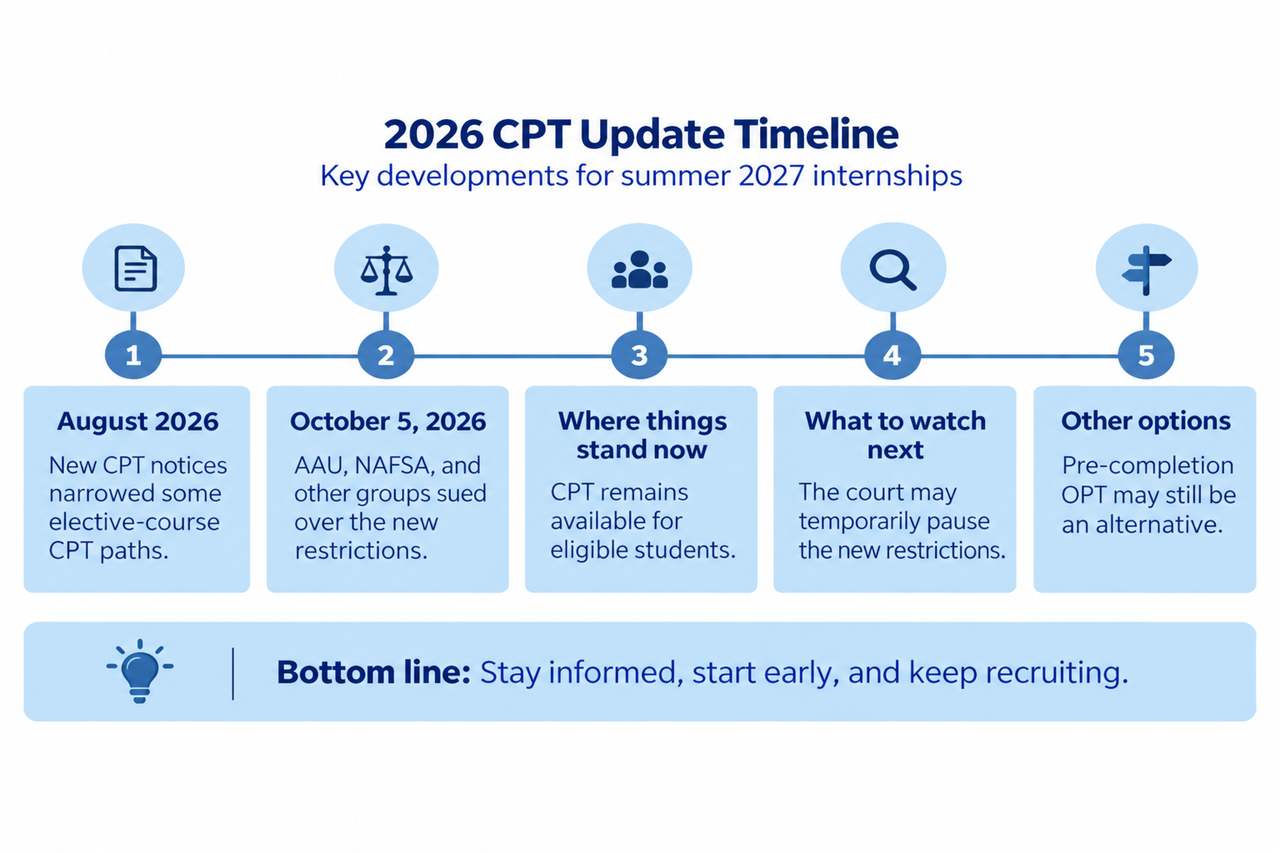
In August 2026, new government guidance restricted CPT for internships that aren't required for graduation. But on October 5, four major higher education organizations filed a lawsuit challenging the restrictions, bringing new hope for summer 2027 internships. CPT is still available for eligible students, and pre-completion OPT may be another option.
If you're targeting investment banking or other finance internships, don't put recruiting on hold while waiting for the court's decision. Banks and other financial firms are already recruiting for future summer programs. Keep preparing for applications and interviews while checking your work authorization options with your school's international student office.
Below, One Strategy Group (OSG) breaks down what changed, why universities are suing, what this means for summer 2027, and what international students should do next.
1. What Are the New CPT Rules for 2026?
The short answer: taking an internship course for credit may no longer be enough. Under the August guidance, the internship generally needs to be required by your academic program.
1.1 What Is CPT, and How Does It Work?
Curricular Practical Training (CPT) is permission for eligible F-1 students to work in an internship connected to their studies. Your university's international student adviser, called a Designated School Official (DSO), decides whether to authorize it.
Before the August change, universities often approved CPT in two situations:
Internship course: You took an approved internship course for credit, sometimes as an elective.
Required internship: Your degree program required an internship to graduate, even if it didn't award separate internship credit.
1.2 What Changed in August 2026?
On August 12 and August 24, the Student and Exchange Visitor Program (SEVP) sentnew CPT guidance to universities. The key message was simple: the internship must be required as part of the curriculum, not just an optional course that earns credit.
That left some students in a difficult position. Many universities temporarily paused CPT processing while reviewing the guidance. Students who had planned fall internships faced delays, and some had to reconsider their work plans.
2. Why Are Universities Suing Over the New CPT Rules?
This is one of the most positive developments so far: on October 5, 2026, four major higher education organizations, including the Association of American Universities (AAU), took the CPT restrictions to federal court. Their goal is to get a preliminary injunction to temporarily block the new CPT restrictions while the lawsuit continues, and ultimately have them overturned so the previous rules can be restored.
2.1 Who Filed the CPT Lawsuit?
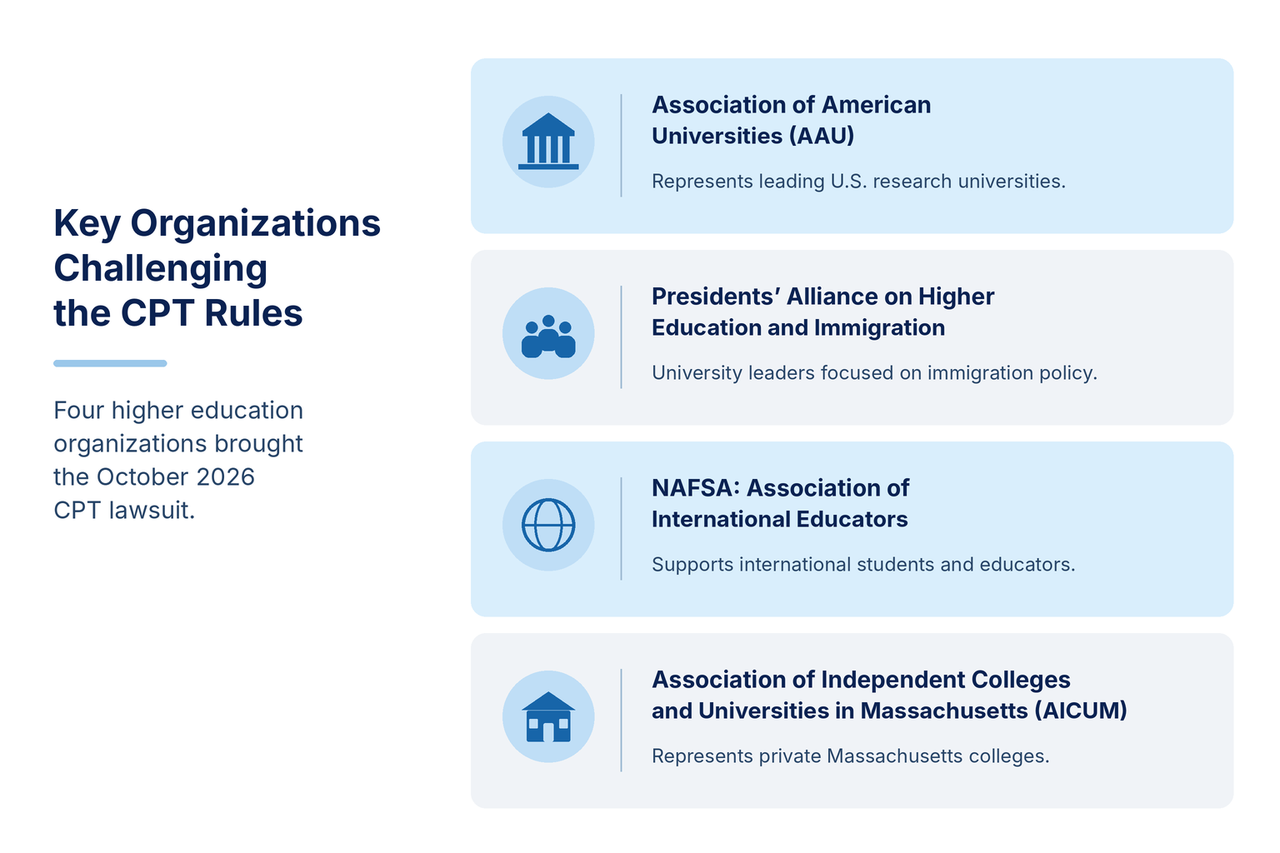
Why does this matter? This isn't one school complaining about one internship. Organizations that work with universities across the country are challenging the policy together. They say it hurts students, universities, and employers that had planned around the previous approach.
2.2 Why Are They Suing?
Their main point: the government made a major change without going through the proper process. They argue that the agencies should have explained the change and allowed the public to comment, rather than introducing it through two notices.
They also say the government ignored people who had already relied on the old approach. Some students had accepted offers or registered for internship classes before their schools changed CPT approvals.
2.3 What Is a Preliminary Injunction, and Why Does It Matter?
A preliminary injunction is a court order that can temporarily stop a policy while a lawsuit is still going on. The university groups asked the judge for one, as well as a longer-term decision against the August guidance.
The judge has not granted that request as of October 9. But if the court pauses the restrictions, schools could have a chance to revisit their CPT policies before summer 2027. That's the next development worth watching.
3. Can International Students Still Use CPT for Summer 2027?
Yes, depending on your internship and your university. If CPT doesn't work for you, pre-completion OPT may be another route.
3.1 If Your Internship Is Required for Graduation
Required internships can still qualify for CPT. If your program requires an internship or practicum to graduate, you may still be eligible under the August guidance. You'll need your school's approval before starting work.
Some universities are also reviewing their academic programs in response to the new rules. For example, USC is working with academic departments to confirm which internships meet graduation requirements and what documents students need to provide.
3.2 If Your Internship Isn't Required, Check Your University's Policy
This is where schools may differ. Some temporarily stopped processing CPT applications. Others have resumed processing requests that meet the current rules.
Students should check the school's current requirements rather than assume an announcement covers every program.
3.3 If CPT Isn't Available, What About Pre-Completion OPT?
Pre-completion OPT lets some F-1 students work in a job related to their major before graduation, even if the internship isn't required by their degree program. Your DSO recommends it, but USCIS must approve the application and issue an Employment Authorization Document (EAD) before you start work.
It's a useful backup, but there are three downsides:
It uses some of your OPT time. Pre-completion OPT reduces how much post-completion OPT you can use after graduating.
It can take longer. USCIS processing adds uncertainty, so you should apply early enough for your start date.
It costs more. You pay the normal USCIS filing fee. If you're eligible and need a faster decision, premium processing is available for an additional fee. As of March 2026, the premium processing fee for Form I-765 is $1,780, on top of the regular application fee. Premium processing speeds up USCIS action; it doesn't guarantee approval or immediate delivery of the EAD.
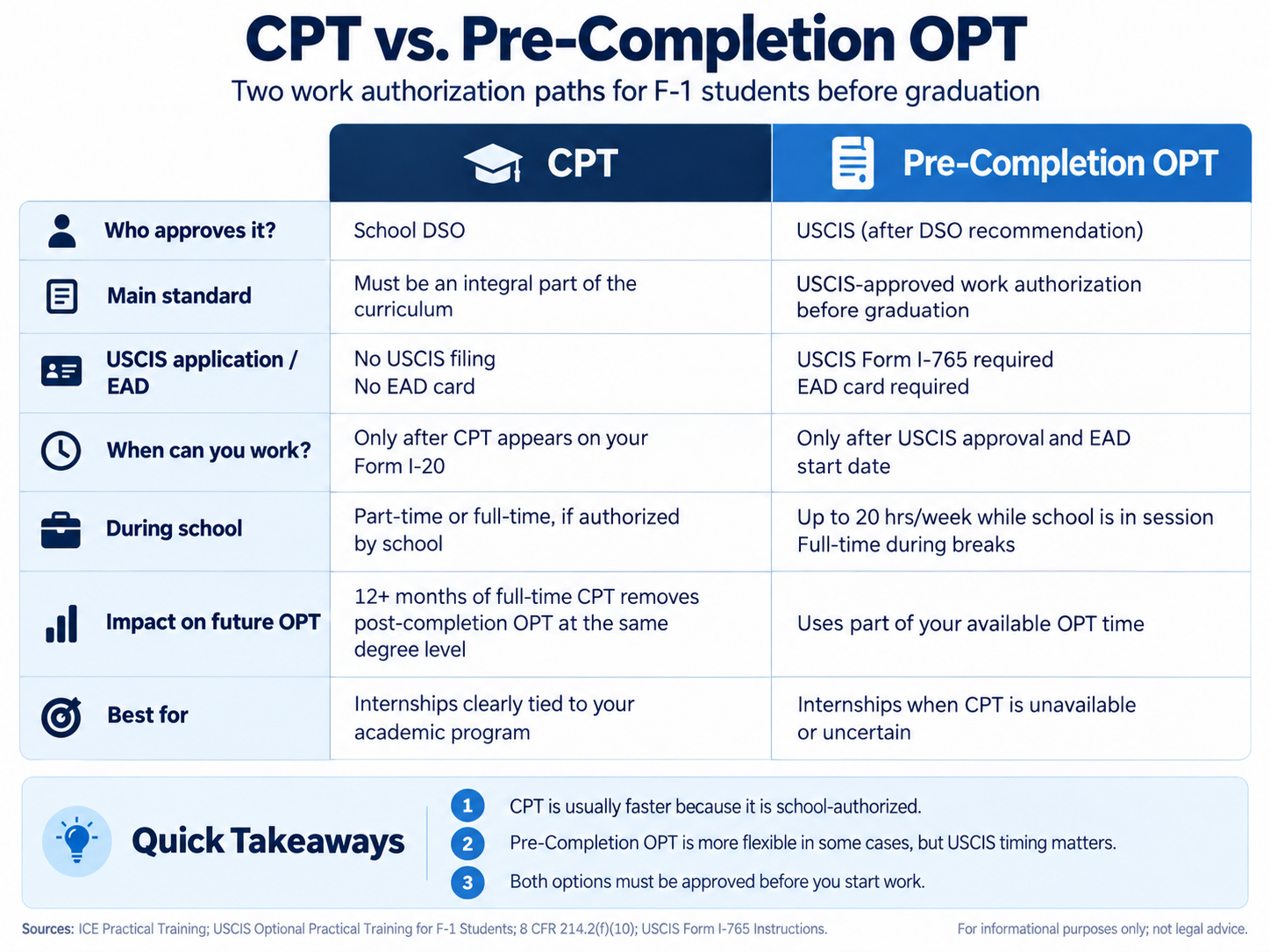
Given the extra time and paperwork involved, planning ahead is especially important. With eight years of experience supporting students pursuing internships in the U.S., One Strategy Group (OSG) has helped students successfully obtain pre-completion OPT and start their internships.
4. Three Reasons to Be Hopeful About CPT for Summer 2027
The lawsuit is a positive step, and there are three good reasons to keep an eye on what happens next.
4.1 A Court Blocked Another F-1 Rule Just Last Month
On September 14, a federal judge blocked a new F-1 and J-1 duration-of-status rule that would have limited students' stay in the US to a fixed period of up to four years, rather than allowing them to stay for the duration of their studies. Students needing more time would have had to apply for an extension. The rule was originally set to take effect the very next day.
The court found that the organizations challenging the rule had a strong case, including concerns that the government hadn't properly justified the changes. Notably, NAFSA and the Presidents' Alliance were involved in that lawsuit too. Now, they're also challenging the CPT restrictions, raising similar concerns about how the government introduced the changes and hoping for another court order that temporarily blocks them.
4.2 There's Still Time Before Summer 2027
Most summer internships start around May or June. As of October 2026, that's several months away.
A judge can rule on a request to pause the policy before deciding the whole lawsuit. If the court acts in time, universities may have a chance to update CPT decisions before summer internships begin.
4.3 Major University Groups Are Pushing Back Together
AAU, NAFSA, the Presidents' Alliance, and AICUM are all part of the lawsuit. They represent a wide range of U.S. universities and international education professionals.
That gives the challenge a strong voice and shows how widely the new CPT guidance has been questioned.
5. What Should International Students Do Now?
Don't wait for the court case to finish. You can check your work authorization options and keep recruiting at the same time.
5.1 If You Already Have a Summer 2027 Offer
Contact your DSO now and ask:
Is my university currently approving CPT for my degree program?
Does my internship qualify, and what documents do I need?
If not, can I apply for pre-completion OPT?
When should I start the application to be ready for my internship?
5.2 If You're Recruiting for Investment Banking or Finance
The recruiting calendar isn't waiting for the CPT lawsuit. Evercore's 2028 summer analyst applications opened on September 9, 2026. Optiver has also posted a Summer 2027 Quantitative Intern role open to eligible students expecting to graduate between December 2027 and June 2029.
With the recent positive developments around CPT, there's good reason to stay hopeful. More importantly, recruiting opportunities are already opening up, so now is the time to start preparing. During the 2026 recruitment season, One Strategy Group (OSG) students secured 692 internship and full-time offers, which included 14 offers from Blackstone, 5 from Point72, 25 from Goldman Sachs, and 19 from Evercore.
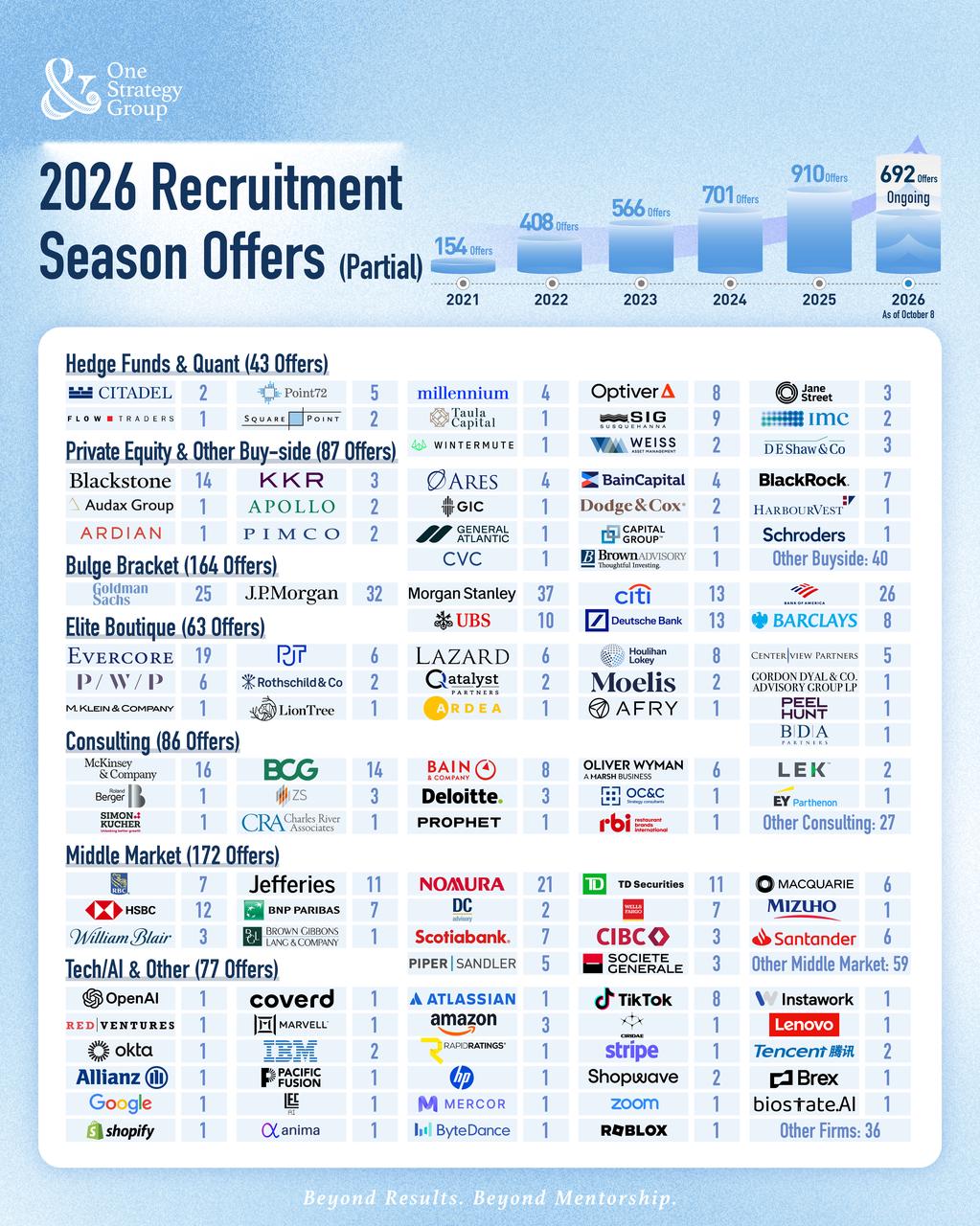
Strong recruiting results take time and preparation. The earlier you start, the more time you have to build your skills, gain experience, and put yourself in a stronger position for upcoming opportunities.
Conclusion: What Does This Mean for Summer 2027?
There's real reason to be hopeful. Major university groups are fighting the August CPT restrictions in court, and schools such as USC have resumed processing eligible requests. Students who can't use CPT may also have pre-completion OPT as an option.
Watch for the judge's decision on the request to pause the guidance. Meanwhile, ask your DSO about your eligibility and keep moving on recruiting. Your internship plans don't have to wait for the lawsuit.
If you're targeting investment banking or other competitive finance internships, One Strategy Group (OSG) can help you make the most of your preparation, from building a recruiting strategy and networking with professionals to preparing for technical and behavioral interviews. Get started early and give yourself the best chance of success.
Disclaimer: This article is for informational and educational purposes only and does not constitute legal or immigration advice. CPT and OPT policies may change. Please refer to your university's international student office and official USCIS or ICE guidance for the latest requirements.
About One Strategy Group (OSG)
Founded in 2018, One Strategy Group (OSG) is a leading U.S.-based career consulting firm helping students pursue careers in global finance, consulting, and technology.
OSG has built a strong reputation among students at top universities across North America, the UK, and APAC through one-on-one mentorship, strong offer conversion rates, and structured recruiting support.
Our leadership and mentorship teams span the U.S., UK, and China, including former professionals from Goldman Sachs, McKinsey, and Blackstone. We provide cross-time-zone career coaching backed by extensive industry expertise.

Free Career Planning Session
Book a free 1-on-1 session with an OSG mentor and map out your path to top firms!
Book Your Free Session →Ready to Write Your Own Success Story?
Book a free 1-on-1 session with an OSG mentor and map out your path to top firms!
Book Your Free Session →


Frequently Asked Questions
No, CPT has not been canceled. The August 2026 guidance restricts CPT for some internships, especially those offered through elective courses rather than required by a degree program. Students who meet the current requirements can still receive CPT authorization from their universities.
On October 5, four major higher education organizations, including AAU and NAFSA, sued the federal government over the new CPT restrictions. They are asking the court to temporarily block the restrictions through a preliminary injunction and ultimately overturn them. A favorable ruling could allow universities to return to their previous CPT practices.
Yes, international students can still pursue summer 2027 internships if they obtain the required work authorization. Some students may qualify for CPT, while others may be able to use pre-completion OPT.