
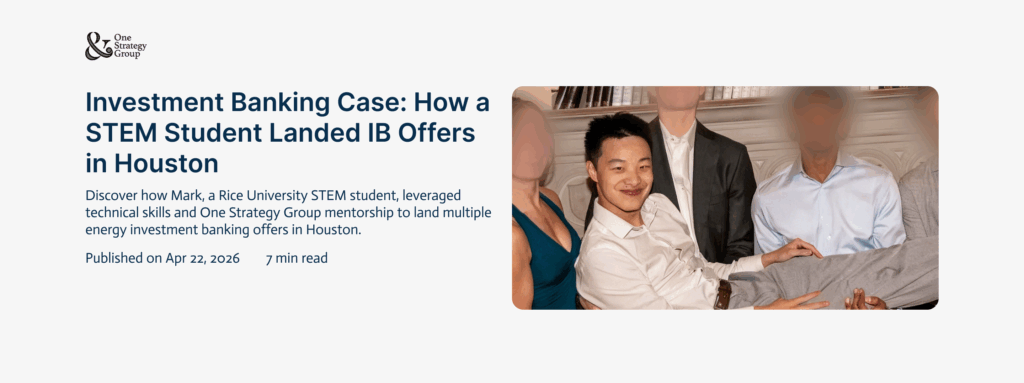
Mark studied Chemical Engineering and Finance at Rice University. His journey shows how STEM students can successfully transition into energy investment banking. With guidance from One Strategy Group (OSG), he turned his technical background into a career advantage.
Through careful preparation and mentorship, Mark landed multiple offers in Houston’s energy investment banking sector. His story highlights the combination of technical expertise, financial insight, and strategic networking.
Exploring the Energy Industry for STEM to Finance Careers
The summer after high school, I had the chance to visit one of the most important shale oil regions in the U.S.—the DJ Basin in Denver. A Rice University alumnus guided me through extraction to transportation. Seeing crude oil being lifted, separated, and transported made me realize the power and complexity of the energy industry.

That experience inspired me to pursue Chemical Engineering at Rice University. I imagined myself as a processing engineer, turning technical knowledge into real-world industrial results. At that point, I thought my career path would be purely technical, focused on engineering in the oil and gas sector.
But during a two-day shadow internship at Phillips 66, an engineer with twelve years of experience told me, “If you want to grow continuously and build influence, purely technical roles have a limited ceiling.” That honesty forced me to reconsider my career options. I realized that while engineers play an essential role, finance and capital ultimately shape the energy industry.
Combining Passion for Energy with Finance
I loved working in the oil and gas sector, but I realized that engineering alone wouldn’t give me the growth and influence I wanted. I wanted a career where I could combine my technical background with financial insight.
Finance sets the blueprint. Engineers implement it. I began wondering whether I could combine my passion for energy with my growing interest in finance. That’s when I came across a video on the One Strategy Group (OSG) blog. She had a similar engineering background and had successfully transitioned into the Energy Investment Banking team. Her journey showed me that I didn’t have to choose between my love for energy and my interest in finance. Energy and finance don’t have to be separate worlds.
Background Reframing and Career Positioning
Through One Strategy Group (OSG) career coaching and mentorship, I learned how to turn my chemical engineering background into a strategic advantage for Energy Investment Banking.
This is more than just career coaching. It was a full system to prepare for Energy Investment Banking. My first challenge was figuring out how to turn my chemical engineering background into an advantage, rather than a gap. Their structured mentorship programs, combined with practical guidance, promised a clear path into Houston’s competitive energy finance market.
My mentors helped me reframe my story. They guided me to connect my oilfield experiences, process optimization lessons from my courses, and a deep understanding of the energy industry into a coherent narrative. This approach made my background highly relevant for energy finance roles.
Mentor Pairing, Practical Experience and Skills Development
One Strategy Group mentorship also matched me with mentors from investment banks and private equity firms. One memorable experience was preparing for a stock pitch competition at my university’s finance club. I chose a cybersecurity company, Fortinet, and worked closely with a technology hedge fund manager mentor from OSG. He helped me analyze the company’s business model, competitive advantage, and valuation. Then, he grilled me from an investor’s perspective.
Thanks to OSG’s guidance, I secured positions in selective finance clubs, and built a foundation through several energy-focused pre-internships. Their mentorship ensured I had both industry insight and practical finance skills, making the transition from STEM to Energy Investment Banking smoother and more strategic.
Networking Strategy
In Houston’s energy investment banking world, networking is critical. I quickly realized that success wasn’t just about submitting applications—it was about building meaningful connections. My mentors at One Strategy Group (OSG) emphasized that networking is not asking for favors. It’s exchanging value. You want each conversation to be insightful or enjoyable for the other person.
I committed to their guidance and set a personal goal: ten calls per week. Before each call, I spent at least thirty minutes researching the person’s LinkedIn profile, recent deals at their firm, and the group’s focus areas. I would then prepare three to five thoughtful questions with my mentor.
Over time, I networked with 171 professionals across 29 investment banks. I spoke with more than seven people at top-tier firms like Goldman Sachs, JPMorgan, and Moelis in Houston. Even mid-tier banks received calls from at least four people. This structured approach helped me gain industry insight, refine my story, and build credibility.
Thanks to OSG mentorship and their career coaching, I turned networking from a daunting task into a powerful tool for entering Energy Investment Banking.
Industry Insight and Integrated Competence
As I gained more exposure, I became fascinated by how Energy Investment Banking works. Unlike other sectors, deals here focus on physical assets rather than only on company valuations. Each project required understanding both technical engineering aspects and financial models.
International politics also plays a big role. A conflict in the Middle East could push oil prices up, while OPEC decisions could bring them down. Watching these dynamics unfold taught me how macro events impact valuations.
Through One Strategy Group (OSG) mentorship, I worked on real financial modeling exercises. I learned to collaborate with engineers to build NAV models, Type Curves, and Hedge Books. This hands-on experience sharpened my analytical skills and prepared me for complex Energy Investment Banking transactions.
I realized that success in this field demands more than finance or technical knowledge alone. It requires integrating both, understanding markets, and being prepared to adapt to constantly changing conditions. With OSG’s guidance, I gained both the technical fluency and industry insight needed to thrive in energy finance.
Conclusion
Many people think Energy Investment Banking is a narrow or niche field. I’ve learned that it is challenging, yes, but full of opportunities. The sector requires technical knowledge, financial acumen, and an understanding of global energy markets.
Through One Strategy Group (OSG) career coaching and mentorship, I was able to bridge the gap between engineering and finance. I developed skills in valuation, financial modeling, and networking, all while keeping my passion for the energy industry alive.
The journey is competitive, but for those willing to put in the work and seek guidance, the rewards are real. If you’re a STEM student considering a career transition into Energy Investment Banking, don’t be discouraged by your background. With structured support, persistence, and strategic networking, you can succeed.
Looking back, I realize that combining curiosity, technical skills, and financial insight was the key to achieving my goals and landing multiple offers in Houston’s energy finance market.