
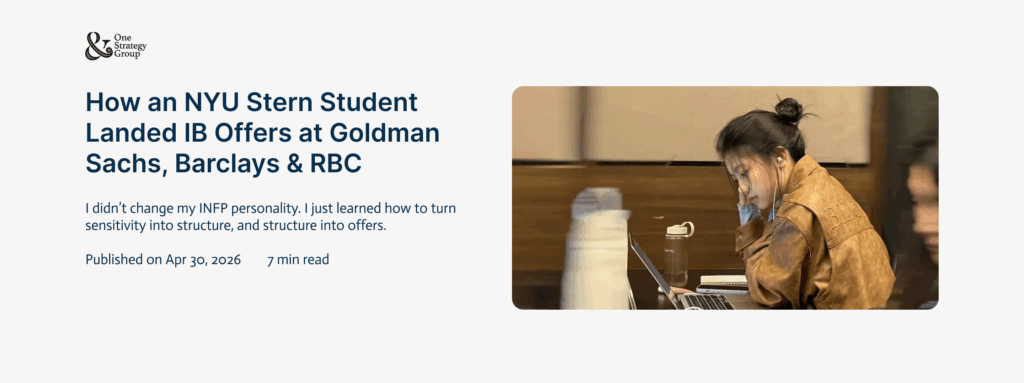
When I first started thinking about investment banking recruiting at NYU Stern, I assumed effort alone would be enough.
I spent most of my time trying to understand the investment banking recruiting process at firms such as Goldman Sachs and Barclays. At the time, I didnFt yet have a clear roadmap, while many peers around me already understood how the recruiting cycle worked.
As a naturally introverted student, I tended to observe first and speak later. In Stern’s highly finance-driven environment, I often felt out of place during networking events and group settings. Many students were actively engaging in finance networking, cold outreach, and relationship building. I attempted to follow the same pace, even when it did not align with my natural working style.
If you’re currently preparing for investment banking interviews or struggling with networking
👉 Explore OSG’s structured mentorship program
To compete in the investment banking recruiting process, I still pushed myself to take action: sending over 200 cold emails, attending weekly networking calls, and continuously refining my resume. I also prepared for behavioral interviews by systematically memorizing and structuring answers.
Despite this effort, results remained limited. I reached final rounds at several firms, yet offers from investment banking did not materialize. Over time, this gap reshaped how I evaluated myself within the broader context of recruiting in IB.
Why DIY Investment Banking Recruiting Didn’t Work
I initially treated investment banking recruiting as a volume game.
The logic was simple. More networking should lead to more interviews. More interviews should lead to at least one offer. I followed that idea closely.
But the reality was different.
Even when I got interviews at Goldman Sachs, I struggled to convert them. I could answer technical questions, but behavioral interviews were harder. My answers often felt long and unfocused. I tried to explain everything at once, especially when I was nervous.

Looking back, I think the main issue was structure.
I did not know how to organize my story in a way that felt clear to interviewers. I also did not know how to control my pace when answering behavioral questions. I was reacting rather than communicating.
By the end of that recruiting cycle, I had gone through multiple superday interviews without success. That experience made me realize that investment banking recruiting is not only about persistence. It is also about how you present yourself under pressure.
At the same time, I started to feel mentally exhausted. I kept hearing phrases like “you will get what you deserve,” but I could not see how my efforts connected to outcomes anymore.
Structured IB Interview Prep with One Strategy Group mentorship
The turning point came when I stopped trying to fix everything on my own.

After a conversation with my mother and a few seniors from NYU who had gone through similar recruiting processes, I started to rethink my approach. They mentioned structured coaching and interview preparation support through One Strategy Group career coaching and One Strategy Group mentorship programs.
At first, I was skeptical. I did not think external guidance would change much. But I also knew my current approach was not working.
I decided to try a more structured process.
What One Strategy Group mentorship Guides Me
Practice turning experiences into structured frameworks
Line-by-line feedback on behavioral answers
Focus on structure, not just content accuracy
Identifying over-explaining before key points
Training to start with clear conclusions
When I started working with One Strategy Group mentorship, the first change was about how I communicated. During my first mock interview feedback session, my mentor Belle pointed out something simple: My answers were not wrong, but they were not structured.
I often explained too much before getting to the main point. This was especially visible in behavioral interviews for investment banking roles, where clarity matters more than detail.
Over time, I learned to slow down. I started organizing my answers before speaking. I also practiced giving conclusions first instead of building toward them.
The feedback was very specific. Instead of general advice, I received line by line comments on how my answers could be improved. That helped me see patterns in my communication that I had never noticed before.
It was not about changing my personality. I am still introverted. But I learned how to express ideas in a way that felt more structured and easier for interviewers to follow.
Goldman Sachs, Barclays & RBC Investment Banking Offers
After adjusting my preparation, the interview experience changed in a noticeable way.
How each investment banking interview felt in practice
- RBC (Credit Risk): Lower pressure, more straightforward conversation, helped build early confidence
- Goldman Sachs (Investment Banking): Highly structured process, multiple technical rounds, strong focus on consistency and market understanding
- Barclays (Investment Banking): More conversational, less formal pressure, allowed for natural discussion across both technical and personal topics
My first offer came from RBC in a credit risk role. The interview felt less intense, but it gave me confidence that my direction was improving.
Later, I went through the investment banking interview process with Goldman Sachs and Barclays.

At Goldman Sachs, the process was demanding. The interviews covered both technical questions and market discussions. I had to stay consistent across multiple rounds. It was challenging, but I felt more controlled compared to my earlier attempts.
At Barclays, the experience was different. I had already received an offer elsewhere, so I was more relaxed. The conversation felt natural. We talked about both technical topics and personal interests. I did not try to perform a version of myself that I thought they wanted to see.
That interview ended up being one of the most natural conversations I had during the recruiting process.
Eventually, I received multiple offers:
- Goldman Sachs (Hong Kong) : Investment Banking Division & Wealth Management, 2026 Summer Analyst Offer
- Barclays (Hong Kong): Investment Banking Division, 2026 Summer Analyst Offer
- Royal Bank of Canada (New York): Credit Risk Review, 2026 Summer Internship Offer
Looking back, the difference was not that I became a different person. The difference was that I learned how to structure my thoughts under pressure.
Final Thought
Reflecting my investment banking recruiting journey, I did not change my personality to become more extroverted to fit a certain image of Wall Street.
What changed was my approach.
I stopped relying only on effort and started focusing on structure in behavioral interviews. That shift made a clear difference in how I performed during interviews at firms like Goldman Sachs and Barclays.
I still think introversion is often misunderstood in investment banking recruiting. It is not a limitation in itself. In my case, it helped me stay observant and careful in how I approached conversations. The key was learning how to translate that into structured communication.
Support from One Strategy Group structured career coaching and mentorship played a role in that transition. Thanks to my mentor, Celine. She helped me step out of emotional overwhelm and think more clearly at my lowest point. I’m also grateful to my RA, who turned my unfocused interview answers into clear, actionable improvements through detailed feedback.
If there is one thing I would share with others going through similar recruiting processes, it is this. Effort matters, but clarity matters just as much.
In investment banking recruiting, how you communicate often shapes the outcome more than how much you prepare.
Disclaimer: OSG is not affiliated with, endorsed by, or partnered with RBC, Goldman Sachs, Barclays, or any other companies mentioned in this article. All offers referenced were independently obtained by students through official recruitment processes, with preparation and guidance provided by OSG.