2027 MBB Salary Increase: First Pay Raise Since 2022 and What It Means for Consulting Recruiting
Luna Bonnell (pseudonym) has been at one of the MBB’s for over 7 years and has worked with students navigating competitive recruiting processes across consulting. Her work focuses on recruiting strategy, networking, interview preparation, and helping students understand how to position their experiences for highly competitive careers.
Published on
November 9, 2026
5
min read

This guide explains what the 2027 salary increases at McKinsey, BCG, and Bain mean for students interested in consulting. It covers the consulting recruiting timeline, how MBB compares with other strategy and consulting firms, and the differences between strategy, economic, healthcare, technology, and other specialized consulting paths. It also breaks down how students can prepare for consulting recruiting through resume building, networking, case interviews, and behavioral interviews.
Below, One Strategy Group (OSG) breaks down the consulting recruiting landscape, from the latest MBB compensation changes to recruiting timelines, firm tiers, specialized consulting paths, and how students can prepare for the application and interview process.
Note: Higher salaries and increased hiring do not necessarily make MBB recruiting easier. McKinsey, BCG, and Bain remain highly selective, so students should view these changes as a positive signal for the consulting market rather than a guarantee of better recruiting outcomes.
1. Why Are MBB Salaries Increasing in 2027?
McKinsey, BCG, and Bain are raising U.S. starting base salaries for 2027 hires, the first reported MBB starting salary increase since 2022. For students considering consulting recruiting, the bigger story is not just the higher paycheck. The increase may also signal stronger competition for talent and renewed hiring demand across consulting.
According to compensation data based on 2027 candidate offer letters, McKinsey, BCG, and Bain are moving U.S. starting base salaries to $120,000 for pre MBA hires and $200,000 for post MBA hires.
Pre-MBA Undergraduate hires
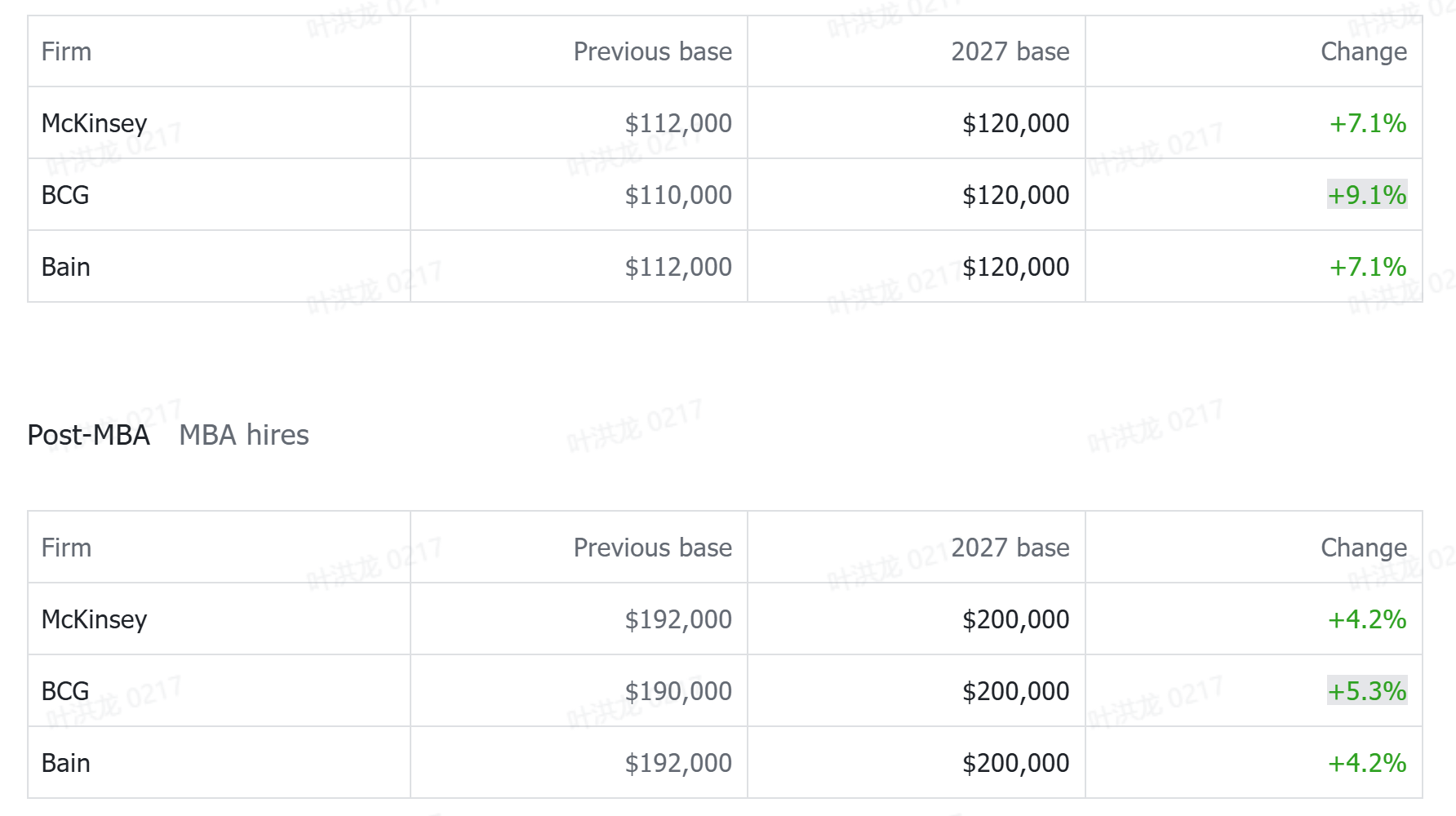
The timing here matters because MBB starting salaries have remained unchanged since 2022. After the post pandemic hiring boom, consulting firms faced slower growth, delayed start dates, and tighter headcount. The latest compensation changes suggest that competition for strong candidates may be increasing again.
There is also another encouraging signal for candidates. McKinsey reportedly plans to increase new consultant hiring by approximately 12% in 2027. At the same time, consulting firms are facing increasing competition from technology and AI companies for top graduates, which may be putting additional pressure on firms to offer more competitive compensation.
However, students should be careful about interpreting this news.
Higher salaries and more hiring do not mean MBB recruiting is suddenly easy. McKinsey, BCG, and Bain remain highly selective. Candidates still need to perform well throughout resume screening, networking, assessments where applicable, case interviews, and behavioral interviews.
Because the recruiting process involves several stages, preparation often begins long before applications actually open. Understanding the consulting recruiting timeline can help students know what to focus on and when.
2. What Is the Consulting Recruiting Timeline?
Consulting recruiting preparation should begin well before applications open. Freshman and sophomore year are primarily about building experience, while the months leading into junior year recruiting should focus more heavily on firm research, networking, resume preparation, case interviews, and behavioral preparation.
There is no universal consulting recruiting deadline. Timelines can vary depending on the firm, office, university, geography, position, and recruiting cycle. Candidates should always confirm current deadlines through official employer recruiting pages.
Still, students can use the following timeline as a general framework, and if you would like a more tailored version, reach out to our consulting mentors for a free consultation.
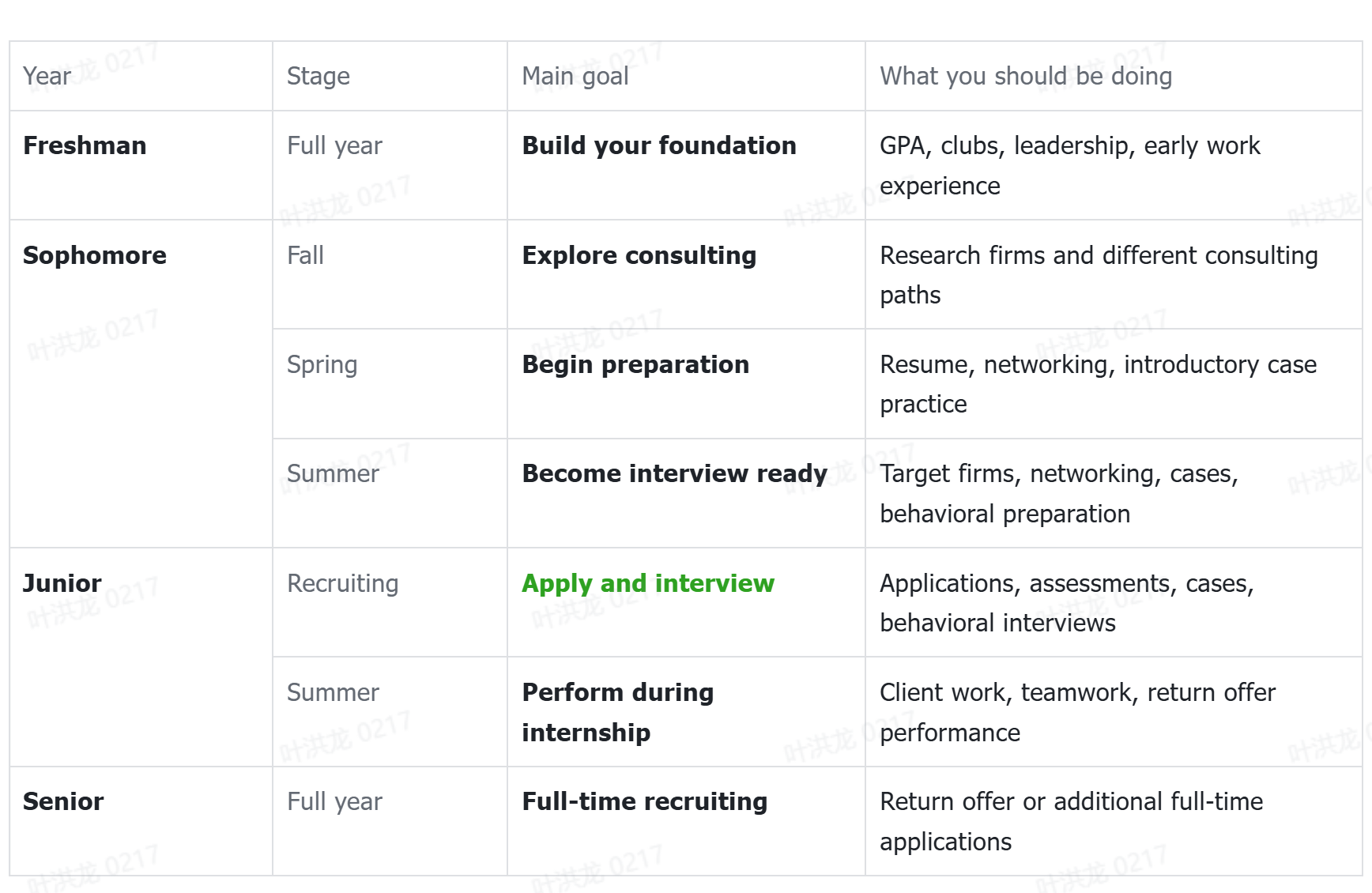
Highlighted: junior recruiting is the main window for summer internships at most firms.
Freshman Year: Building Your Candidate Profile
Freshmen generally do not need to spend their first semester completing dozens of case interviews.
Instead, focus on building experiences that strengthen your resume and demonstrate analytical ability, leadership, communication, teamwork, and impact.
That can include joining student clubs, developing analytical skills, taking on leadership responsibilities, completing internships, participating in research, working on entrepreneurial projects, or becoming involved in activities where you can demonstrate measurable impact.
These experiences can strengthen your profile regardless of what you study. Consulting firms recruit students from a wide range of academic backgrounds, so your major does not need to be directly related to business or consulting. For example, one of our students, a Social Sciences major at LSE, landed offers from both BCG and Bain.
Rather than choosing a major simply because it seems more relevant to consulting, focus on building experiences that demonstrate the qualities firms value, such as problem solving, leadership, communication, teamwork, initiative, and analytical ability.
Sophomore Year: Understand What Consulting Actually Means
Sophomore year is a good time to move from simply knowing that consulting exists to understanding which opportunities actually interest you.
Students can begin researching firms, attending employer presentations, speaking with alumni, and learning what consultants do on different types of projects.
This is also when networking can become more purposeful.
By the end of sophomore year, candidates should ideally have a clearer target list rather than applying indiscriminately to every company with “consulting” in the job description.
Sophomore Spring and Summer: Turning Exploration into Preparation
For students targeting junior summer consulting internships, sophomore spring and summer are when preparation often becomes more structured.
By this stage, aim to have:
A consulting style resume
A preliminary target firm list
An understanding of recruiting timelines
Existing networking conversations
Basic case interview experience
Several strong behavioral stories
A clear explanation for why you want consulting
3. How Are Consulting Firms Divided? MBB vs. Tier 2 vs. Big Four
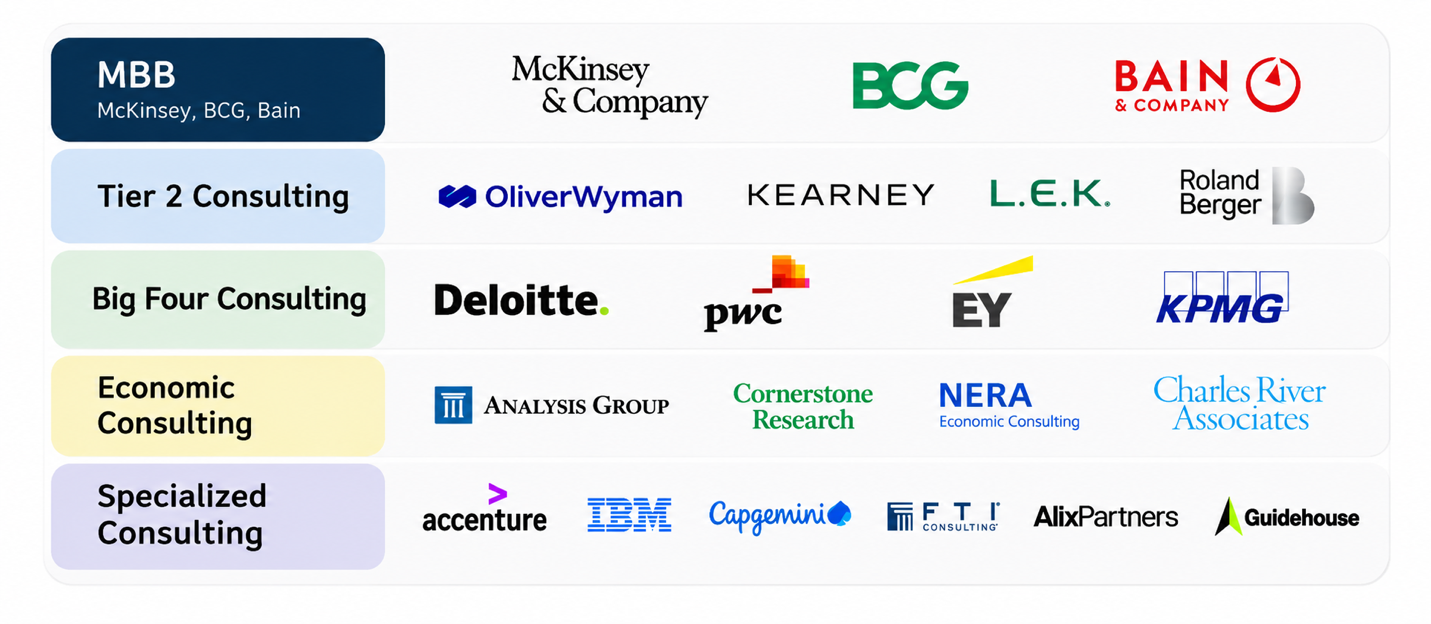
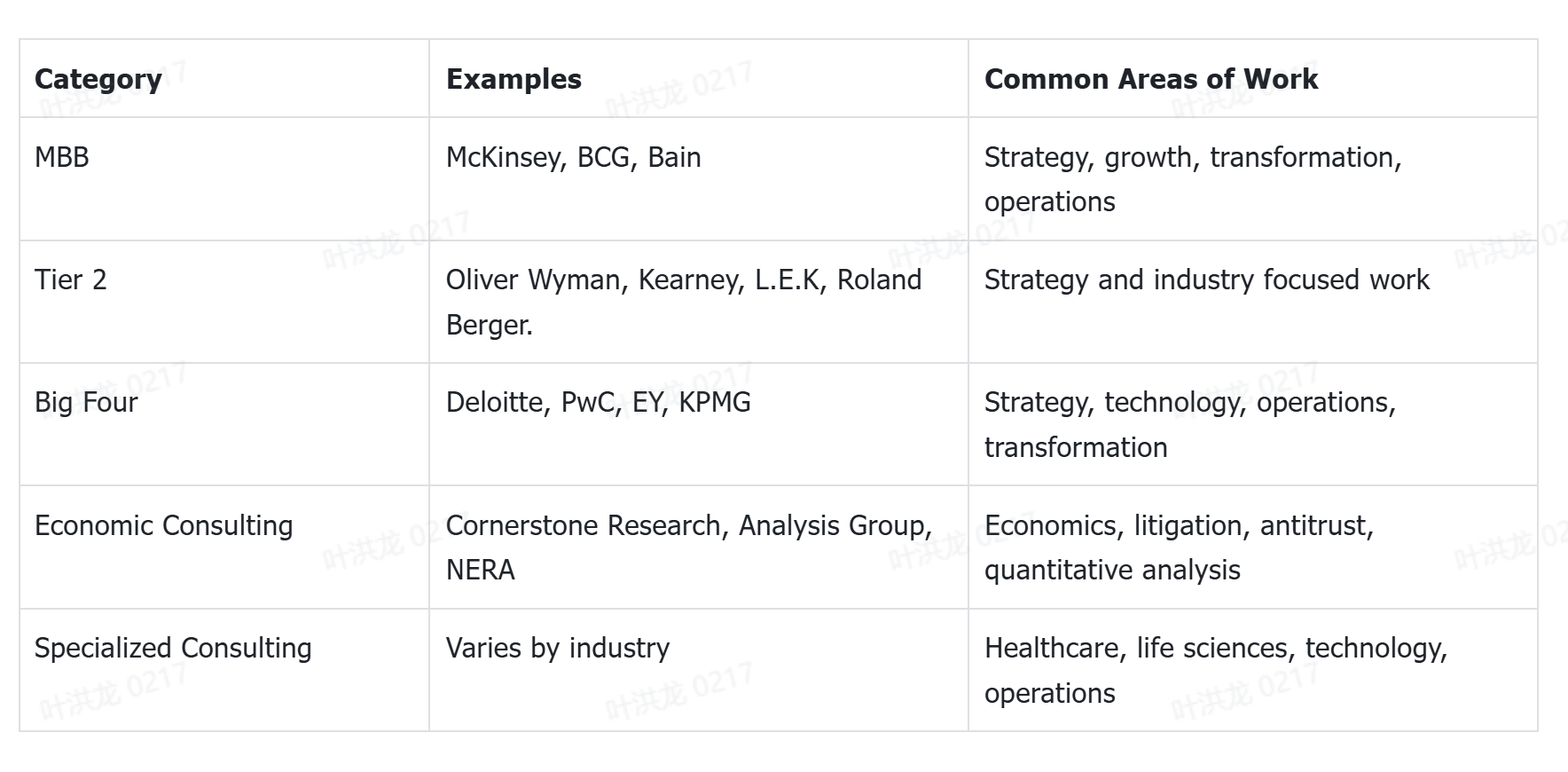
The consulting market includes MBB, other major strategy firms, the Big Four, economic consulting firms, and specialized firms. These categories are useful for understanding the market, but they should not be treated as a universal ranking of every consulting opportunity.
MBB: McKinsey, BCG, and Bain
MBB refers to McKinsey & Company, Boston Consulting Group, and Bain & Company.
The three firms are commonly grouped together because of their global presence, reputation, selective recruiting processes, compensation, and work with major corporate and institutional clients.
While the MBB acronym is useful, McKinsey, BCG, and Bain are separate firms with their own cultures, client relationships, industry strengths, and office networks. Candidates should therefore research the individual firm rather than treating MBB as a single employer.
Tier 2 Consulting
Outside MBB is another group of highly competitive management consulting firms commonly referred to as Tier 2.
Common examples include:
Oliver Wyman
Kearney
L.E.K. Consulting
Roland Berger
These firms work across a range of industries and business problems, including strategy, operations, transformation, and other areas of management consulting. Each also has different industry strengths and geographic footprints, so candidates should research the specific firm and office when deciding where to apply.
Tier 2 also should not be viewed as a strict ranking or a second choice to MBB. The type of work, industry exposure, culture, and career opportunities can vary significantly across firms.
Big Four Consulting
The Big Four are Deloitte, PwC, EY, and KPMG. Unlike firms primarily associated with management consulting, these companies have large professional services businesses that extend beyond consulting.
Their consulting and advisory practices can cover a wide range of areas, including:
Strategy
Technology transformation
Operations
Human capital
Transactions
Risk
Data and analytics
Digital transformation
Strategy& is part of PwC, while EY-Parthenon is part of EY. Both focus primarily on strategy consulting, helping companies make important business decisions related to growth, market entry, mergers and acquisitions, and long-term planning. These practices often work on more strategy-focused projects, while other consulting teams within their parent firms may focus on areas such as technology implementation, operations, risk management, and business transformation.
Because the Big Four cover such a broad range of services, the specific practice and position matter just as much as the company name. Candidates should therefore understand the team they are applying to and the type of work it performs rather than evaluating an opportunity based only on the firm name.
Boutique and Specialized Consulting Firms
Boutique and specialized consulting firms focus on specific industries, functions, or types of business problems.
Some firms concentrate heavily on areas such as healthcare, life sciences, economics, technology, or operations, while others work across several industries but are particularly well known for certain specialties.
For students who already have a clear professional interest, these firms can offer more focused exposure to the type of work they want to pursue.
Understanding the different types of firms is only part of choosing a consulting career. Students should also understand how the actual work differs across consulting fields.
4. What Are the Different Types of Consulting Careers?
Consulting careers differ substantially depending on the problems being solved. Strategy, economic, healthcare, technology, operations, and human capital consulting each require somewhat different knowledge and can lead to different professional experiences.
Understanding these differences early can help students create a much more targeted recruiting strategy.

Strategy and Management Consulting
Strategy and management consulting are what many students picture when they hear the word consulting.
Typical client questions might include:
Should this company enter a new market?
Why is profitability declining?
How should the company price a new product?
Which customer segment should management prioritize?
How should a company respond to a new competitor?
Where should management invest for future growth?
Projects often require consultants to break a broad question into smaller problems, analyze data, interview stakeholders, research markets, develop recommendations, and present findings to clients.
Economic Consulting
Economic consulting combines consulting with economics, statistics, finance, and quantitative research.
Firms such as Cornerstone Research, Analysis Group, and NERA Economic Consulting can work on areas including:
Antitrust and competition
Litigation
Financial economics
Regulation
Damages analysis
Market analysis
Expert testimony support
Students with backgrounds in economics, mathematics, statistics, finance, computer science, econometrics, or quantitative research may find economic consulting particularly attractive.
Economic consulting interviews can also differ from traditional MBB case interviews, so candidates should make sure their preparation matches the actual position.
Healthcare and Life Sciences Consulting
Healthcare and life sciences consulting focuses on organizations such as pharmaceutical companies, biotechnology companies, medical device manufacturers, healthcare providers, and other participants in the healthcare system.
Projects might involve product launches, commercial strategy, market access, pricing, competitive analysis, growth opportunities, or operational questions.
Students with science backgrounds may find that their academic knowledge gives them useful context for this work, although many healthcare consulting positions also recruit candidates from business and other academic backgrounds.
Technology Consulting
Technology consulting can cover a broad range of work, including:
Digital transformation
AI strategy and implementation
Cloud migration
Cybersecurity
Data and analytics
Enterprise systems
Technology strategy
This area has become increasingly important as businesses evaluate how AI and other technologies can change their operations.
A client may know that generative AI could improve productivity but have no idea which processes should be automated, how employees should adapt, or whether the investment will generate an acceptable return.
Consultants can help answer those questions.
Candidates should pay close attention to the specific position because technology consulting can describe very different roles.
A technology strategy position may resemble traditional management consulting, while a technical implementation position may require more specialized technical knowledge.
Operations and Human Capital Consulting
Operations consultants focus on how companies actually produce and deliver goods and services.
Typical problems can involve supply chains, procurement, manufacturing, logistics, productivity, process improvement, and cost reduction.
For example, a company experiencing rising costs might hire consultants to determine where inefficiencies exist across its supply chain and recommend operational changes.
This work can appeal to students interested in seeing how strategic decisions translate into the day to day functioning of a business.
5. How Should You Prepare for Consulting Recruiting?
To become a strong consulting candidate, students should focus on five key areas: selecting the right firms, building a strong resume, networking, preparing for case interviews, and developing strong behavioral stories.

Step 1: Decide What Type of Consulting You Want
Before sending applications, determine what kind of consulting opportunities you actually want.
Start with questions such as:
Which industries interest me?
Do I prefer broad business problems or specialized work?
Which cities or offices am I considering?
What type of projects would I like to work on?
Which firms recruit for those opportunities?
This creates a more focused target list and makes subsequent research more useful.
It also prevents a common mistake: preparing for “consulting” as though every consulting position requires the same background and interview process.
Step 2: Build a Consulting Resume
A consulting resume should make your impact easy to understand.
Compare these examples:
Weak: Conducted market research for a startup.
Stronger: Analyzed more than 500 customer responses across four segments to identify two priority markets, informing the startup's go to market strategy.
The second example communicates scope, analysis, and outcome.
Strong consulting resume bullets should generally make it easy to understand:
What you did
How you did it
What changed because of your work
Do not invent metrics or exaggerate your impact simply to make a bullet appear stronger. Quantification is useful only when the underlying figure is accurate and defensible.
Students who want additional feedback can also have their resumes peer reviewed by OSG mentors to identify areas where their experiences, impact, and achievements could be communicated more clearly.
Step 3: Start Networking Before You Need Something
Networking can help students learn more about consulting firms, understand different offices and roles, and build relationships before applications open.
Students can connect with alumni, consultants, recruiters, and former interns to learn more about their experiences. The goal should be to understand the firm, not simply collect coffee chats or ask for referrals.
Instead of asking questions that can easily be answered on a company website, use these conversations to learn about people's actual experiences.
For example:
Why did you choose this office?
What surprised you after joining?
What types of projects have you worked on?
How does staffing work in your office?
What distinguishes strong new consultants?
How did you approach recruiting from my university or background?
These conversations can help you determine whether a firm is a good fit while giving you a more specific understanding of its culture and work. Additionally, starting early also allows you to build genuine relationships rather than reaching out only when you need an interview or referral.
Step 4: Prepare for Case Interviews
The case interview is one of the most distinctive parts of consulting recruiting.
Rather than asking candidates to recall a fixed body of information, case interviews generally present a business problem that the candidate must work through.
A strong case preparation process should develop five core abilities:
Structuring: Can you break an ambiguous problem into logical components?
Quantitative Analysis: Can you perform calculations accurately and interpret their meaning?
Business Judgment: Can you identify which factors actually matter?
Communication: Can the interviewer easily follow your thinking?
Synthesis: Can you turn your analysis into a clear recommendation?
Developing these skills takes time and practice. Rather than memorizing a framework for every possible case, candidates should focus on learning how to approach unfamiliar problems and adapt as new information is introduced.
Each practice case should also help identify specific areas for improvement. If your structure was weak, practice breaking down unfamiliar business problems. If your math was slow, work on calculations and data interpretation. If your final recommendation was unclear, practice summarizing your analysis in a concise and structured way.
After every practice case, ask:
Was my structure specific to the problem?
Did I explain why I wanted certain information?
Did I make unnecessary math mistakes?
Did I interpret the chart instead of simply reading it?
Did my recommendation answer the client's actual question?
The objective is not to complete the largest possible number of cases. It is to become better at solving each new one.
Step 5: Prepare for Behavioral Interviews
Case interviews receive significant attention, but behavioral interviews can also play an important role in consulting recruiting.
Candidates should be prepared to discuss experiences involving leadership, teamwork, conflict, initiative, setbacks, difficult decisions, and personal impact.
A strong behavioral answer usually establishes the situation quickly, explains the candidate's own actions, and shows what happened as a result.
Candidates should know their experiences well enough to answer follow up questions without sounding as though they are reciting a memorized script.
What Does Successful Preparation Look Like in Practice?
As recruiting approaches, several parts of the process often happen at once. Students may be networking with target firms while practicing cases, preparing behavioral stories, and finalizing their resumes.
The importance of preparing across each of these areas is also reflected in OSG’s 2027 recruiting cycle. Students received 56 consulting offers, including 16 from McKinsey, 11 from BCG, and 7 from Bain.
While individual outcomes vary, these results illustrate that successful consulting recruiting involves much more than case interview preparation alone. Candidates must navigate the entire process, from building a strong application and identifying target firms to networking and preparing for both case and behavioral interviews.
Ultimately, consulting recruiting is a process, and strong candidates prepare for each stage rather than relying on a single interview skill.
6. What Does the 2027 MBB Salary Increase Mean for Students?

The 2027 MBB salary increase makes consulting compensation more competitive, but salary should remain one part of a much broader career decision.
For students already interested in consulting, the increase is straightforwardly relevant: successful candidates entering MBB will begin with higher base compensation than recent incoming classes.
The reported hiring developments may also be encouraging for students entering upcoming recruiting cycles.
But neither development changes the fundamental question of whether consulting is a good fit for a particular student.
Look Beyond Starting Salary
A starting salary is easy to compare because it produces a single number, but career experiences are harder to compare.
Students evaluating consulting opportunities should also consider:
The type of client work
Industries they can explore
Learning and professional development
Team and firm culture
Office location
Travel expectations
Promotion opportunities
Potential career paths after consulting
A student who strongly prefers healthcare, for example, might care more about healthcare exposure than a relatively small difference in starting compensation.
Someone interested in technology may place greater weight on digital and AI projects.
Another candidate may prioritize generalist experience because they want exposure to several industries before specializing.
The best opportunity therefore depends on what the student wants to learn and where they want the experience to lead.
Conclusion: How to Approach Consulting Recruiting in 2027
The 2027 MBB salary increase is an important development, but understanding consulting recruiting requires looking beyond compensation.
McKinsey, BCG, and Bain are reportedly raising U.S. starting base salaries to $120,000 for pre MBA hires and $200,000 for post MBA hires. For students considering consulting, however, the more important question is how to position themselves for these opportunities.
Consulting is not a single career path. Different firms specialize in different types of work, and positions that all carry the word “consulting” can involve very different responsibilities and career experiences.
Students should therefore begin by understanding the industry, identifying the type of work that interests them, and building a recruiting strategy around the firms and roles that align with those interests.
A simple process looks like this:
Explore consulting → Choose target firms → Build relevant experience → Refine your resume → Network → Prepare cases → Prepare behavioral stories → Interview
The timing of these steps will depend on where you are in the recruiting process. A freshman exploring consulting should have very different priorities from a junior with interviews approaching in several weeks.
The goal is to understand what stage you are in, what comes next, and what you can do now to become a stronger candidate before recruiting begins.
For students who want additional guidance, OSG provides consulting recruiting support based on factors such as a student's school, year, target firms, target offices, and current stage of preparation. When considering any recruiting support, students should evaluate the mentors, services, costs, and type of preparation offered based on their individual needs.
Ultimately, there is no shortcut to consulting recruiting. The strongest approach is to understand what firms are evaluating, identify the areas where you need to improve, and give yourself enough time to develop them before applications and interviews begin.
About OSG
One Strategy Group (OSG) helps students navigate competitive recruiting across consulting, finance, and other career paths. We provide career exploration, technical preparation, application support, networking guidance, and mock interviews.
Our mentors work with students throughout different stages of the recruiting process, from exploring career options and building a strong resume to preparing for applications and interviews.
Students can also explore our student cases to see how candidates from different backgrounds have approached recruiting.
Free Career Planning Session
Book a one-on-one conversation to discuss target roles, your recruiting stage, and preparation priorities.
Explore More Resources
Early Bain 2027 Full‑Time Offer: How a Berkeley Pre‑Med Candidate Cracked MBB Consulting
Cheerful‑minded Rose: Landing a BCG Offer Without Over‑Competing or Performative Grind

Free Career Planning Session
Book a free 1-on-1 session with an OSG mentor and map out your path to top firms!
Book Your Free Session →Ready to Write Your Own Success Story?
Book a free 1-on-1 session with an OSG mentor and map out your path to top firms!
Book Your Free Session →Explore More Resources



Frequently Asked Questions
Most undergraduate candidates should begin exploring consulting during freshman or sophomore year and become more serious about networking, resume development, and case preparation before junior summer recruiting. You do not need intensive interview preparation as a freshman. Early college is better spent developing meaningful experiences, leadership, analytical ability, and a strong academic foundation. As recruiting approaches, you can gradually increase your focus on networking, case interviews, behavioral preparation, and firm specific research. Exact application schedules vary by firm, office, school, and recruiting cycle, so candidates should always verify current deadlines through official employer recruiting pages.
MBB recruiting is highly competitive, even as McKinsey, BCG, and Bain increase starting salaries and expand hiring in certain areas. Candidates are evaluated across multiple stages of the recruiting process, including their resume, academic and professional experiences, assessments, case interviews, and behavioral interviews. Higher salaries or increased hiring should therefore not be interpreted as meaning that MBB recruiting has become significantly easier. Students should still prepare early, research individual firms and offices, and develop the skills required throughout the recruiting process. A stronger hiring environment can create more opportunities, but it does not eliminate the selectivity of MBB recruiting.
Management consulting generally addresses business problems such as growth, market entry, pricing, operations, and corporate strategy, while economic consulting uses economics and quantitative analysis more heavily in areas such as litigation, antitrust, regulation, and financial economics. As a result, economic consulting can place greater emphasis on economics, statistics, econometrics, finance, research, and quantitative skills. Management consulting recruiting generally places greater emphasis on broad business problem solving, communication, and traditional case interviews. Neither path is inherently better. The right choice depends on the problems you enjoy solving, your academic and professional background, and the skills you want to develop.