Quant Trading Salary 2027: Base Pay, Bonuses, Internships & Recruiting Guide
Prepared by the One Strategy Group editorial team. We support students pursuing finance, consulting, and technology careers. In our 2027 Optiver recruiting update, we reported 84 buy-side offers, including eight Optiver quant-trading offers. Offer counts are not placement rates or counts of distinct students.
Published on
October 19, 2026
5
min read
In our 2027 Optiver recruiting update, we reported 84 buy-side offers, including eight Optiver quant-trading offers, with successful applicants from the class of 2029. Our separately dated October 8, 2026 recap lists $90,000 in summer compensation and $700,000 in first-year compensation for selected Optiver Chicago quant-trading entries, and $100,000 and $850,000, respectively, for the MIT Jane Street NYC quant-trading entry. These are separate compensation periods, not base salaries or amounts to add together. Industry reporting also describes Optiver undergraduate quant internship pay of up to $88,000; that published benchmark is distinct from our individual $90,000 entries. Match the role, office, payment period, and written terms before comparing offers.
What Is a Quant Trading Salary?
A quant trading salary is the fixed annual cash pay attached to a role that uses mathematics, statistics, programming, or systematic decision-making to trade financial instruments. A compensation package can also include a signing payment, guaranteed or discretionary bonuses, deferred awards, and benefits.
For students, the confusion often starts with a number in a group chat.
Someone shares a returning intern's package. Someone else posts a salary from a job advertisement. A third annualizes a weekly internship rate. All three numbers become “salary,” although they describe different things.
At One Strategy Group, we support candidates from career exploration through interview preparation and offer decisions. Our students' 2027 recruiting results include entries at Jane Street, D. E. Shaw, Optiver, SIG, IMC, and other firms. We use our own recruiting recap below to show the compensation attached to specific entries, while employer career resources help explain the work and interview preparation.
This guide explains which figures you can compare, what to check in a written offer, and how the preparation differs across trading and research.

Photo: Citadel Securities internship program. Employer photograph; not an OSG student case.
1. How Much Do Quant Trading and Research Roles Pay in the 2027 Recruiting Cycle?
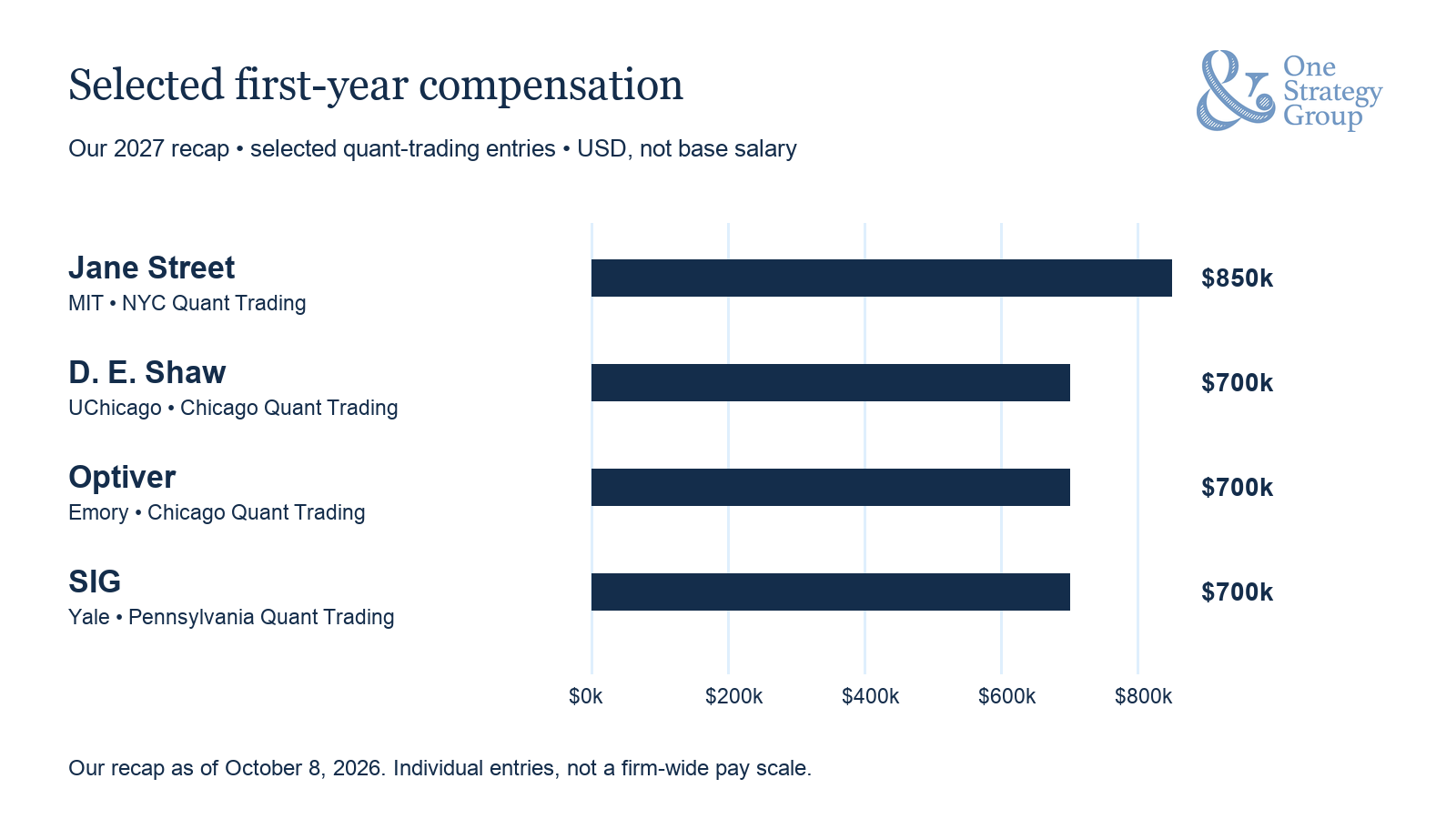
Our 2027 Hedge Fund & Quant Recruiting Recap poster records 36 offers as of October 8, 2026. The selected entries below reproduce the employer, location, student university, and compensation figures from that dated poster. We keep its labels—summer internship compensation and first-year compensation—because it does not give a base-salary and bonus breakdown. Our separate Optiver recruiting update reports 84 offers across the broader buy-side category; the two counts should not be added or treated as identical categories.
Selected compensation figures from our 2027 recruiting recap
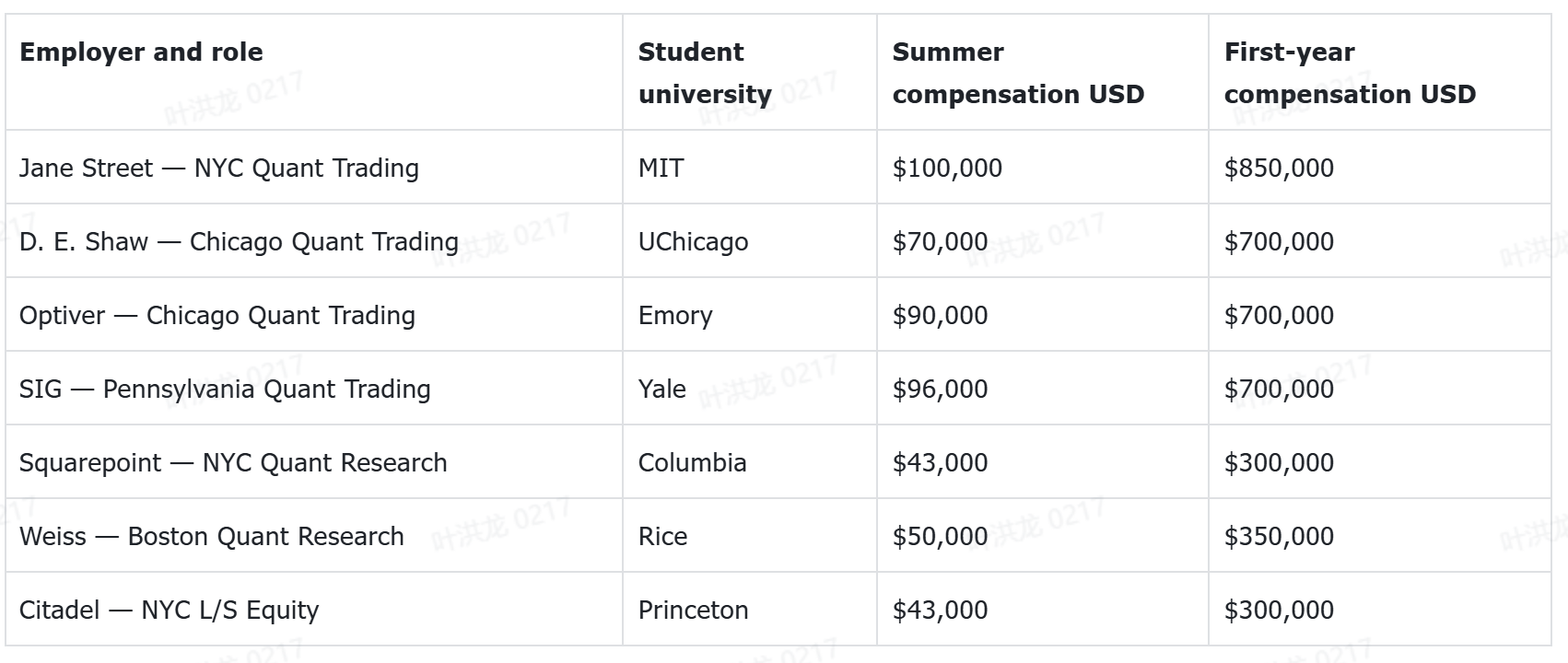
These are selected OSG-reported entries, not all 36 offers and not a firm-wide pay scale. Each row's two amounts describe different compensation periods; the recap does not establish that every internship converted into a full-time offer. It does not itemize signing payments, bonus guarantees, deferred awards, or tax treatment. The full recap below also includes research, strategy and product, software engineering, and long/short equity roles. Do not treat every entry as a quant-trading offer.
Our full 2027 hedge fund and quant recruiting recap
Our MIT student's Jane Street NYC quant-trading entry lists $850,000 in first-year compensation. Our UChicago student's D. E. Shaw Chicago quant-trading entry, our Emory student's Optiver Chicago quant-trading entry, and our Yale student's SIG Pennsylvania quant-trading entry each list $700,000. The university and office details matter: these are specific entries in our recap, not compensation promises for every student at those firms.
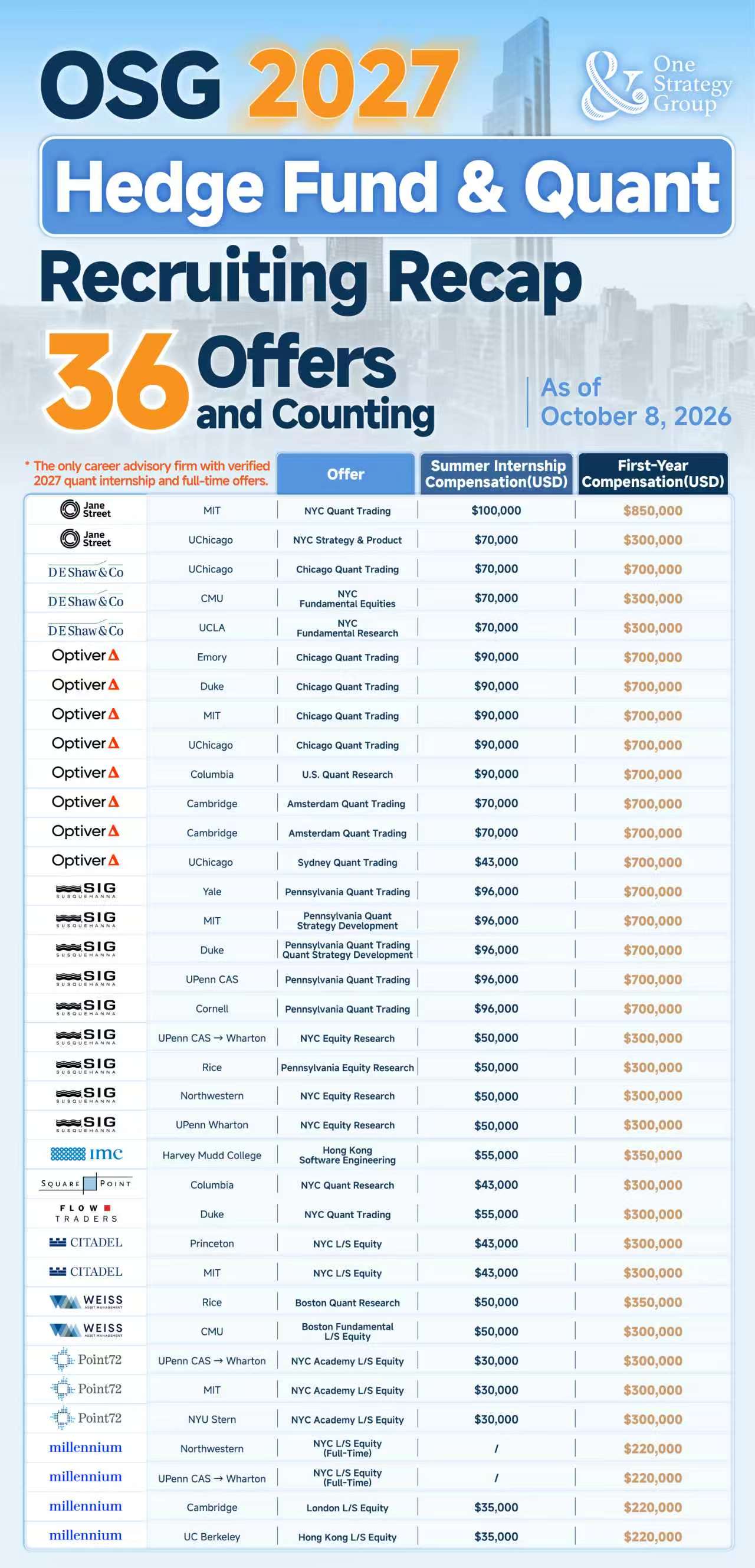
Our hedge fund and quant recap dated October 8, 2026. The 36-offer snapshot is separate from the broader 84-offer count in our Optiver recruiting update.
Why separate traders, researchers, and developers?
A trader may evaluate live risk and adjust pricing as information changes. A researcher may formulate a prediction problem and test whether a signal survives outside the development sample. A developer may build the infrastructure that allows those models to run reliably.
The responsibilities overlap, but the qualifications can differ sharply. A PhD research salary cannot substitute for an undergraduate trading offer.
HRT's student-role descriptions make this distinction concrete: Algorithm Developers research predictive models using quantitative and programming skills, while software engineers build trading and research infrastructure. The page is useful for choosing a role even where it supplies no salary.
How should you read the Jane Street first-year figure
Our recap labels the Jane Street MIT NYC quant-trading entry as $100,000 in summer internship compensation and $850,000 in first-year compensation. The latter is not labeled annual base salary. Without the underlying written breakdown, it should not be described as guaranteed recurring cash, and the summer amount should not be added to it to create a larger first-year figure.
The eFinancialCareers report on graduate trading compensation provides wider industry context. The student-entry figures in our table come from our dated recap rather than anonymous market reports. Before comparing an offer with any headline, establish what is guaranteed, when it is paid, and what remains after the first year.
What Optiver financial results tell applicants
Optiver's compensation attracts attention alongside the scale of its trading business. In its official 2025 financial results, the firm reported €4.556 billion in net trading income, up 30%, and €1.769 billion in net profit attributable to equity holders, up 29%. It also described investment in AI, data, and compute, and expansion into new business areas and U.S. capital markets.
Those results provide context for investment in talent, but they do not establish an individual graduate's compensation or a guaranteed relationship between company profit and bonuses. Our Optiver update discusses graduate packages around $700,000, while selected entries in our poster label $700,000 as first-year compensation. Neither figure should be presented as a universal Optiver base salary. For applicants, the useful response is to prepare for the research, programming, and decision-making work that the firm describes, rather than choose a role from the headline alone.
Does our Citadel entry refer to Citadel Securities
No. The recap labels the Princeton and MIT NYC long/short equity entries Citadel, with $43,000 in summer internship compensation and $300,000 in first-year compensation for each. It does not label those entries Citadel Securities or quant trading.
For students researching Citadel Securities compensation, use the firm's own career pages to identify the relevant role. A Citadel equity entry in our recap is not evidence of a Citadel Securities trading package. We have not assigned a separate Citadel Securities compensation figure to our students from this recap.
Quant trading versus hedge fund careers: compare the job, not just the firm name
“Hedge fund salary,” “quant researcher salary,” and “quant trader salary” are related searches, but not interchangeable categories. Citadel Securities describes itself as a market maker on its internship page; do not treat a Citadel Securities opening as a Citadel hedge-fund opening. Similarly, a quantitative developer building execution systems and a researcher testing predictive signals can have different hiring requirements at the same employer.
For a useful comparison, match the office, degree level, seniority, job responsibilities, and compensation period. We do not turn these selected student outcomes into a general investment banking or hedge fund salary range because the roles and compensation periods differ.
2. What Should You Read First in a Quant Offer Letter?
Start with the payment schedule. A single package total can combine cash paid immediately, money earned over a year, and compensation that depends on a future decision.
The six components to identify
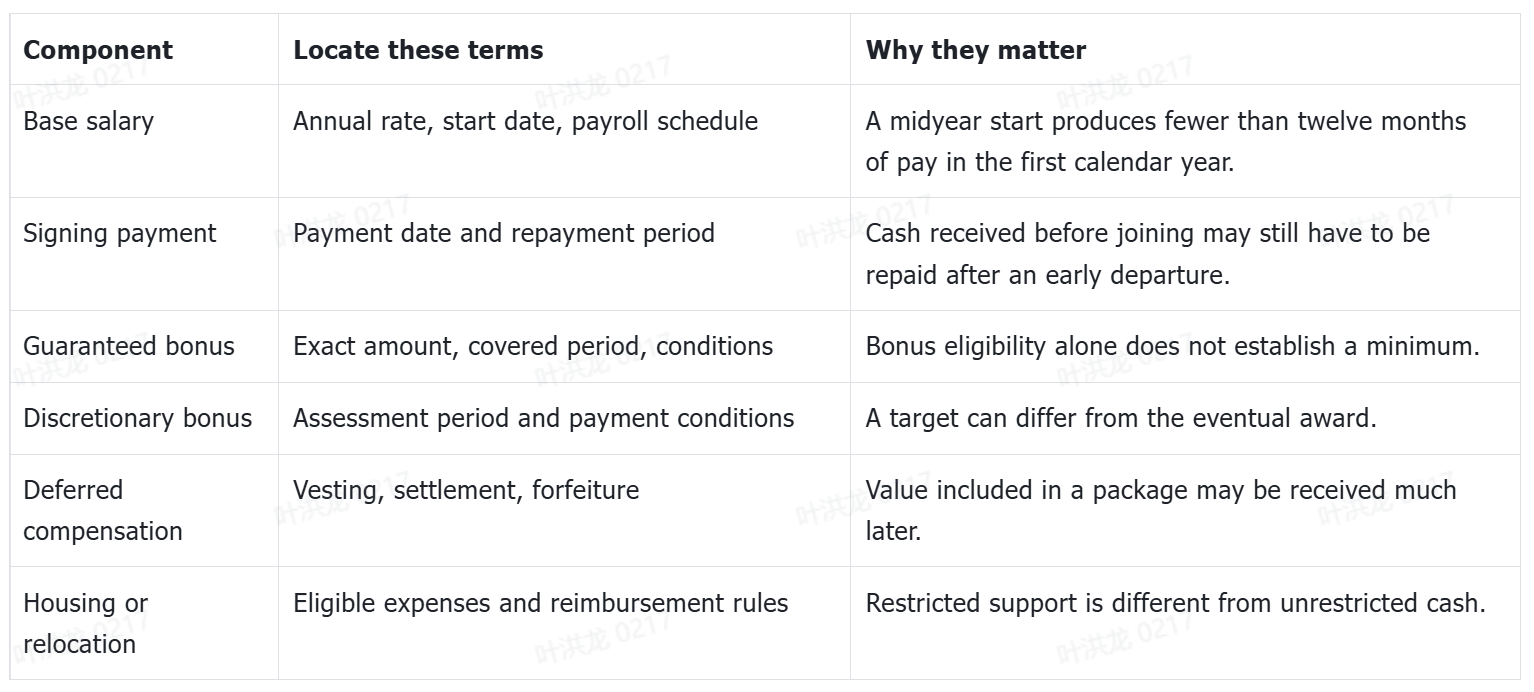
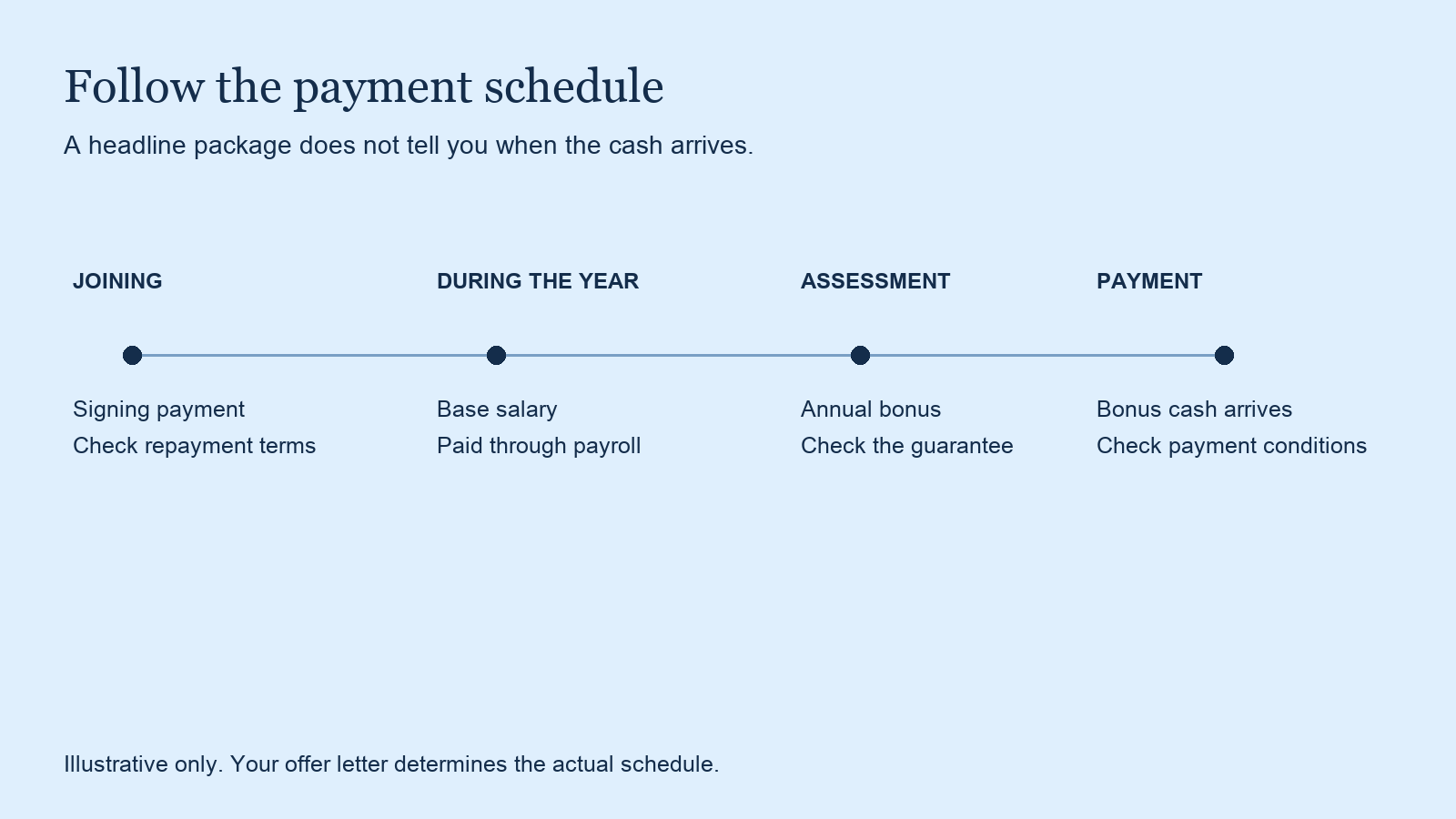
Illustrative timeline. The actual payment schedule comes from your contract.
Compare the same employment period
Suppose an offer starts July 1. The annual base rate describes twelve months of pay, while the first calendar year includes six months of employment. A bonus may cover that shorter period, follow another fiscal calendar, or be paid after year-end.
Create separate columns for cash paid in the first twelve months, cash earned for that period but payable later, one-time payments, and variable awards. Avoid counting the same bonus when it is earned and again when it is paid.
Ask precisely about repayment
For a signing payment, ask whether repayment is full or prorated, how long the obligation lasts, and which departures trigger it. Ask how repayment is administered if payroll has already withheld tax. The contract and payroll treatment determine the answer; “this is standard” does not resolve it.
3. How Much Do Quant Trading Interns Earn?
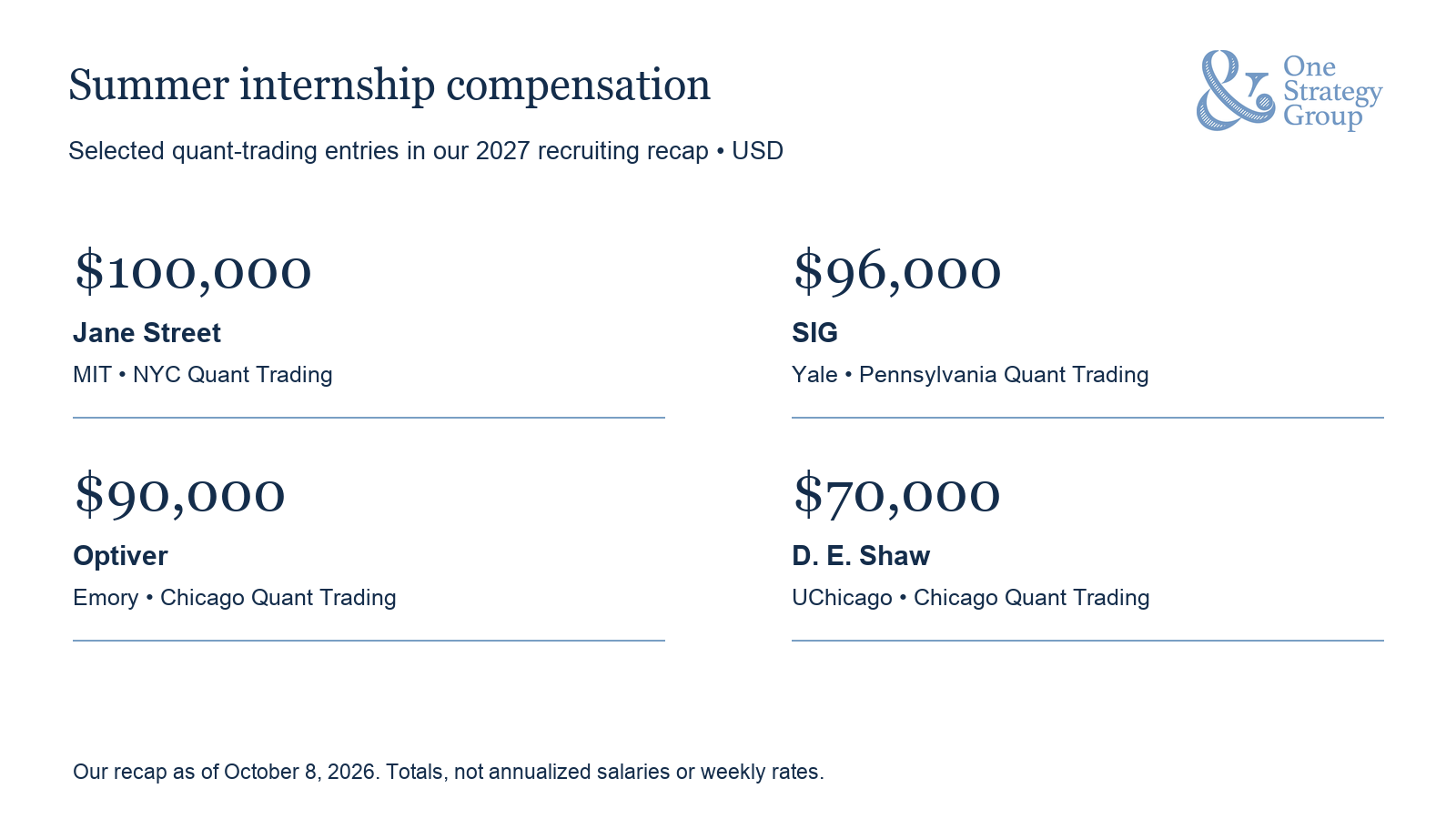
Our recap gives summer internship compensation totals rather than weekly rates. Keep those totals attached to their specific role and office, and do not annualize them into a graduate salary.
For the selected quant-trading entries, our recap lists $100,000 at Jane Street NYC, $96,000 at SIG Pennsylvania, $90,000 at Optiver Chicago, and $70,000 at D. E. Shaw Chicago in summer internship compensation. These are the recap's amounts, not a calculation from an assumed program length. It does not specify whether each total includes signing, housing, or travel support.
Location changes the comparison. Our Optiver entries list $90,000 in summer compensation for Chicago quant trading, $70,000 for Amsterdam quant trading, and $43,000 for Sydney quant trading, all under the recap's USD heading. Those locations should not be combined into one universal Optiver internship salary. Confirm the payroll currency, conversion basis if relevant, program duration, and support included in your own offer.
Why Optiver internship figures can differ across sources
eFinancialCareers' report on 2027 electronic-trading internship pay describes Optiver undergraduate quant compensation of up to $88,000 for the internship. We retained that qualification in our Optiver update. It is a reported program benchmark, whereas the $90,000 amounts in our poster are attached to specific OSG student entries. We do not relabel either amount or assume the difference is a signing bonus. The written offer must establish the compensation components and payment period.
What should you compare besides summer pay?
For an example of program structure, Citadel Securities' internship page describes team rotations, project work, and formal feedback. Education includes research techniques, mock trading, and game theory. This employer program information is separate from the compensation entries in our recap.
Ask how projects are assigned, who evaluates the intern, and how full-time placement is decided. A substantial summer paycheck does not tell you whether you will spend the internship doing the work you want after graduation.

Photo: Citadel Securities. Use the internship to assess the work and mentorship alongside compensation.
4. What Have Our Students Learned While Recruiting for Quant Roles?
In our 2027 Optiver recruiting update, we reported 84 buy-side offers, including eight Optiver quant-trading offers. Our successful Optiver applicants included University of Chicago and Duke students graduating in 2029. These outcomes show that preparing for quant internship recruiting can be relevant before junior year; they do not mean every first-year student is eligible for every program.
The poster above remains our 36-offer hedge fund and quant snapshot as of October 8, 2026. The separate update uses the broader buy-side label and does not state the same snapshot date. We do not combine those counts into a new total or infer a growth rate from them.
Our student experiences also include an IMC Chicago quant-trading internship and a Citadel Securities New York summer trading role. Their preparation gives applicants concrete examples of how to approach the process.
Probability practice has to transfer into a live conversation
One student we supported for Citadel Securities completed 673 practice problems over a summer and repeated a simplified trading game four times before the interview. The game required updating prices as information changed and explaining decisions while other candidates participated.
The useful lesson is the difference between solving privately and reasoning in front of another person. A candidate may calculate expected value correctly, then struggle to explain how their quote changes when the counterparty has better information.
When practicing, record the answer, the assumption behind it, and your response to a changed assumption. Checking only the final number misses much of the exercise.
Several offers can help clarify which work fits
Another student we supported completed 76 interviews across two recruiting cycles and received offers from IMC, Two Sigma, and Goldman Sachs. Her experience included comparing trading exercises with longer research problems.
That distinction helps when choosing a path. Do you enjoy making repeated decisions under time pressure, or spending longer investigating why a model behaves as it does? Salary cannot answer that question for you.
These individual experiences are published under pseudonyms. They illustrate preparation and career choices, rather than a typical offer count or salary distribution.
5. What Should You Prepare Before Applying for a High-Paying Quant Role?
Use the exact role description to build your preparation plan. A broad finance syllabus can leave substantial gaps for quant recruiting.
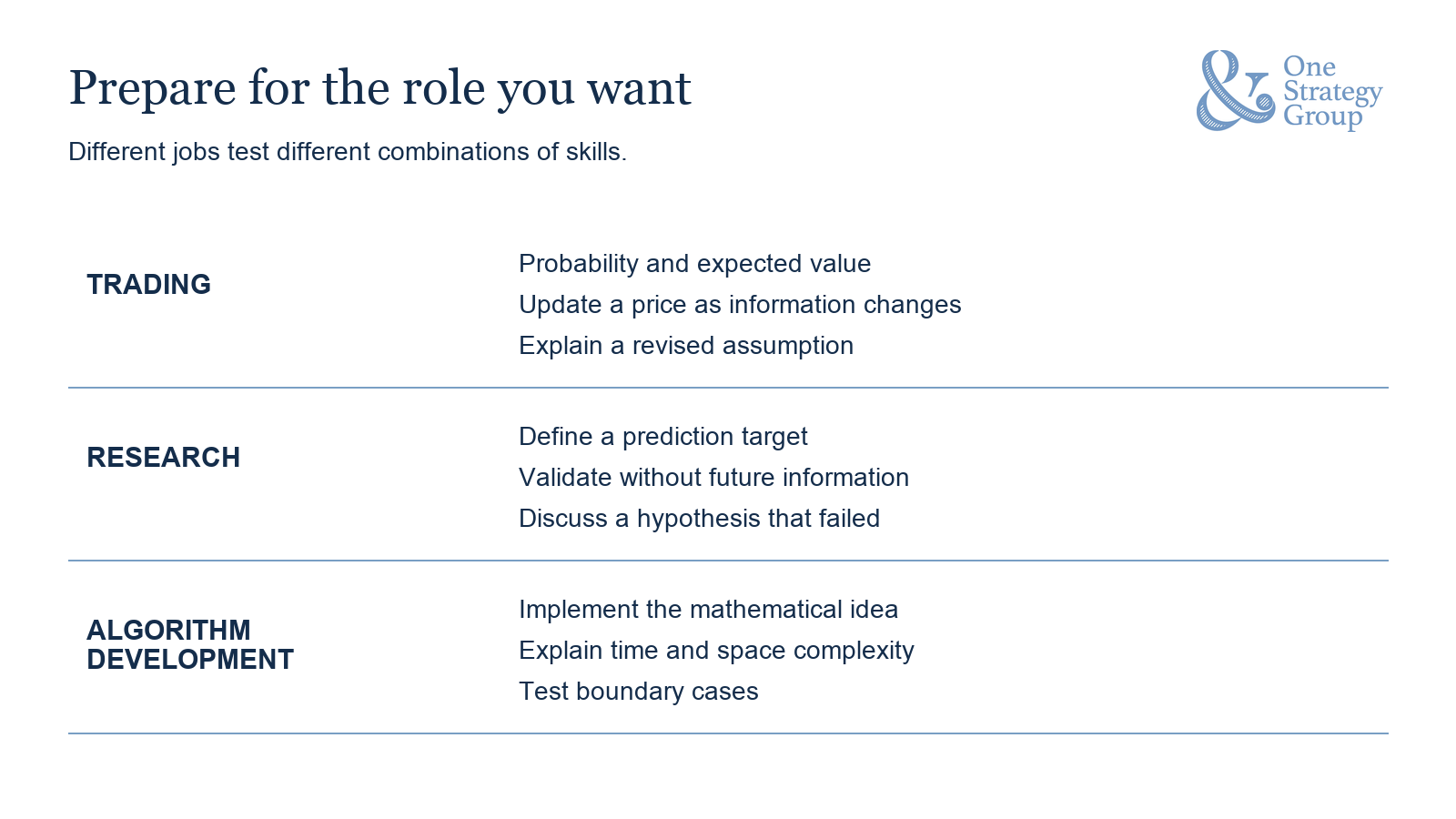
Trading: probability, expected value, and market making
Jane Street's Probability & Markets guide introduces concepts used in its trading and research interviews. Its interview guidance describes collaborative problem solving and says trading candidates are not tested on prior finance or economics knowledge.
Begin with a simple exercise. A fair six-sided die has an expected face value of 3.5. Now suppose a counterparty can choose whether to trade with you after seeing information you do not have. Your original expectation alone no longer determines whether accepting the trade is attractive. Their decision to trade contains information.
Practice explaining what you knew beforehand, what their action reveals, and why you revise your estimate. This connects classroom probability with adverse selection.
For additional practice, Jane Street specifically recommends the first five or six questions in the clubs and diamonds suits of its Probability Playing Cards. That is a focused starting point for interview preparation.
Research: explain how you tested an idea
Prepare one project from question to result. Identify the prediction target, information available at prediction time, validation split, and baseline you tried to beat.
For a time-series project, explain how you preserved time order. A random split can allow future information to influence evaluation. For a backtest, explain costs and show what happens outside the period used to choose the model.
Our recommended project discussion includes a failed hypothesis, sensitivity to an assumption, or result that did not survive validation. Those details demonstrate how you evaluate evidence.

Photo: Hudson River Trading. A real workplace photograph from the firm's culture page, not an OSG student case.
Citadel Securities quant research interviews: what is publicly specified?
The firm's published quantitative research interview process describes a 45–60-minute remote first round covering technical and behavioral skills. It identifies programming, data structures, algorithms, and problem solving; candidates should also be ready to discuss projects, internships, and technical interests. Its onsite second round usually comprises three to five 60-minute interviews, followed by team-fit review.
Prepare a two-minute project overview and a deeper technical explanation. Be able to define your input data, defend the validation method, write or discuss the implementation, and explain a limitation. This is guidance for the published research process, not a promise that every trading or engineering interview follows the same sequence.
Algorithm development: translate the model into code
HRT describes a typical technical process involving a coding test, one or two phone screens, and a multi-round final interview. It also instructs applicants to apply to one posting and indicate other role or office interests within the application.
Practice implementing mathematical ideas, explaining complexity, and testing boundary cases. Preparing probability alone leaves the programming component exposed.
Quant resume and coding-test preparation: make each claim testable
Our recommended quant resume review starts with the claims an interviewer can probe. For a research project, name the question, method, validation setup, and your own contribution. For a software project, identify the language, implementation challenge, and what you measured. Include a result only when you can explain how it was obtained; a backtest return without costs or evaluation dates is not persuasive evidence by itself.
For coding practice, solve a problem, describe the approach aloud, identify its time and space complexity, and test an empty input, a boundary case, and a case that breaks your first implementation. For probability interview questions, write down the conditioning information before calculating. For market-making practice, explain both your estimate and what would make you change it. These exercises target distinct skills rather than a generic “quant interview” checklist.

Photo: Citadel Securities internship program. Programming and explaining your reasoning are separate preparation tasks.
6. How Should International Students Compare Quant Opportunities?
Check eligibility for the exact opening. A firm's reputation for sponsorship does not establish the policy of every team.
Optiver's 2027 New York PhD researcher posting explicitly supports U.S. immigration sponsorship. IMC's Chicago PhD researcher posting specifies graduates between September 2026 and July 2027 and February or August 2027 start dates.
Can students graduating in 2029 recruit for summer 2027
Optiver's published Summer 2027 Chicago Quantitative Intern listing included STEM bachelor's and master's students graduating between December 2027 and June 2029, with sophomore standing or higher. That window explains why the class of 2029 could be in scope. The listing also described quantitative reasoning, mathematics, probability, statistics, and programming skills, and said candidates could be considered for trading or research internships.
Our UChicago and Duke class-of-2029 outcomes are examples from this recruiting season, not a blanket eligibility rule. Starting preparation in first year and being eligible to intern as a sophomore are different things. Check the current Optiver job board for availability and the exact role requirements; a published eligibility window does not mean applications remain open.
Keep a tracker with the role URL, office, degree requirement, graduation window, start dates, application status, and recruiter-confirmed sponsorship information. These fields help eliminate unsuitable openings before investing weeks in preparation.
Quant internship recruiting timeline: which application should you submit?
Start with graduation eligibility, not the largest salary in a search result. A 2027 full-time job and a summer internship leading to a later graduation year are different application tracks. Use HRT's student opportunities and Citadel Securities' openings filters to separate internships from new-graduate roles, then read the specific posting for its cohort requirements.
Our recommended sequence is practical: shortlist eligible roles; identify the probability, coding, or research gaps; prepare a resume whose projects you can defend; then track assessments and interview feedback separately by employer. Do not invent a universal quant application deadline. If no closing date appears, check the live posting and ask recruiting about timing. The absence of a deadline is not evidence that the role will remain open.
If you are considering both banking and quant, our freshman-to-junior investment banking recruiting timeline helps organize the banking side. Keep a separate quant tracker because the application dates and interview stages can differ.
7. How Do You Choose Between Two Quant Offers?
Request the missing terms before ranking the packages.

Photo: Hudson River Trading. Ask about learning opportunities and the people you will work with as well as compensation.
Questions that make a comparison usable
Is the bonus a contractual minimum, a target, or entirely discretionary?
Does “first-year pay” mean twelve months from joining or a partial calendar year?
Which payment is one-time, and what recurring compensation is stated?
Must you remain employed on the bonus payment date?
What repayment conditions apply to signing and relocation payments?
Is the team assignment confirmed?
Who evaluates the first year, and what training happens before live responsibility?
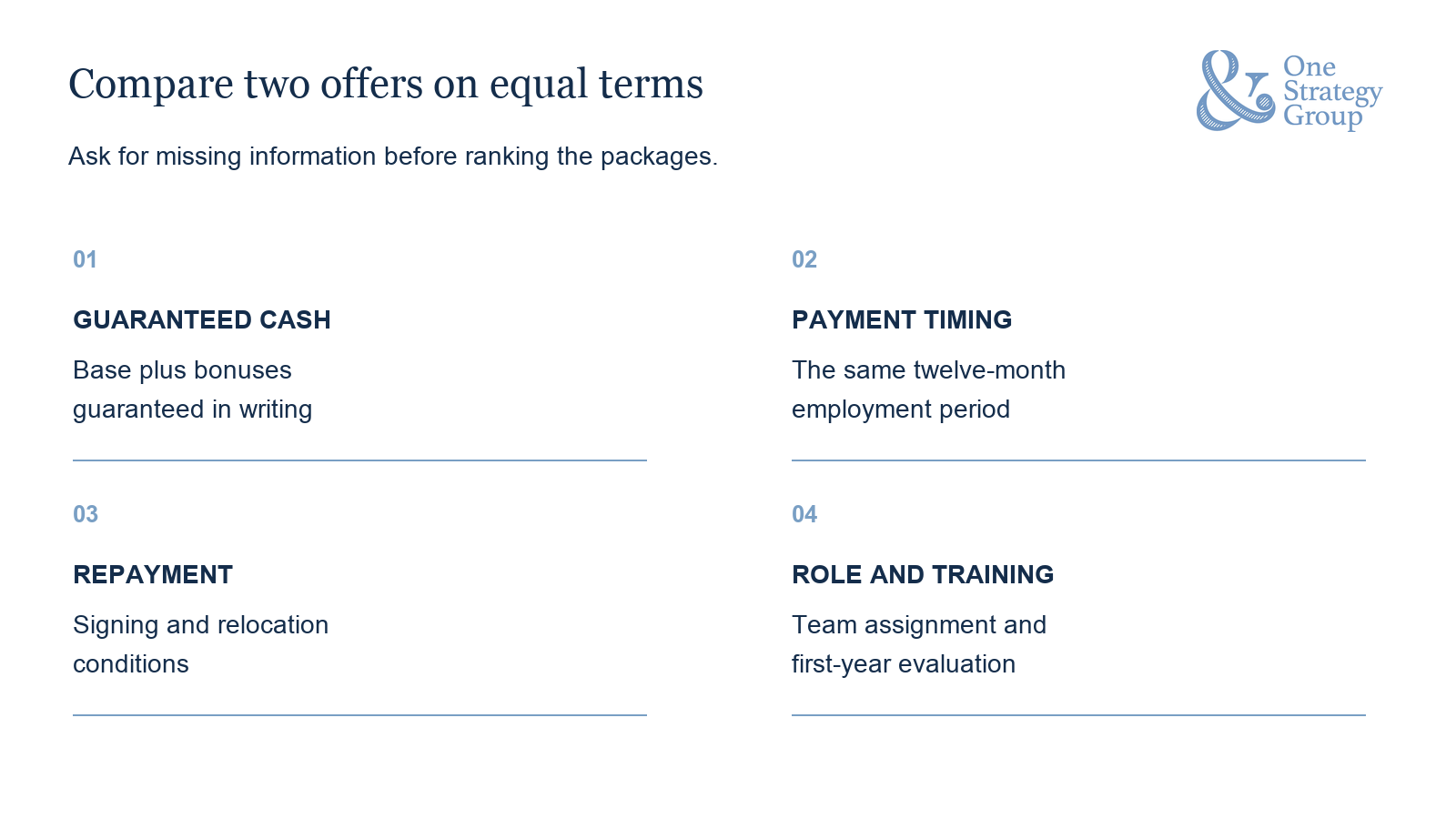
If one recruiter quotes base salary and another quotes total compensation, ask both for the same breakdown. Keep an unconfirmed bonus outside guaranteed cash. Then consider the work, training, location, and contract terms alongside pay.
About OSG
We provide career exploration, technical preparation, applications, networking support, and mock interviews. In our 2027 Optiver update, we reported 84 buy-side offers, including eight Optiver quant-trading offers. Our student experiences include candidates entering quantitative trading and research from different academic backgrounds.
For quant candidates, we begin with the target role and next recruiting obstacle: probability, coding, a research discussion, or explaining decisions in a trading game. Preparation should address that obstacle directly.
Free Career Planning Session
Book a one-on-one conversation to discuss target roles, your recruiting stage, and preparation priorities.
Explore More Resources
Investment Banking Recruiting Timeline: Freshman to Junior
Our Student's Path to an IMC Chicago Quant Internship
What 76 Quant Interviews Taught Our Student About Choosing an Offer
Source note: Student-entry compensation figures reproduce our October 8, 2026 recruiting poster and retain its USD labels. Our separate 2027 Optiver update reports 84 buy-side offers, including eight Optiver quant-trading offers. The reported $88,000 internship benchmark is identified separately from individual OSG entries, and company financial results come from Optiver. Summer and first-year compensation are different periods; the poster does not itemize base salary or guarantees. These outcomes are not a placement rate or promise of future results. Employer names do not imply a partnership or endorsement.

Free Career Planning Session
Book a free 1-on-1 session with an OSG mentor and map out your path to top firms!
Book Your Free Session →Ready to Write Your Own Success Story?
Book a free 1-on-1 session with an OSG mentor and map out your path to top firms!
Book Your Free Session →Explore More Resources


Frequently Asked Questions
Our Optiver update discusses graduate packages around $700,000, and selected entries in our October 8 recap label $700,000 as first-year compensation. That does not establish $700,000 in annual base salary, guaranteed recurring cash, or a universal offer for all graduates. Ask for base pay, signing cash, guaranteed and discretionary bonuses, payment dates, and any deferred awards separately. The summer internship amount is a different compensation period and should not be added to the first-year figure.
The $88,000 figure is the upper end described in eFinancialCareers' reporting on undergraduate quant internship pay for 2027. The Emory, Duke, MIT, and UChicago Optiver Chicago quant-trading entries in our dated poster each list $90,000 in summer compensation. These are different source types and scopes. Without their itemized terms, do not assume the figures cover identical components or invent a reason for the difference. Neither number guarantees another applicant the same package.
Optiver's published Chicago listing included graduation dates through June 2029 and required sophomore standing or higher, alongside the stated degree and technical requirements. Our update reports successful UChicago and Duke students graduating in 2029. That supports preparing before junior year, not assuming every first-year student qualifies. Confirm your graduation date, standing at the required time, summer availability, and whether the relevant opening is still accepting applications.