



Student Cases

Quant
Quant
What 76 Quant Interviews Taught Me About Picking the Right Offer
Victor compared it to Go. He said I was already winning the board — I just needed to close it out cleanly. Then he told me he sometimes prepares last minute too, and that what matters is whether you're a little better than the last round. That was the night I stopped trying to be perfect.
Published on
May 26, 2026
6
min read
Sophomore year I sat through 76 quant interviews over two recruiting cycles. By the end I had offers from IMC Trading in Chicago, Two Sigma in New York, and Goldman Sachs for the summer of 2026. Quant research recruiting at this tier runs under a 1% acceptance rate at the largest firms, but the number that mattered to me was not the odds. It was the number of nights I spent convinced that the next offer would finally make me feel like enough.
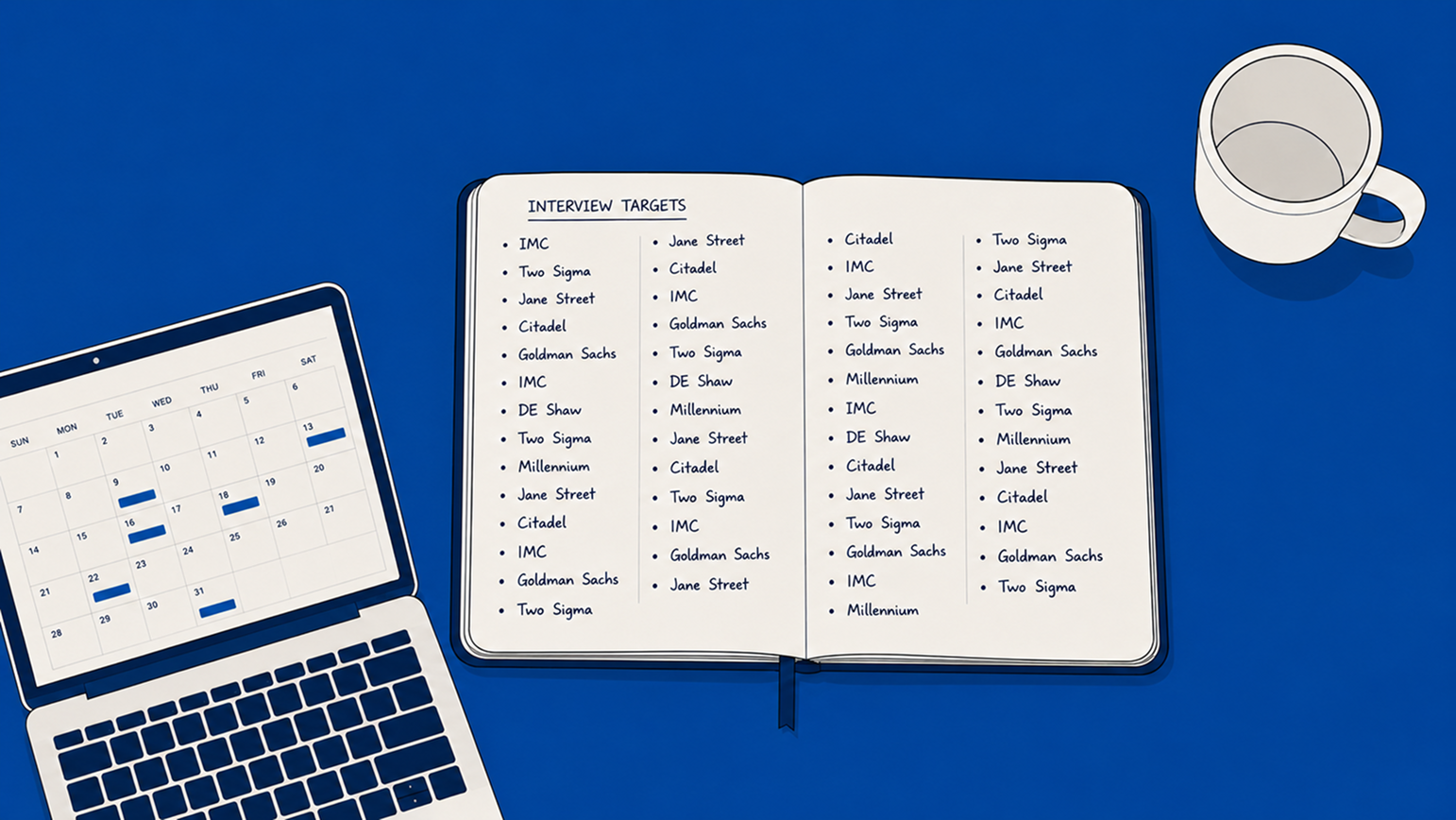
This is the story of how I stopped collecting interviews and started choosing them. Quant recruiting in 2026 taught me more about myself than about probability puzzles. The One Strategy Group mentorship I worked through was part of how I got there, but the bigger shift was internal.
From Humanities to Math: How I Found My Path to Quant
I spent most of high school writing humanities papers. Gender Studies, mostly. I was good at it on paper and miserable about it in practice. The night before every meeting with my professor I would stay up until 4 a.m. dragging sentences across a Google Doc.
Then the pandemic hit and I picked up AMC problems out of boredom. Six hours at a whiteboard felt like ten minutes. That was the signal. I transferred from Rice to Columbia the following year to study math and computer science. The Two Sigma offer is, in a strange way, the long-tail consequence of being trapped in a quiet apartment with a stack of contest problems.
Why I Couldn't Stop Interviewing
The Offer That Wasn't Enough
I got my first quant offer about six months into working with One Strategy Group career coaching. I should have been done. Instead I opened my laptop the next morning and applied to twelve more firms.
The logic at the time felt obvious. The offer was good but not the offer. There was a version of me, somewhere down the recruiting funnel, who got into the firm that mattered. I owed it to her to keep going.
That is not how I would describe it now. Now I would say I was scared of what stopping might mean about me.
Ten Interviews a Week for Two Years
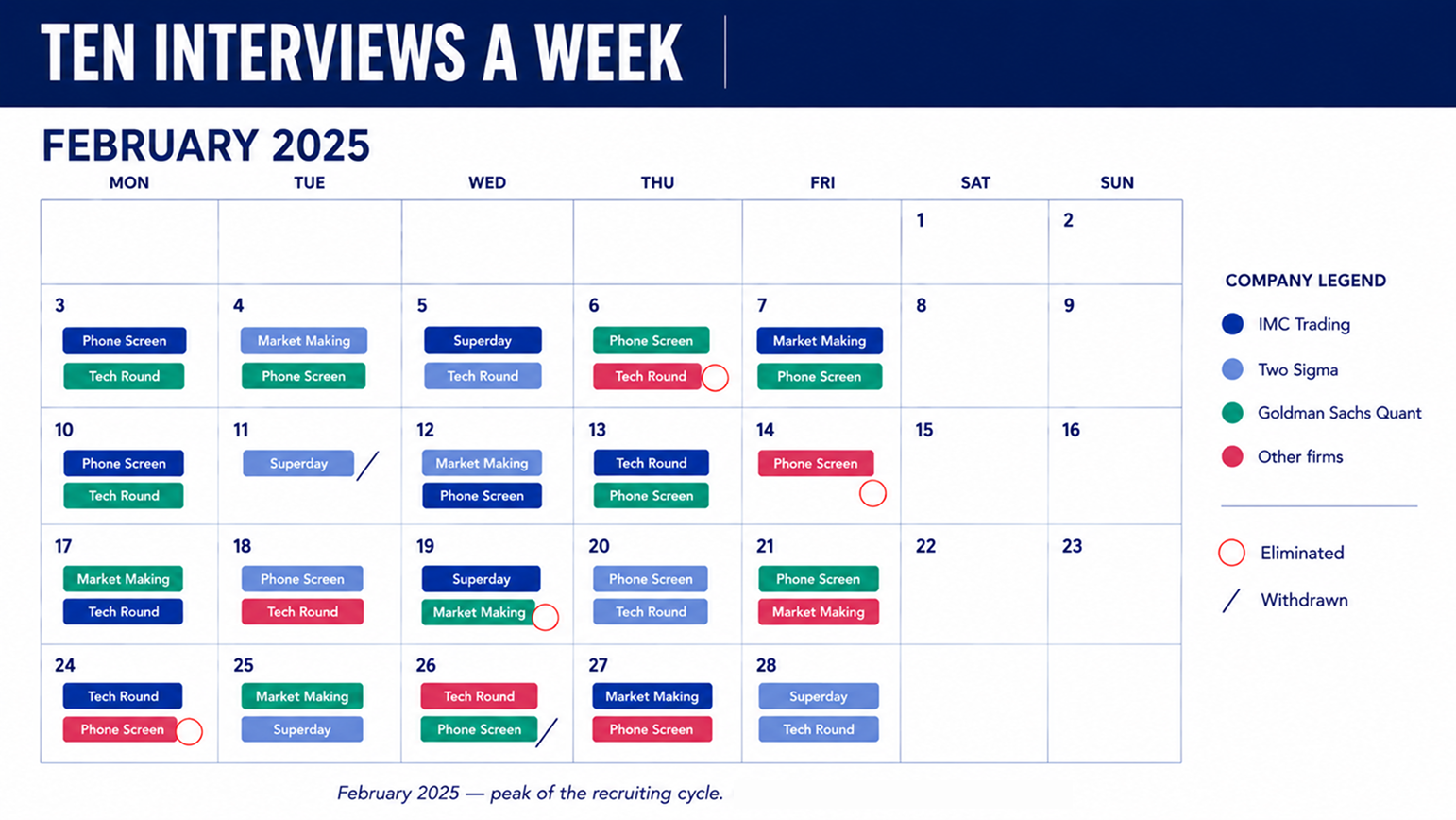
At peak I was doing ten interviews a week. Phone screens, technical rounds, market making games, mental math under a stopwatch, superdays in three different cities. The screenshot of my February calendar looked less like a schedule and more like a weather map.
What kept me going was not love of the work. It was a specific kind of fear — the fear that if I paused, someone I respected would see me as ordinary. Interviews became my proof of concept. Each one, regardless of outcome, was a way of telling myself I still belonged in the room.
The Jane Street Breakdown: When Achievement Stopped Being Enough
I bombed Jane Street. Not borderline. Bombed.
On the train back, a friend said the obvious thing. "You already have good offers. You can finally relax." I started crying in the seat, which was embarrassing, and then I figured out why I was crying, which was worse.
I was relieved.
Some quiet part of me had wanted permission to stop, and a missed offer had given it. That was the part I was angry at. Not the part that failed the interview — the part that felt freed by failing. If I needed an external excuse to rest, then everything I had told myself about drive was a lie. What I was calling drive was fear of being ordinary, wearing better clothes.
The Chicago Hotel Call: A Conversation That Changed How I Compete
The IMC superday was three weeks later. I flew into Chicago the night before and realized I had not finished the practice problems my mentor Victor had sent. Not most of them. Not even half.
Victor had spent months walking me through the IMC track. He had competed in math olympiads, he had traded options professionally, and he had specifically built out a practice set for the kinds of market making games IMC runs in the superday. I had skipped them.
I called him from the hotel room. He picked up on the third ring.
What My Mentor Said About Progress
Victor played Go competitively as a teenager and tends to reach for it as a metaphor. That night he said I was already ahead on the board. The opening had gone well. Most of the territory was mine. The only thing left was to close out the endgame without making a stupid move.
Then he said something I did not expect. He told me that he sometimes prepares last minute for things too. That cramming the night before a hard meeting was not a moral failure. The thing that mattered, he said, was whether I was a little better in this interview than I had been in the last one. Not perfect. Better.
I had spent two years building a story about myself in which one missed practice question was proof of inadequacy. Victor dismantled that story in about four minutes. I sat on the hotel bed afterward and worked through the practice set with the lamp on until 3 a.m. The next morning I walked into the superday and got the offer.

Quant Trading vs. Quant Research: How I Found the Right Fit
Why Two Sigma Felt Different
After IMC, I had a working theory that I wanted to be a trader. Trading is fast. Trading has scoreboard feedback every few minutes. Trading rewards the part of me that wins arguments.
Then I interviewed at Two Sigma.
The interviewer gave me a long, layered probability puzzle. No clock pressure. No simulated P&L. Just a problem that opened up the deeper I went. Around minute 40 I noticed I was smiling, which I had not done in any of the previous 60 interviews. It was the same feeling as the AMC problems during lockdown. The pleasure was not in beating anyone. It was in the puzzle itself.
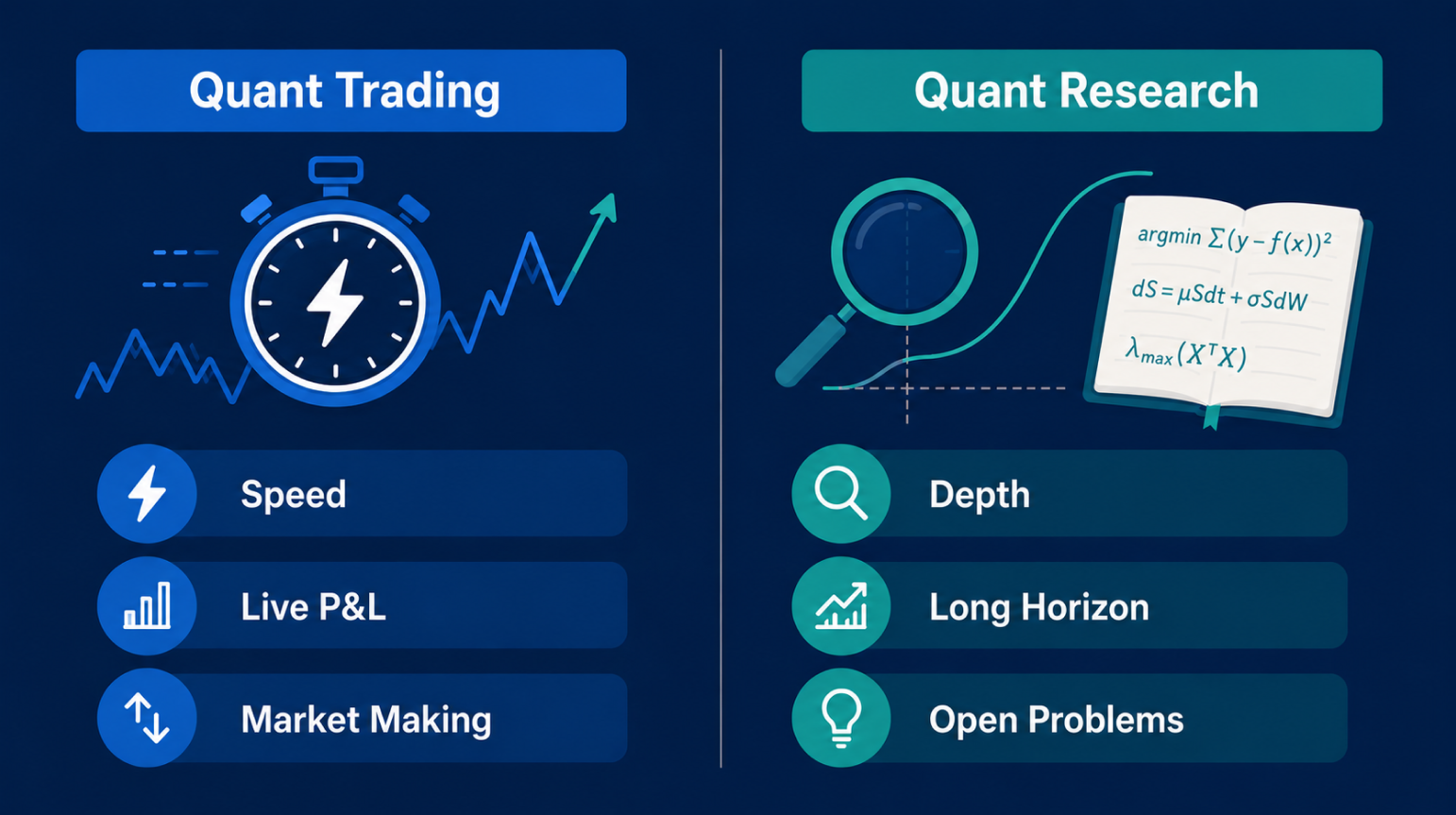
Quant trading rewards a specific kind of competitive instinct: the urge to beat the market in the next hour. Quant research is different. The reward is patience, sitting with a question for weeks until something gives. I had assumed I was the first type because the first type is louder. Two Sigma showed me I was the second.
What I Look For Now
The recruiting season ended with three offers in three different shapes. IMC's quant trading role in Chicago. Two Sigma's quant research position in New York. Goldman Sachs's quant investment seat for summer 2026.
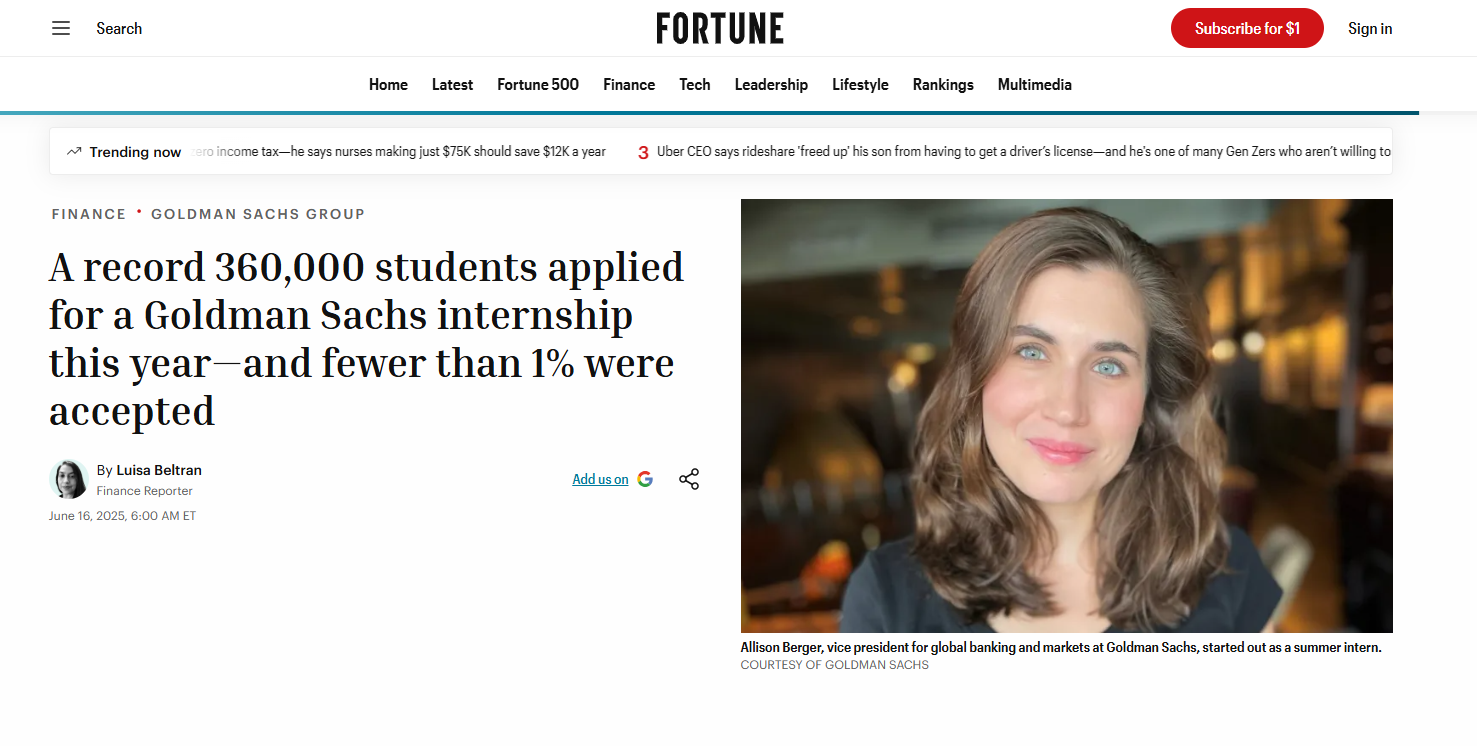
To put the last one in context: for the class of 2025, Goldman received more than 360,000 applications and accepted roughly 2,600 students, a 0.7% acceptance rate (Fortune, June 2025). I knew those numbers going in. They are part of why I could not stop. What I did not know was that the offer would not feel different from the others once I had it. The feeling I was chasing was not on the other side of any specific logo.
I picked based on the kind of problem I wanted to spend ten years getting better at. Working through One Strategy Group career coaching helped me see this earlier than I would have alone. Victor and the other mentors I worked with did not push me toward any specific firm. They kept asking which problems I actually liked solving when no one was watching. That question is harder than any market making game.
What I Would Tell Someone Starting Quant Recruiting Now
Three things, in order.
First, your offer count is not your value. I needed 76 interviews to internalize this. You can probably get there faster.
Second, the difference between quant trading and quant research is real and worth taking seriously before you commit. Sit with a long probability problem and notice whether you want it to end or want it to keep opening up. That answer is more diagnostic than any aptitude test.
Third, find a mentor who will pick up the phone at midnight in a hotel room and remind you that being a little better than last time is the whole game. I found mine through One Strategy Group quant mentorship. Yours may come from elsewhere. The source matters less than the fact that you have one before you need them.
The night before Chicago, Victor told me I was winning the board. He was wrong about the specific game and right about the larger one. The larger game is not about being the most special person in the room. It is about staying in the room long enough to find out what you actually want to do once you are there.
Disclaimer: One Strategy Group has no affiliation or partnership with the firms mentioned in this article. All offers described were obtained by the student through standard campus and lateral recruiting channels.
Free Career Planning Session
Book a free 1-on-1 session with an OSG mentor and map out your path to top firms!
Book Your Free Session →Ready to Write Your Own Success Story?
Book a free 1-on-1 session with an OSG mentor and map out your path to top firms!
Book Your Free Session →


Frequently Asked Questions
Yes, though it shapes preparation. Competition math accelerates pattern recognition, but firms like Two Sigma also hire candidates who built those skills through coursework and structured problem sets. The bigger differentiator is whether you enjoy sitting with a hard problem. OSG mentorship works through this kind of multi-path question with each student.
Quant trading interviews stress speed: market making games, mental math under a timer, and live P&L reasoning. Quant research interviews favor depth: layered probability problems, model selection logic, and open-ended discussion. Practice both styles to find which one you actually want to keep doing.
OSG pairs students with mentors from quant trading and research seats, then runs structured preparation: firm-specific problem sets, mock superdays, and frameworks for choosing between trading and research. The service is coaching, not placement. Offers like the ones in this story are earned on merit.



.jpg)