



Student Cases

Investment Banking (Finance)
Investment Banking (Finance)
The "No" That Changed My Goldman Sachs Recruiting Strategy
When the interviewer just said 'No,' I had a second where I almost flinched. Then I realized the same composure I'd built up for years was the thing that would carry me through the next ninety seconds.
Published on
May 21, 2026
6
min read
Lead-in
The Goldman Sachs final round was on a Tuesday afternoon. I'd been on the call for about twenty minutes when one of the interviewers, an MD who'd barely shifted his expression the entire time, looked up after my answer and said one word.
"No."
Not a follow-up. Not a hint about what he wanted instead. Just the word, flat, and then a pause that he clearly was not going to fill. I had maybe two seconds before the silence started doing damage. What I did in those two seconds is most of what this case study is actually about.
A Single Word in the Final Round
The question had been a standard behavioral prompt about a time I'd worked under a difficult deadline. I'd answered it the way I would have a month earlier, in the way that felt natural, leading with the texture of the situation and circling toward the takeaway. The "no" was telling me that the structure was wrong, not the content. So I reset. I went back to the start, opened with the result, then walked the situation, the action, the result a second time, in that order. He nodded once and moved on.
I didn't get the next question right either, but I got it less wrong. That's the whole arc of recruiting, in retrospect. You stop trying to be impressive and you start trying to be legible.
The Path That Got Me There
By the time I sat down for that final round, I'd been recruiting in some form for almost two years. I joined a target school as a freshman with a vague interest in finance and the same questions everyone has. Was I sure about this? Was I sure enough to give up the next eighteen months to it?
I joined ten clubs my first year. I networked into a private equity internship the summer after freshman year. I read 10-Ks on flights and flew to San Francisco four times sophomore year just to see what the tech ecosystem actually looked like in person. None of that was wasted, but none of it was a strategy either. I had volume. I did not have a map.
Ten Clubs, One Private Equity Internship, Zero Framework
What I had at the end of sophomore fall was a résumé that read well and a head full of disconnected facts. I knew what a DCF was in the abstract. I could not have built one cleanly under time pressure. I knew what storytelling meant in behavioral interviews. I could not have told you why my own stories were landing flat. That gap, between knowing about things and knowing them, is the gap that the recruiting timeline does not give you time to close on your own.
Where the Self-Study Approach Broke Down
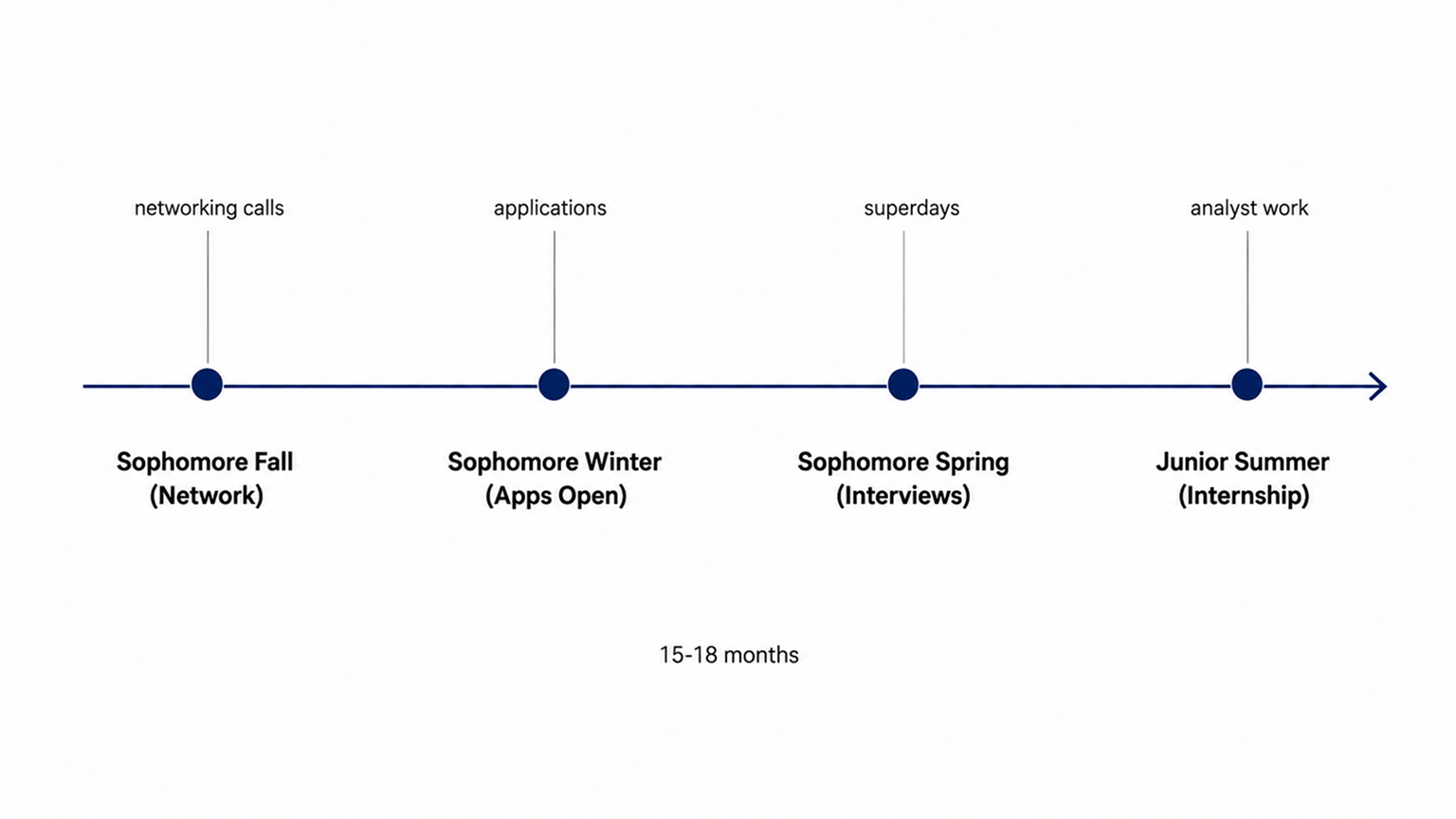
Investment banking recruiting in the United States now starts roughly eighteen months before the internship itself. Yale's Office of Career Strategy notes that bulge bracket banks open summer 2027 applications as early as January 2026, with recruiting for sophomores beginning the year prior.
By the time you understand what's happening, the cycle is mostly over. That compression is part of why 2026 finance recruiting trends keep pushing self-study to fail at the margin. Not because the material is impossible, but because there is no slack in the schedule to discover what you don't know.
Technicals: From Cramming to a Structured Curriculum
My technical prep before One Strategy Group looked like everyone else's. I had a Wall Street Prep guide on my desktop, a half-finished modeling course, and a folder of M&I question banks. I'd cram before each round and forget half of it the next week. The problem wasn't motivation. The problem was that I was treating a system like a vocabulary list.
What changed was the sequencing. My lead mentor, Zoran, built out a curriculum that started with the actual logic underneath the questions, accounting flows, valuation frameworks, capital structure, before drilling into the high-frequency interview questions on top of those foundations. Once the base layer was solid, the questions stopped feeling random. They started feeling like variations on a smaller number of underlying ideas.
Behavioral: Rebuilding the Story Spine
The behavioral side was worse. I'd been told I was a good communicator my whole life, which turns out to be one of the more dangerous things to believe going into recruiting. My stories were vivid. They were also long, unstructured, and weighted toward what I found interesting rather than what an interviewer needed to know.
We rebuilt the spine. Each story got reduced to one core theme, one decision, one result. Paul was the mentor who would actually call out when I was hiding behind narrative texture instead of making a point. Steven heard every version of every story and pointed out which ones I was telling because I wanted to, versus which ones earned their seat. Taylor handled the parts of the process that were less about answers and more about staying intact through a four-month sprint. These are essentially the four Ps of behavioral interview preparation operating in practice rather than theory.
At the end of that H2, the broader point is that there is a structured approach to breaking into investment banking that does not look like "do more of everything."
How I Worked with One Strategy Group Mentorship
"I stopped treating recruiting like a lottery the moment someone showed me the actual map. Before that, I was networking, interning, flying to SF, doing everything, but I didn't know what the picture was supposed to look like."
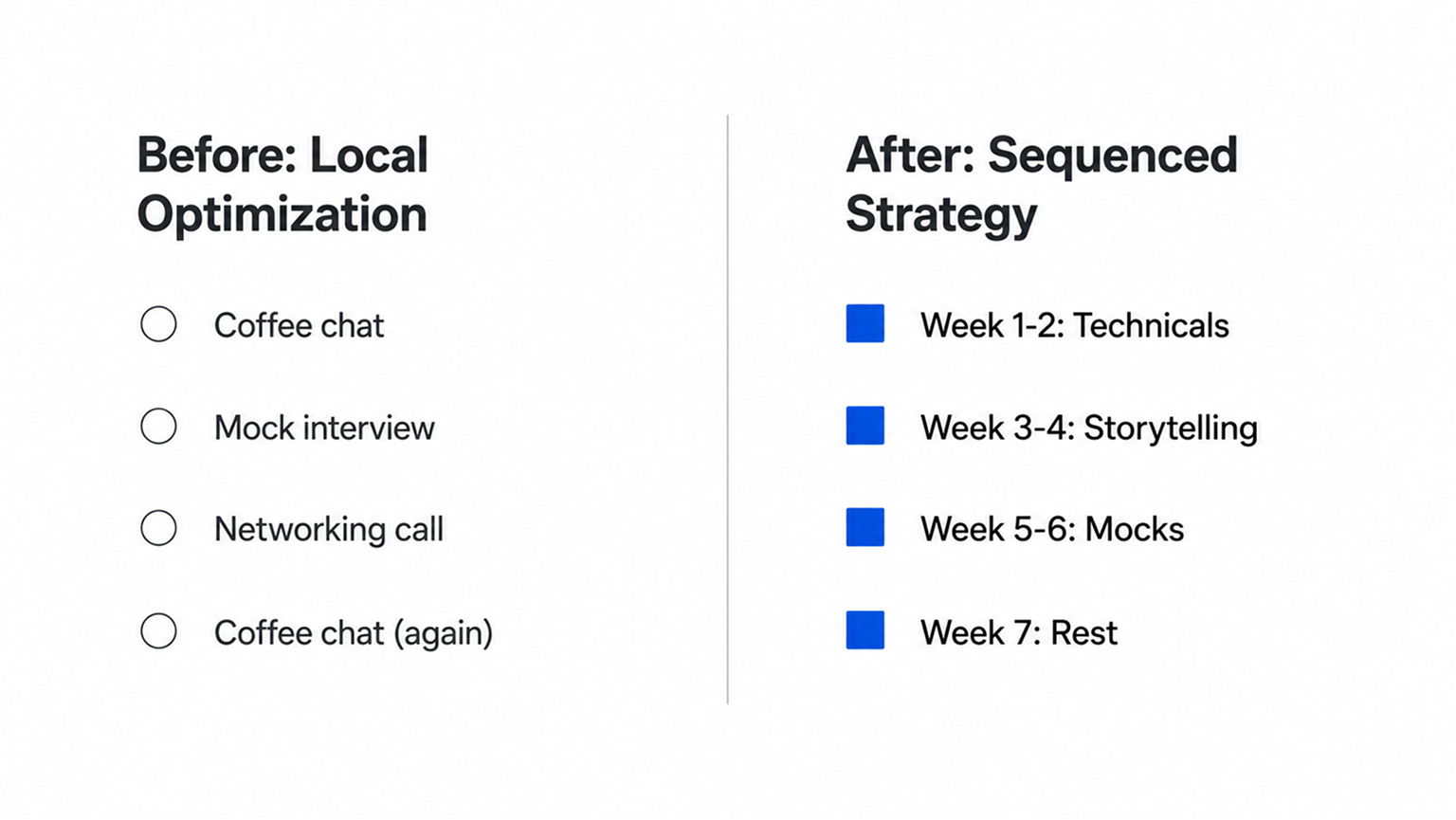
The most useful thing about working with an investment banking career coach was not any single piece of advice. It was that I stopped optimizing locally. Before, every networking call, every mock interview, every coffee chat was a one-off event I tried to nail. After, each one slotted into a larger sequence that had a shape. The shape told me which weeks were for technical drilling, which were for storytelling iteration, and which were for rest, which turned out to matter more than I'd expected.
The One Strategy Group career coaching framework also forced me to think about my Goldman target the way the bank actually thinks about candidates. Not as a question of whether I was good enough, but as a question of whether I was legible enough. Could the MD across the table reconstruct, in ninety seconds, why I was sitting there and what kind of analyst I'd be? That reframe alone changed how I prepared for every round after.

Recruiting Through a 13-Hour Time Difference
The hardest stretch wasn't the prep. It was a week in late fall when I'd flown home after an early Evercore program and a tragedy at my university community happened the day I landed. A close friend was gone. I was thirteen hours offset from every interviewer on my calendar.
I gave myself a week of pause on everything that wasn't already scheduled. The interviews already on the calendar I took at one, two, three in the morning local time, ran through them, hung up, and went back to whatever I was trying to do with the rest of the night. I don't recommend it as a strategy. I'm describing it because it happened, and because it taught me something I hadn't understood about my own composure under load.
The same flatness that had been a defensive habit growing up turned out to be a workable interview muscle. Not denial, not suppression. Just the ability to hold the work and the feeling in separate rooms long enough to get through ninety minutes on a call, and then to let the feeling back in afterward.
Choosing Goldman Sachs
The Goldman offer came through on a Wednesday. I was in the middle of an unrelated startup meeting and saw the New York number flash on my phone.
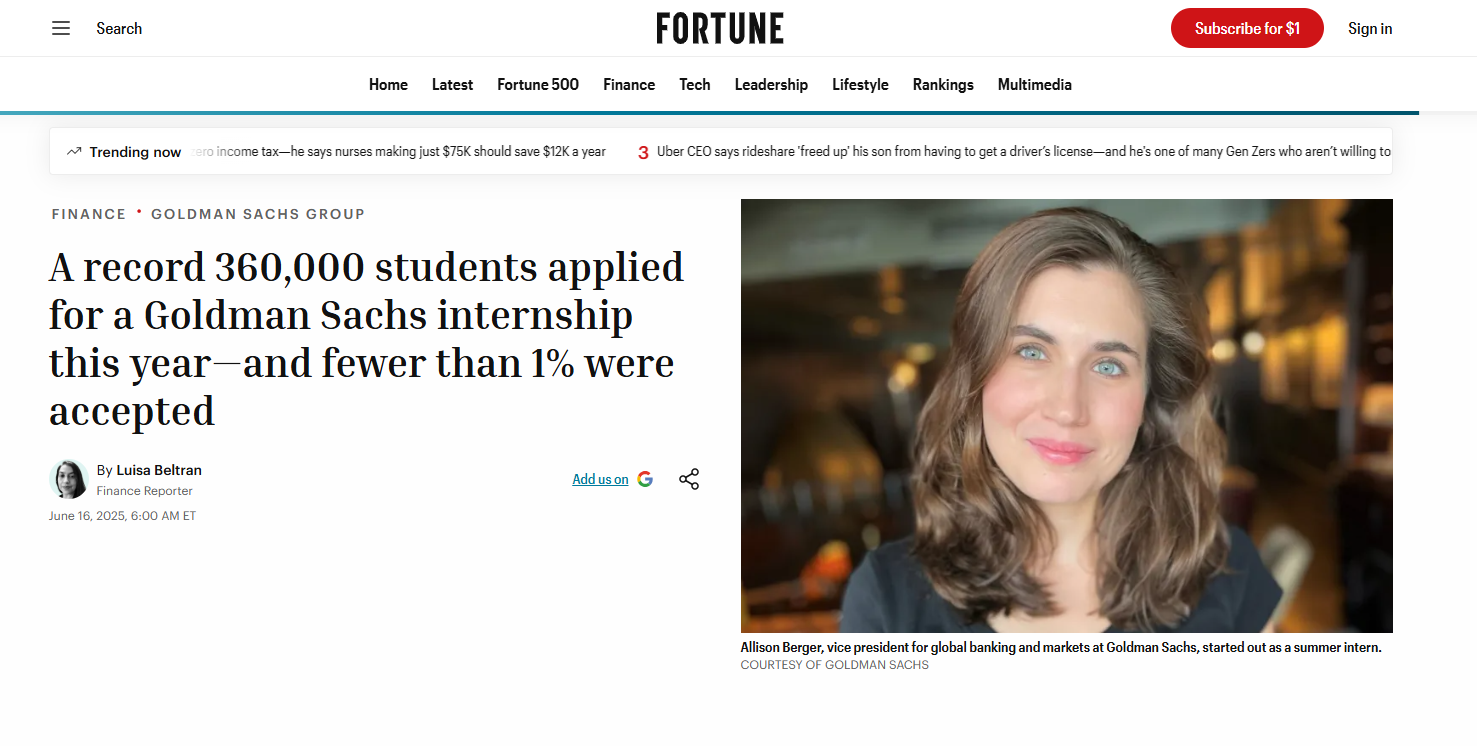
For Goldman's 2025 summer analyst class, the bank received more than 360,000 applicants for roughly 2,500 to 3,000 spots, an acceptance rate of about 0.7%, according to reporting from Fortune. Those numbers are the wallpaper. What actually matters about Goldman, once you're inside the funnel, is whether the platform fits what you want to do next.
For me, the answer came down to the technology coverage focus inside Goldman Sachs TMT. I'd spent two years pulling toward technology, reading product launches the way other people read sports scores, flying out to San Francisco because I wanted to see the companies before I read about them.
2025 was a record year for global M&A, with Goldman ranked as the top financial advisor by deal value according to LSEG. Inside that activity, technology has been the dominant sector. Sitting inside Goldman TMT puts me as close to the deal flow shaping the next decade of the industry as a junior analyst can reasonably get.

The other piece, which I'd be lying if I didn't mention, was fit. I'd done a sophomore-summer internship in a team where I was one of very few people from my background, and I'd burned a lot of energy proving I belonged there before I could do any actual work. The conversations during the Goldman process felt different. Less performance, more substance. That's not a marketing line. It's what made me sign.
What I'd Tell Someone Starting Recruiting Now
Three things, in the order I learned them.
1. Start with the structure before the volume. Ten clubs and four cities of networking did less for me than three weeks of disciplined technical prep with someone who could see where my logic broke. If you're choosing between another coffee chat and another hour with your accounting fundamentals at the start, choose the accounting. There are also resources for international students navigating US recruiting that are worth knowing exist before you need them.
2. Be legible, not impressive. Most interview answers fail because the listener can't reconstruct the point fast enough, not because the point was bad. Result first, then situation, then action, then result again. Boring works.
3. Take the offer that fits the next two years of work, not the next two weeks of conversation. The prestige of a name fades the first time you sit at a desk and don't want to be there. The team, the deal flow, and the kind of work you'll actually do on Monday morning are what compound.
I started recruiting wanting to prove something. I finished it understanding what I actually wanted to build. Those are very different things, and One Strategy Group career coaching career coaching is most of what closed the distance between them.
Disclaimer: One Strategy Group has no partnership or affiliation with any of the companies mentioned in this article. All One Strategy Group students develop their skills through One Strategy Group services and secure their offers through official campus or lateral recruiting channels.
Free Career Planning Session
Book a free 1-on-1 session with an OSG mentor and map out your path to top firms!
Book Your Free Session →Ready to Write Your Own Success Story?
Book a free 1-on-1 session with an OSG mentor and map out your path to top firms!
Book Your Free Session →Explore More Resources



Frequently Asked Questions
Yes, and increasingly that's the only realistic window. Bulge bracket banks now open summer analyst applications as early as January of sophomore year, so by junior fall the cycle is largely closed. Starting structured prep by sophomore winter is the practical floor for competitive candidates.
Build your technical foundation before drilling questions, then rebuild every behavioral story with a single core theme, decision, and result. The goal isn't to sound impressive in ninety seconds. It's to be legible enough that the interviewer can reconstruct your point on the first pass.
One Strategy Group mentorship pairs students with senior bankers who structure the technical curriculum, rebuild behavioral storytelling, and sequence the recruiting calendar. It's most useful for sophomores who have networking volume but lack a coherent framework connecting prep, interviews, and offer decisions.



.jpg)