



Student Cases

Investment Banking (Finance)
Investment Banking (Finance)
How Two Target School Candidates Cracked Elite Boutique Investment Banking
In recruiting, some players are dealt rockets. Others get a 2-7 offsuit. But that's just the start of the game. What really separates people is how they play the hand they're given.
Published on
May 20, 2026
7
min read
If you're an undergrad chasing a Summer Analyst seat in investment banking, you already know the hardest part isn't the technicals. It's the information gap. If you're earlier in the process and still figuring out how to actually break into investment banking, the playbook side is one thing. Knowing which boutique banks recruit early. Knowing how a TMT group differs from a generalist coverage team. Knowing what a VP actually wants to hear when they ask "walk me through your resume."
Mason and I picked most of that up by getting it wrong first. We went to the same high school overseas but barely knew each other back then. Last Thanksgiving, at a small reunion on the West Coast, we ended up sitting next to each other. Mason glanced at my phone, saw a pinned group chat labeled OSG, and said "wait, I'm in OSG too."

That was the moment we stopped being acquaintances and started swapping rejection stories. A few months later, we both signed Summer Analyst offers at Tier 1 boutique investment banks.
This is how that happened.
Same High School, Different Paths Into Finance
Mason — The NYU Stern Student Who Always Knew
Mason was the kind of student who knew he wanted to be in finance before most of us knew what an income statement was. He started trading stocks at sixteen. He spent his last two years before college running investment club projects and competing in case competitions. NYU Stern wasn't a fallback. It was the plan from the start.
What pulled him toward tech-focused investment banking specifically was a pattern he kept noticing. Every interesting story in the market had a tech company at the center of it. A software business, a chip designer, an AI lab. He was particularly drawn to software M&A. The deal logic, the multiples, the fact that every other transaction in 2024 and 2025 seemed to involve an AI angle. He decided early that TMT investment banking was the seat he wanted.
Oliver — The Northwestern Student Who Found Finance Through Curiosity
My path was less linear. I joined a business club at Northwestern during my freshman year and started picking up finance from the people around me. The more I talked to upperclassmen who'd done banking summers, the more I saw a real fit. Analytical work, fast feedback loops, a clear ladder. So I started preparing for recruiting, mostly without a real plan, and eventually found One Strategy Group through a recommendation.
I wasn't certain investment banking was the only option. I just knew I wanted to see if I could compete for it.
Where Investment Banking Recruiting Actually Breaks You
Mason's Information Gap
Mason came in with more financial knowledge than most sophomores. That turned out to mean almost nothing for recruiting.
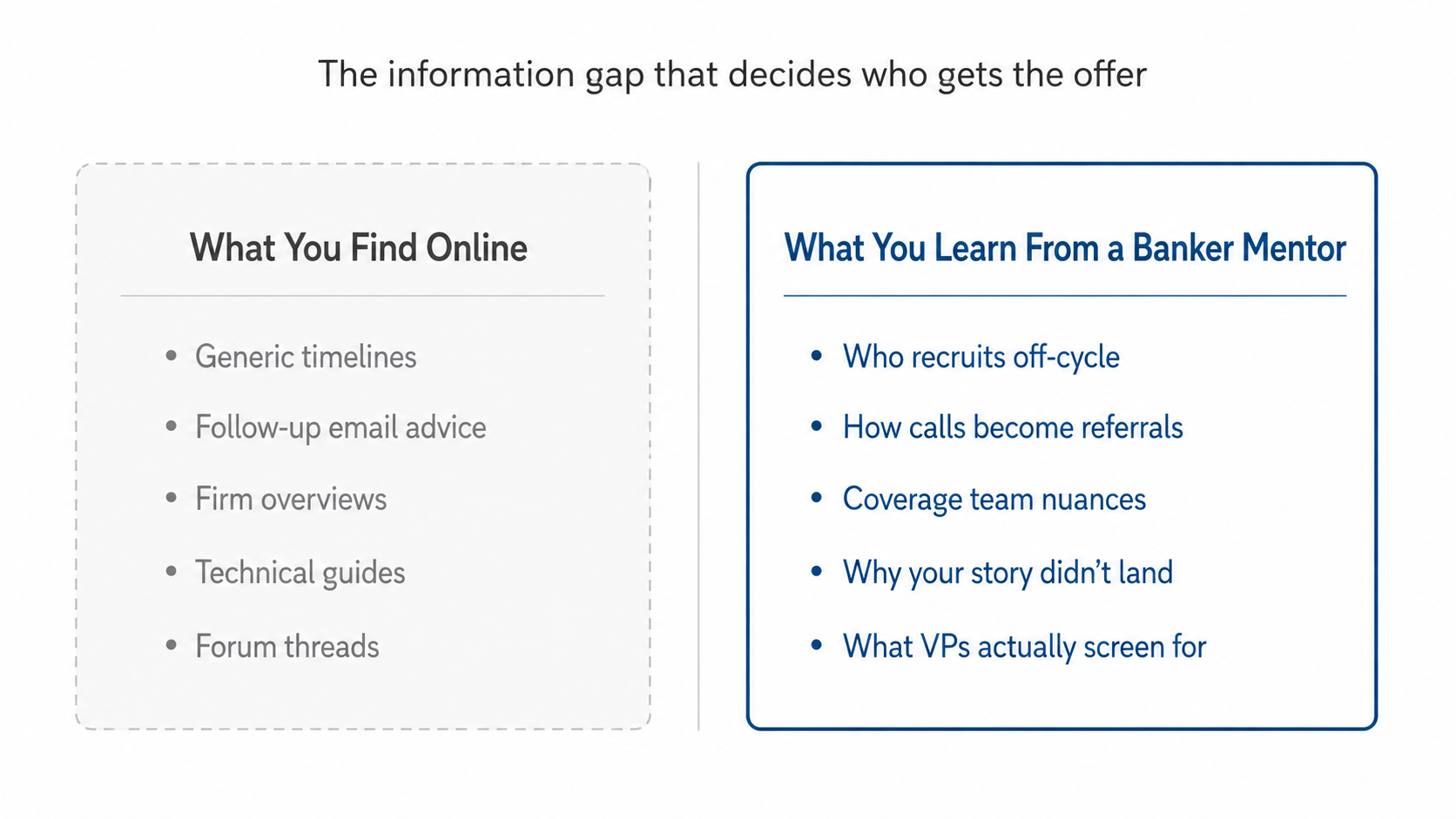
"I knew accounting. I knew valuation at textbook level," he said. "I had no idea how to tell the difference between covering a SaaS company, a semiconductor company, and a consumer internet company in an actual pitch context." When he started Googling, the answers were either too generic or buried behind paywalls.
He also didn't know the Summer Analyst recruiting timeline. He didn't know which boutiques opened apps in July, which ones did off-cycle, or how networking calls were supposed to feel different from coffee chats. Most of the networking advice you find online for investment banking stops at "send a follow-up email." It doesn't tell you what to say in the call itself, or how to turn a 20-minute chat into a referral. None of that lives in a textbook. It lives in the heads of people who've already gone through it.
That gap is the one One Strategy Group mentorship was useful for. His assigned mentor, a VP at a boutique IB tech group, didn't hand him scripts. He walked Mason through how a real banker would frame the TMT landscape and what each interviewer was actually trying to test.
My First Real Rejection
I came into recruiting with no real history of failure. School had been smooth. Internships had been smooth. So the first few investment banking interview rejections didn't register as my problem. I told myself the interviewer was off. The market was tough. The case was unfair.
The first time I did a real debrief with my RA at One Strategy Group, she walked through what I'd actually said in the interview and told me, pretty directly, where I'd lost the room. It was not fun to hear. It was also the first time I understood that I'd been losing rounds for reasons I could control.
The scariest part of investment banking interviews is that most rejections come with no feedback. You walk out, you wait, and then you get a no. You never learn what to fix. The only way through that is to simulate enough interviews with someone who'll tell you the truth. There's solid evidence that mock interview practice sharpens both case-solving and behavioral delivery, and the same logic applies on the banking side.

3 AM Mocks and Honest Feedback Inside the Mentorship
A lot of Mason's progress happened at three in the morning.
His mentor Jackson, a TMT VP at a boutique IB, ran weekly mock interviews with him on a fixed schedule. Time zones meant some sessions started at 2 or 3 AM Mason's time. They drilled through LBO modeling step by step, the kind of technical prep that's hard to do alone because you can build a model that looks right and still get every assumption wrong. Jackson would catch the wrong sources and uses, the missing debt schedule, the sloppy returns waterfall. Then they'd do it again the next week.
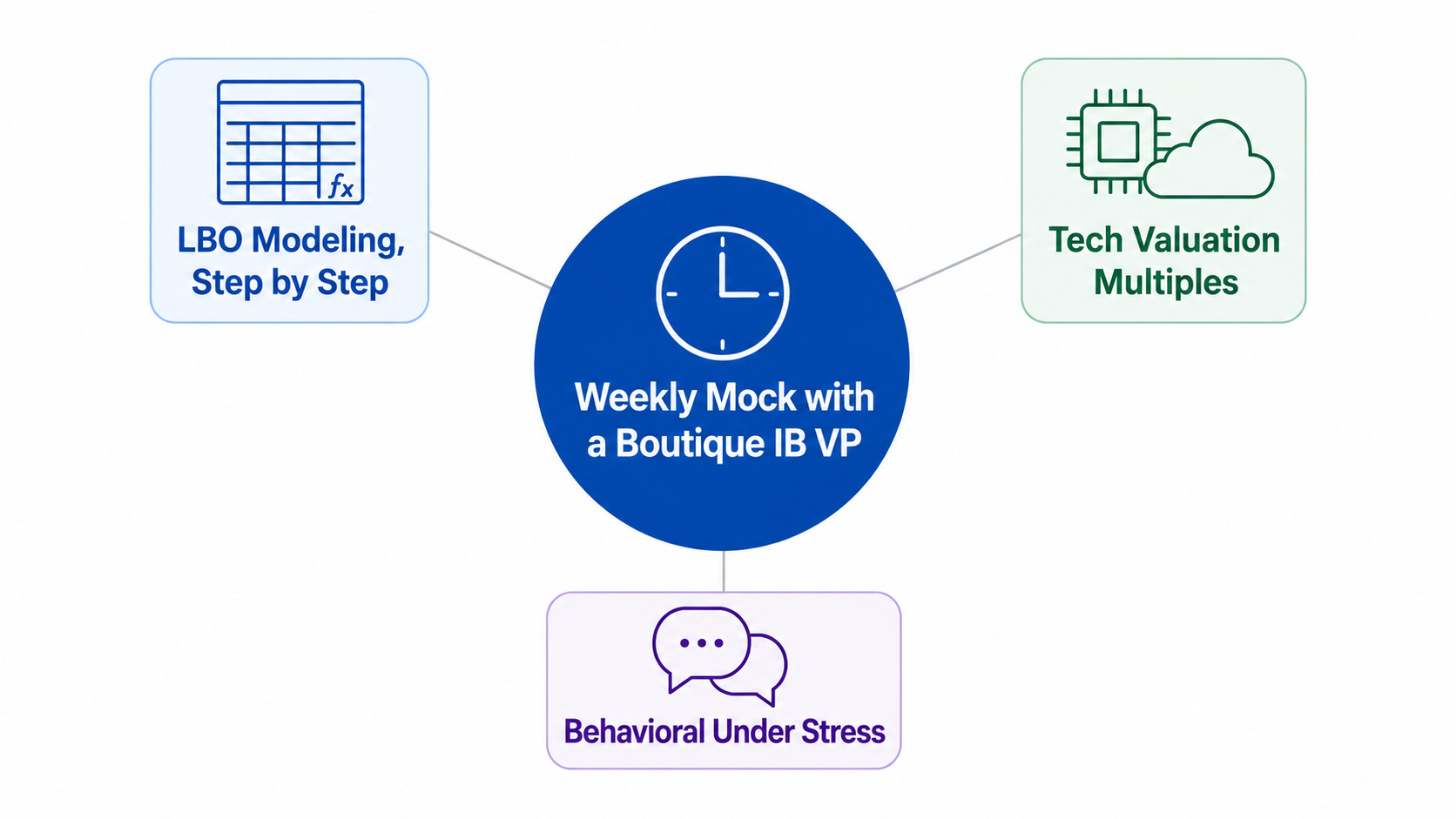
The behavioral side got the same treatment. Mason's "tell me about yourself" stopped sounding like a script and started sounding like a conversation. The first few sessions were rough. By the tenth, he could feel the difference.
My experience was less dramatic but worked the same way. Every wrong answer got dissected. Every weak networking email got rewritten. The point of One Strategy Group career coaching wasn't to hand me a winning template. It was to make sure I understood why something worked, so the next interview wasn't a coin flip.The role of a professional investment banking career coach isn't to give you answers. It's to make sure you stop giving the same wrong ones.
Top boutique investment banks now receive thousands of applications for each Summer Analyst class. In that environment, the gap between getting an offer and getting cut is usually not technical skill. It's how prepared you are for the part of the process nobody teaches in class.
Offer Day, and What Came After
Oliver's Quiet Relief
I don't remember feeling excited when I got my offer call. I remember feeling done.
There was a moment a few weeks before that, standing outside an office for a final round, when I thought about turning around and going home. Not quitting in any dramatic way. Just walking off and pretending I'd never started recruiting. I didn't. But I came closer than I told anyone at the time.
When the offer call finally came, on a normal weekday afternoon, the main feeling was relief. The kind of relief that comes from being able to put something heavy down.

Mason's Pool-Side Final Round
Mason had four superdays stack on top of each other in the same week.
The Saturday before, he gave up trying to prep more. He went to a pool, got in the water, and stayed there for an hour. Not relaxed. Just out of capacity. He got out, dried off, and went to interview.
He got the offer in the elevator on the way down.
What Investment Banking Recruiting Actually Teaches You
By the end, neither of us thought recruiting was about being the smartest person in the room. It was about being the most coachable.
Mason calls recruiting the most useful course he took in college, and he didn't mean that as a brag. He meant that the work of getting an offer, the volume of rejection, the constant calibration, the public failure, taught him a working style he didn't have before. Getting an offer didn't feel like winning. It felt like signing up for harder work.
If anyone asked me for early career finance advice right now, I'd say this: a Wall Street career doesn't really start on day one of the analyst program. It starts in the months you spend learning how to fail in front of a mentor without falling apart. The technical skills compound from there. The hiring landscape itself has also shifted — anyone tracking 2026 finance careers trends can see that early prep matters more than it did even three years ago.
Going Through It With Someone Else
The thing I'd tell anyone starting investment banking recruiting is don't do it alone.
Mason and I weren't competing. We were applying to overlapping firms, sometimes the same groups, and we still shared every networking contact, every interview question we remembered, every mistake we made. When one of us got an offer, the other one's first reaction wasn't envy. It was relief that the system worked.
That's the part of One Strategy Group that's hard to describe from the outside. The mentor calls and the mocks matter. So does the room of other students going through the same thing at the same time. You don't have to manufacture motivation when you're surrounded by people who are also up at midnight rewriting their stories. The community angle matters even more for someone navigating US recruiting, where the information gap on top of the cultural gap can double the difficulty.
Conclusion
From two strangers at a Thanksgiving dinner to two Summer Analysts heading to Wall Street, the throughline isn't talent or pedigree. It's the willingness to keep refining the same hand over and over until it plays.
If you're early in the process and feeling lost, that's the normal starting point. The work is figuring out who'll tell you the truth about what you're doing wrong. For a broader view of how that process actually unfolds across different industries, this overview of navigating your career journey with One Strategy Group covers the framework Mason and I used.
Free Career Planning Session
Book a free 1-on-1 session with an OSG mentor and map out your path to top firms!
Book Your Free Session →Ready to Write Your Own Success Story?
Book a free 1-on-1 session with an OSG mentor and map out your path to top firms!
Book Your Free Session →Explore More Resources



Frequently Asked Questions
Boutique investment banks have moved earlier each year. Many now open Summer Analyst applications in the spring of sophomore year, with some bulge brackets and elite boutiques starting even earlier. Off-cycle and accelerated programs run almost year-round at smaller shops.
For most boutique IB technical prep, you should expect at least one LBO question, often a paper LBO done verbally. Stronger candidates can walk through sources and uses, capital structure assumptions, and exit multiples without notes.
The ones that work are the boring ones. Send the email. Show up to the call having read three things about the banker's deals. Ask one specific question you couldn't have Googled. Follow up after, with a clear ask. Volume matters, but the quality of the first message decides whether a banker reads the second.



.jpg)