



Student Cases

Buy-side (Finance)
Buy-side (Finance)
Oxford CS to a Tier-One Hedge Fund: What the Final Round Actually Tests
Technical skill sets the floor. Recruiting strategy sets the ceiling. I'd been optimizing the wrong one for two years.
Published on
May 28, 2026
6
min read
I came into recruiting with a clean technical resume and a quiet confidence that turned out to be the problem. Goldman Sachs received 315,126 applications for 2,600 intern spots in 2024, a 0.9% acceptance rate, according to figures Goldman posted that the firm called its "most competitive class in history." Hedge funds at the top of the buy-side recruit out of an even smaller pool. I knew the numbers. I assumed my code would do the work.
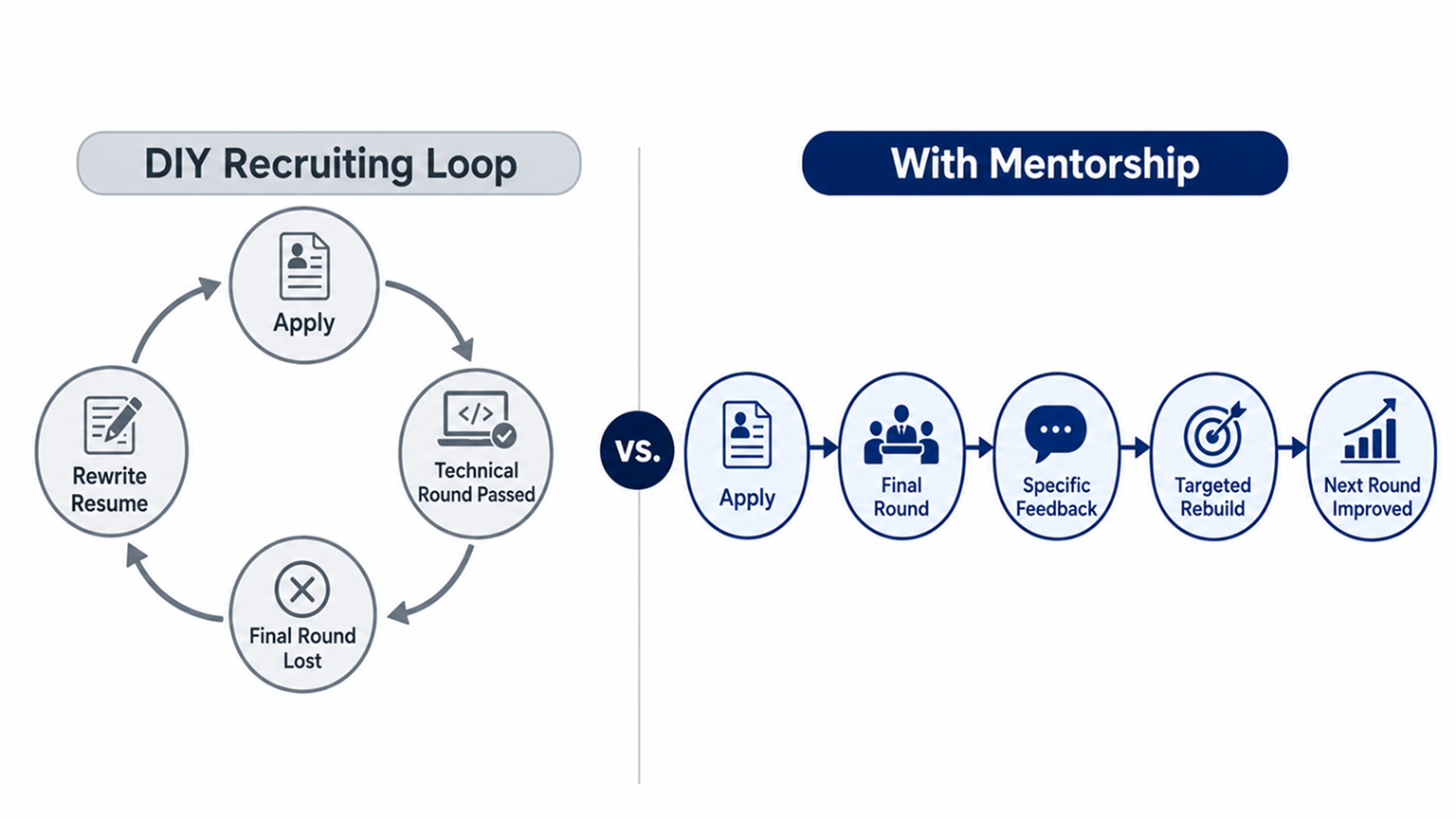
It didn't. I passed every technical round at Jefferies and McKinsey, then lost both at the final stage. Jane Street rejected me at the onsite. By the time I sat down with the Man Group team a year later, I'd reworked nearly everything about how I interviewed, and most of that rework happened with One Strategy Group mentorship. This is what I'd tell a technical student trying to break into hedge fund recruiting, written from the other side of the offer call.
Before college I'd already started writing code for fun, and I picked Oxford Computer Science without thinking too hard about what came after. My early plan was simple. Sample a non-tech IT role in year one. Do a serious software engineering internship in year two. Push into something less obvious in year three. I assumed technical fluency was the constraint that mattered. It wasn't.
Why DIY Stopped Working at the Final Round
The Pattern I Couldn't See on My Own
My first two interview cycles followed the same arc. Recruiters liked the resume. The technical screens went well. I could talk through data structures and walk an interviewer through my projects without flinching. Then I'd hit the final round and lose.
The hard part was that nobody told me why. Firms send the same polite rejection regardless of what actually went wrong, which left me running my own post-mortems on incomplete data. This is consistent with the broader 2026 careers in finance landscape, where opacity at the final stage is structural rather than personal. Was it the way I framed a project? The way I answered "tell me about a time you disagreed with your team"? Some signal I wasn't picking up on? I rewrote my resume four times in a semester based on guesses.
When the Jane Street Rejection Forced a Decision
Jane Street was the one I'd been pointing at for two years. When that rejection landed, the pattern stopped feeling like bad luck. I was good at the parts of interviewing that have a right answer, and bad at the parts that don't. No amount of LeetCode was going to fix that, because LeetCode wasn't what was breaking.
That was the week I stopped trying to debug the process alone.
What Changed After I Joined One Strategy Group
I'd heard about OSG in my first year. A few friends had worked with them and done well. I told myself I'd figure it out on my own, and then I spent two years finding out I couldn't. When I finally signed up, I got matched with Shane, a senior mentor who'd spent years in tech and finance recruiting on the other side of the table. If you've wondered what an investment banking career coach actually does, the work Shane did with me is a fair picture of it, applied to the buy-side.
Shane read me quickly. As a textbook ENTJ, I solved problems by stripping them to logic and moving fast, which works in a coding interview and fails in a behavioral one. "You're strong," he said. "But you have to make the interviewer see it." That sentence did more work than any feedback I'd had from a firm.
Resume as Advertising, Not Autobiography
The first thing we tore down was my resume. I'd been treating it as a complete account of everything I'd done, terrified of leaving anything out. Shane's framing under One Strategy Group career coaching was the opposite. A resume is an advertisement aimed at one reader for ninety seconds. Anything that doesn't earn its line should go.
We cut roughly a third of what was on the page. What stayed got rewritten from an interviewer's point of view, with the strongest lines moved to where eyes actually land. One page, denser but easier to read.
Rebuilding Behavioral Answers with STAR + Reflection
The harder problem was the behavioral round. It overlaps with the 4 Ps framework for interview preparation in that the work is less about answers and more about how you show up.
Shane didn't hand me a script. He had me write out my stories, then made me rebuild each one with STAR, with one extra step inserted between the Situation and the Result: reflection. Not just what I did, but what I learned about how I work. Then he had me record self-introductions until I stopped sounding like I was reciting them.
Two things changed in those sessions. I learned to leave room for the interviewer to ask follow-ups instead of front-loading every detail. And I stopped trying to give the "right" answer and started giving a real one. By the time One Strategy Group mock rounds were behind me, the questions that used to freeze me had become the easiest part of the interview.

Inside the Man Group Final Round
Man Group ended 2025 with $227.6 billion in assets under management, a record high for the world's largest publicly listed hedge fund firm, according to Hedgeweek's February 2026 reporting on the firm's earnings. I knew the numbers walking in. I also knew, for the first time, that I was ready. For background on how recruiting works across investment banking and the buy-side, the structural differences are worth understanding before you decide where to spend your prep cycles.

The Hallway Conversation That Wasn't on the Prep List
The interview itself went smoothly. The behavioral questions I'd prepared for came up in shapes I recognized, and I had answers that felt like mine instead of memorized.
The moment that stuck with me wasn't in the interview room. The conference room floor had a small motion-tracking installation by the door that projected shadows of people walking past. On the way out, the interviewer and I started talking about how it worked. Five minutes of two technical people being curious about the same thing. The interview pressure dropped to zero. I think that conversation mattered more than half the prepared answers.
The Train Ride Home, and the Call That Came First
I caught the train back to Oxford and made it to my room. Before I'd even sat down properly, my phone rang. Man Group. The offer.
A week later, a second Tier 1 hedge fund came back with an offer too. That one had been a different kind of process, much more technically dense, with the kind of questions that made me genuinely uncertain in the moment. Two offers, two different signals about what I was capable of.
Choosing Between Two Tier-One Hedge Fund Offers
I told my parents first. They've never worked in finance and didn't fully understand what either firm did, but they've always trusted me to make the call. That kind of clean, unconditional backing is underrated.
I told a few friends next, most of whom were still in the middle of their own cycles. Being the first in the group with news meant my call notes became other people's prep notes, which felt like the right way to close out a year of recruiting.
I won't get into which firm I picked or the deliberation, partly because it's still recent and partly because the choice was less interesting than the fact that I had one to make. Two years earlier I'd been losing every final round. The distance between those two points is what I wanted to write about.
What I'd Tell a Technical Student Recruiting for Buy-Side
Refuse to spiral. A rejection is information, not a verdict. The case for reflecting on rejection as preparation data sounds soft until it's the only thing keeping you on the calendar. In one stretch I interviewed at seven firms across seventeen rounds, and the only thing that kept me functional was the next interview already being on the calendar. Action is the only reliable cure for the anxiety that recruiting generates.
Technical skill is the floor. It gets you the first interview and it keeps the technical rounds clean. The ceiling, though, is set by how clearly you communicate who you are and why you'd be good to work with. That part is learnable. I didn't learn it on my own, and looking back, I don't think I could have.
From the Oxford library to a hedge fund seat, I'm still the same person who got curious about code at fifteen. Every rejection and every late-night mock pushed me toward something I wanted more than I knew. One Strategy Group didn't write the answers. It taught me how to find mine.
Disclaimer: One Strategy Group is not affiliated with, endorsed by, or sponsored by Man Group, Jane Street, Jefferies, McKinsey, Goldman Sachs, or the University of Oxford. All company names and logos are the property of their respective owners and are referenced solely for editorial context. Individual recruiting outcomes vary based on candidate background, market conditions, and effort, and no specific result is guaranteed.
Free Career Planning Session
Book a free 1-on-1 session with an OSG mentor and map out your path to top firms!
Book Your Free Session →Ready to Write Your Own Success Story?
Book a free 1-on-1 session with an OSG mentor and map out your path to top firms!
Book Your Free Session →Explore More Resources



Frequently Asked Questions
Yes, though the technical resume only opens the first door. Final-round hedge fund interviews lean heavily on behavioral fit and communication, not just coding ability. Most rejections at the final stage come from how the story is told, not whether the candidate can build a model.
Rebuild each story with the STAR method, then add a reflection step between Situation and Result. Record self-introductions until they stop sounding scripted. Leave room for the interviewer to ask follow-ups instead of front-loading every detail of what you did and why it mattered.
One Strategy Group matches students with senior mentors who have worked on the hiring side of finance and tech. The work covers resume rebuilds, behavioral mock rounds, and feedback loops that firms do not provide after rejections. It tends to help technical students whose final rounds keep breaking on non-technical signals.



.jpg)