What Top Quant Firms Look For 2027 Quant Interview Prep Guide
Michael Hsueh has 8+ years of experience in quantitative finance and has helped students prepare for roles in quant trading, research, and development. His experience spans technical training, interview preparation, and project development, giving him firsthand insight into the skills top quant firms look for in candidates.
Published on
November 16, 2026
5
min read

Learn what top quant firms look for in candidates, how interviews test reasoning and decision making, and how to prepare for trading, research, and developer roles.
This guide explains what top quant firms look for in candidates beyond strong math and coding skills. It covers how quant interviews test technical depth, problem solving, adaptability, communication, and decision making under pressure. It also explains why strong students can still struggle in interviews, how to test whether you are actually interview ready, and how structured quant interview prep can help identify and improve specific weaknesses.
Below, One Strategy Group (OSG) breaks down how top quant firms evaluate candidates, why knowing the technical material is only part of the interview process, and how students can prepare through technical training, mock interviews, trading simulations, project work, and targeted feedback.
Note: Quant recruiting processes vary by firm, role, team, and recruiting cycle. Strong math, coding, or academic performance does not guarantee an interview or offer. Students should always check each firm's current job descriptions and official recruiting information when preparing.
What Do Top Quant Firms Actually Look for?
Top quant firms look for candidates who can combine strong technical ability with problem solving, communication, and decision making.
Getting into a top quantitative trading firm is highly competitive. Firms such as Jane Street, Citadel Securities, Optiver, IMC, and Hudson River Trading attract students with strong backgrounds in mathematics, computer science, statistics, physics, and engineering.
However, having a high GPA or being good at math does not automatically make someone a strong quant candidate.
Quant firms look beyond technical knowledge alone. Candidates may be evaluated on probability and statistics, programming, research ability, problem solving, and how well they can explain their thinking under pressure. Firms want to see whether candidates can take what they have learned and apply it when faced with an unfamiliar problem or new information.
A candidate who memorizes hundreds of probability questions may perform well when they recognize the problem. The real test often comes when an interviewer changes an assumption, asks why the candidate chose a particular approach, or introduces information that requires them to reconsider their answer.
This is also why useful quant interview prep resources should go beyond large banks of probability questions. Candidates need opportunities to explain their assumptions, respond to follow up questions, and adjust their reasoning when the problem changes.
At OSG, students practice these skills through diagnostic mock interviews with mentors who help identify areas for improvement and provide targeted feedback on their reasoning, communication, and interview performance. Students can then strengthen these skills through quantitative projects and simulated trading exercises.

What Skills Do Top Quant Firms Look for?
The most important quant skills generally include mathematical reasoning, programming, research ability, decision making, and communication, but the importance of each skill depends on the role.
There is no single profile that every quant firm is looking for. A student targeting quant trading may prepare differently from someone targeting quant research or quant development.
Understanding these differences can help students spend more time developing the skills that are actually relevant to their target role.

Math and Probability
Strong mathematical reasoning is one of the foundations of quant recruiting, but firms are not simply looking for students who can memorize formulas.
Probability questions can test whether a candidate understands expected value, conditional probability, distributions, statistics, and uncertainty. More importantly, they can show how the candidate approaches a problem when the answer is not immediately obvious.
Consider a simple quant interview probability question:
Quant Interview Question 1: Coin Toss Probability
You flip a fair coin three times. What is the probability of getting exactly two heads?
There are eight equally likely outcomes from three coin flips. Three of those outcomes contain exactly two heads: HHT, HTH, and THH.
Therefore:
P(exactly two heads) = 3/8 = 37.5%
Getting the original answer correct demonstrates an understanding of the basic probability. But an interviewer can then change one condition:
Follow up: What if the coin is biased and has a 60% probability of landing heads?
The candidate can no longer use 3/8 because the eight outcomes are no longer equally likely. Each sequence containing exactly two heads has a probability of:
(0.6)² × (0.4) = 0.144
Since there are three possible sequences containing exactly two heads:
P(exactly two heads) = 3 × 0.144 = 0.432, or 43.2%
The mathematics is still relatively simple. The important part is recognizing that one changed assumption makes the original method inappropriate and then adjusting the reasoning accordingly.
A second quant interview question can test the same skill through expected value:
Quant Interview Question 2: Expected Value
A game pays you $10 if a fair coin lands heads and you lose $6 if it lands tails. What is the expected value of playing once?
Expected Value = (0.5 × $10) + (0.5 × −$6) = $2
Now suppose the interviewer changes the probability of heads from 50% to 40%.
Expected Value = (0.4 × $10) + (0.6 × −$6) = $0.40
The game still has a positive expected value, but it has become much less attractive. The interviewer could continue by changing the payout or probabilities and asking the candidate when the game would no longer be worth playing.
These follow up questions reveal more than whether a candidate knows an expected value formula. They show whether the candidate can update their reasoning as the information changes.
This is why effective quant interview prep should include variations of familiar problems rather than only repeating the same question types.
Programming Skills
Programming matters across many quant roles, but the level and type of coding expected can vary significantly by position.
Quantitative researchers may use programming to clean data, test hypotheses, build models, and evaluate strategies.
Quantitative developers may need much deeper knowledge of algorithms, data structures, systems, performance, and languages such as C++.
Quantitative traders may also use programming, although the level and type of coding can depend heavily on the firm and team.
For students, this means simply listing Python, C++, or machine learning on a resume is not enough.
An interviewer may ask:
Why did you choose this approach?
How efficiently does the code run?
What edge cases could break it?
Why did you choose this data structure?
How would you change the solution if the input changed?
Is there another way to solve the problem?
For example, a candidate might initially be asked to write a function that finds whether a list contains duplicate values. After the candidate produces a working solution, the interviewer could ask how the approach changes if the list contains millions of values or if memory usage becomes a constraint.
The first question tests whether the candidate can write functioning code. The follow up begins testing algorithms, data structures, time complexity, and whether the candidate can adapt the solution when the constraints change.
The underlying skill being tested is not simply whether you know the syntax of a programming language.
It is whether you can use programming to solve problems.
That distinction matters when choosing quant interview preparation resources. Someone learning Python for the first time needs different preparation from someone who can already code but struggles with algorithms or explaining technical decisions during an interview.
Research Ability and Projects
A strong quant project shows how a student thinks, not simply which model or programming language they used.
Suppose a student writes on their resume:
“Built a machine learning model to predict stock prices.”
At first glance, that sounds impressive.
But for a quantitative researcher, the model itself is only the beginning.
An interviewer could ask:
Why did you choose those features?
What information was available when the prediction was made?
How did you divide the training and testing data?
What benchmark did the model outperform?
Did you account for transaction costs?
How did the model perform out of sample?
Under what conditions did the strategy stop working?
These questions can quickly reveal whether the student deeply understands the project or simply knows how to describe the final result.
For example, backtesting can also reveal problems with how a strategy was designed. Suppose a company releases new financial information after the market closes. A strategy cannot realistically use that information to make a trade earlier that same day because the information was not available yet. If a backtest assumes that it could, the strategy may appear more profitable than it actually would have been in real trading.
Therefore, a sophisticated model with poor validation can be less impressive than a simpler project where the student can clearly explain the hypothesis, methodology, assumptions, limitations, and results.
Strong quant projects for students should therefore be built with the interview conversation in mind.
The goal is not just to build something.
The goal is to understand it well enough to defend it.
Decision Making Under Uncertainty
Quant trading requires candidates to make decisions even when they do not have perfect information.
This is especially important for quant trader roles. Probability games, market making exercises, and trading simulations can place candidates in situations where there is not always one obvious answer.
A candidate may need to estimate value, decide how much risk to take, react to new information, or update a previous decision as the situation changes.
A useful way to think about this process is:
Information → Assumption → Decision → New Information → Adjustment → Outcome → Review
If a candidate estimates that an asset is worth $100 and is asked to make a market around that estimate. The candidate might initially quote a bid of $99 and an ask of $101.
The interviewer could then provide new information suggesting the asset is more valuable than originally estimated. The important question is no longer whether $99 and $101 were reasonable before. The candidate now needs to decide how quickly and by how much to adjust the estimate and quotes based on the new information.
Importantly, a good decision does not always produce a good outcome.
A candidate can make a reasonable decision based on the information available and still lose. They can also make a poor decision and get lucky.
Interviewers may therefore be interested in the reasoning behind a decision, not simply the final result. Candidates should be able to explain what information they used, what assumptions they made, and why their decision made sense at that moment.
Communication Under Pressure
Strong technical skills are much more useful when a candidate can clearly explain the reasoning behind them.
Quant interviews are often interactive. An interviewer may interrupt an answer, challenge an assumption, or introduce new information while the candidate is still working through the problem.
For example, an interviewer might ask:
Why did you choose that approach?
What assumption are you making?
What happens if I change this condition?
Is there another way to solve it?
Would you still make the same decision?
A student may understand how to solve a problem on paper but still struggle to explain each step aloud while responding to follow up questions.
This is why communication is an important part of quant interview preparation. Candidates need to practice thinking aloud, defending their assumptions, and staying clear when the interviewer pushes back.
What Do Different Quant Roles Look for?
The skills firms prioritize can vary significantly between quant trading, quant research, and quant development.
A simplified comparison looks like this:
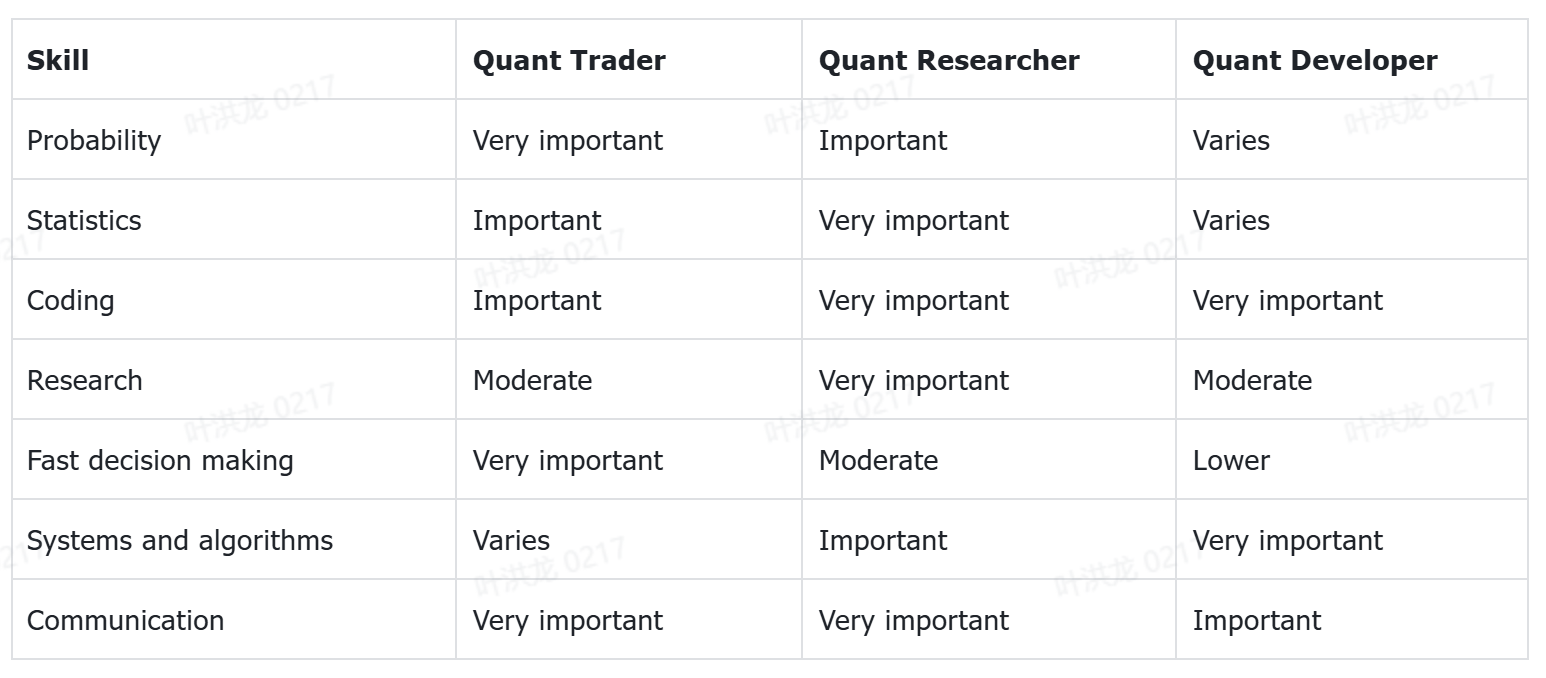
These are general differences rather than fixed rules. Expectations can vary by firm, team, and position.
The interview process can also differ significantly across firms. Students preparing for Quant Trading interviews at firms such as Jane Street, Citadel Securities, Optiver, IMC, or Hudson River Trading should not assume that every firm will emphasize the same questions or interview format.
The main takeaway is that students should prepare for the specific role they are targeting rather than treating all quant interviews the same way.

Why Do Strong Students Still Fail Quant Interviews?
Strong students can struggle in quant interviews because knowing the technical material is different from applying it to an unfamiliar problem under pressure.
A student may have excellent grades in probability, statistics, mathematics, or computer science and still find a quant interview difficult.
In school, problems usually appear within a familiar context. Students often know what subject they are being tested on, and which concepts are likely to be relevant.
Quant interviews can remove many of those clues.
A candidate may first need to determine what type of problem they are facing, choose an approach, explain their reasoning, respond to follow up questions, and change direction if an assumption no longer works.
This creates a gap between knowing the material and being able to use it during an interview.
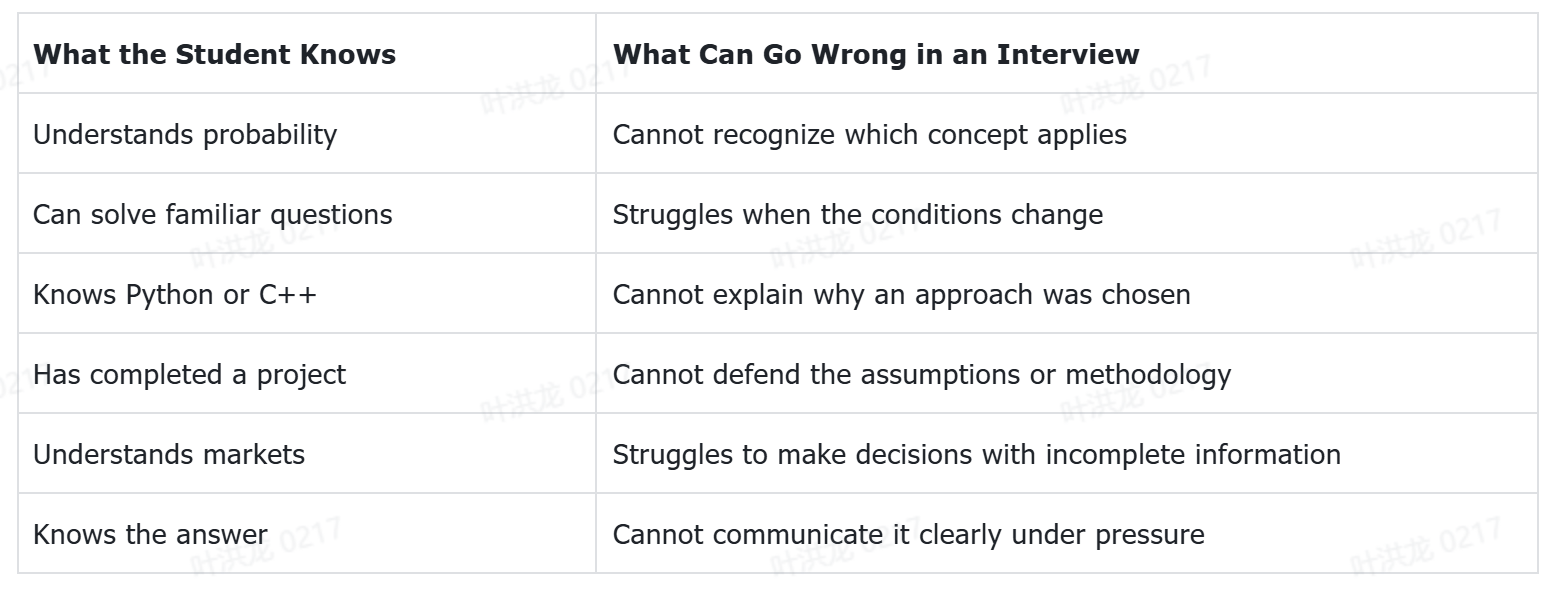
This is why simply completing more questions does not always solve the problem.
If the weakness is technical knowledge, the student may need to review the underlying concept. But if the student understands the concept and struggles when the interviewer changes the problem, they may need more practice applying that knowledge in unfamiliar situations.
The same applies to communication. A student may solve a problem correctly on paper but struggle to explain their reasoning while an interviewer asks questions.
Effective quant interview prep should therefore help candidates identify why they are struggling rather than treating every incorrect answer as the same problem.
How Do You Know If You Are Ready for a Quant Interview?
Quant interview readiness is better measured by how you handle unfamiliar problems than by how many practice questions you have completed.
Completing hundreds of probability, coding, or brainteaser questions can be useful for building technical knowledge and recognizing common problem types.
But question count alone does not show whether a student can perform when an interviewer changes the problem.
A more useful test is whether you can:
Solve a problem you have not seen before.
Explain why you chose your approach.
Identify the assumptions behind your answer.
Respond when an interviewer challenges your reasoning.
Recognize when your original approach is wrong.
Adjust your answer when new information is introduced.
Defend the methodology and limitations of your projects.
Communicate clearly while working under time pressure.
For example, imagine you have practiced 300 probability questions and can solve most of them correctly.
Instead of immediately completing another 100, take one question you already know and change an assumption. Then try to solve it again without looking at the original solution.
Next, explain your reasoning aloud.
Then ask what would happen if another condition changed.
This tests whether you understand the underlying logic rather than simply recognizing the pattern.
Candidates can use the same approach for coding and projects. Instead of only asking whether the code works, ask why the solution was designed that way, where it could fail, and what would need to change under a different set of constraints.
Instead of only describing a project result, ask whether you can explain the data, assumptions, methodology, testing process, limitations, and potential sources of error.
A useful readiness check therefore goes beyond:
“Can I get the answer right?”
It also asks:
“Can I explain why?”
“Can I defend my assumptions?”
“Can I adapt if the problem changes?”
“Can I recognize and correct a mistake?”
If the answer to those questions is consistently yes across the major skills required for your target role, you are much closer to being interview ready.
How Does OSG Prepare Students for Quant Interviews?
OSG's quant preparation system combines technical training, diagnostic mock interviews, quantitative projects, and trading simulations to help students build and apply the skills required for different quant roles.
Understanding what quant firms look for is only the first step. Students also need opportunities to apply those skills, identify weaknesses, and improve before real interviews begin.
OSG's preparation is structured around several parts of the recruiting process, from building technical foundations to practicing interviews and making decisions in simulated trading environments. Rather than treating these areas separately, the goal is to connect technical learning with application and feedback.
Eight Core Quant Training Modules
OSG's technical curriculum covers eight areas designed to build skills across quantitative trading, research, and development.
The curriculum includes probability and brainteasers, statistics, mathematics, options theory, programming, machine learning, market making games, and quant projects.
Within these modules, students can work through topics such as classical probability, Bayes' theorem, expected value and variance, Markov chains, linear algebra, calculus, PCA, Python, C++, algorithms, data structures, fair value, bid ask spreads, position sizing, and arbitrage.
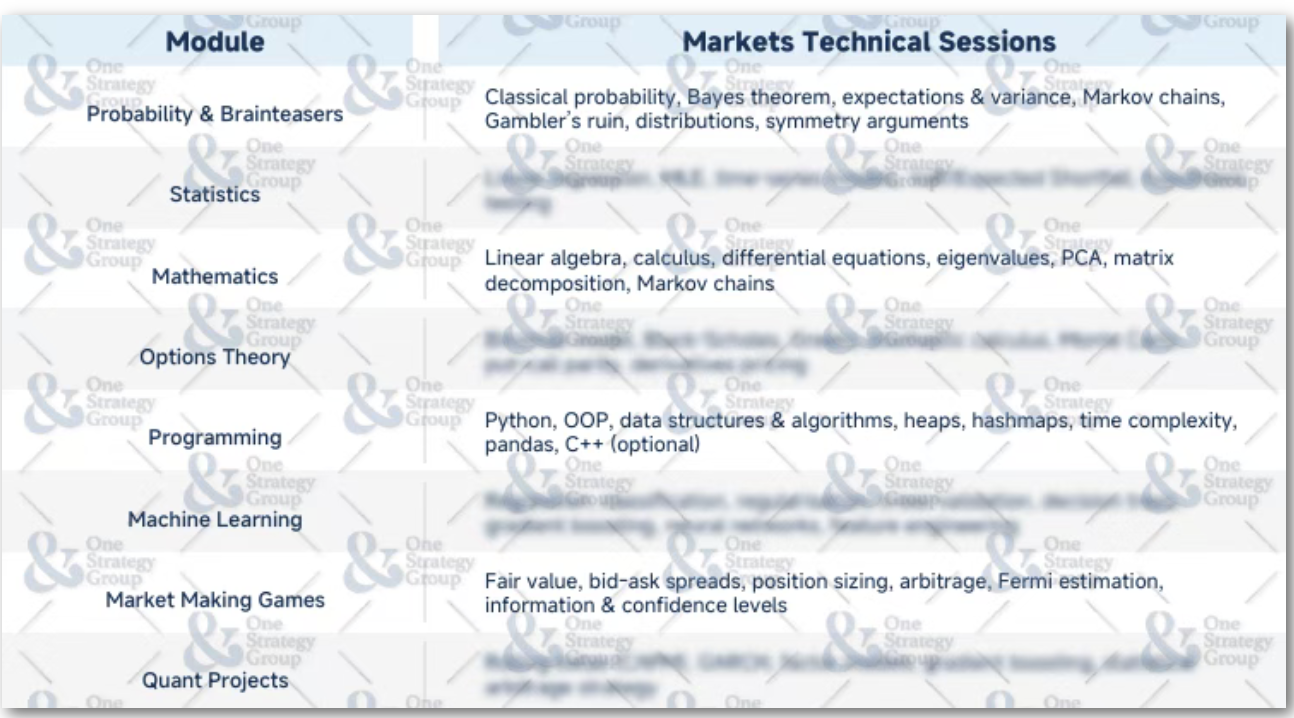
The goal is not simply to recognize a formula or memorize a solution. Students should gradually move from understanding a concept to applying it when the problem changes:
Learning the Concept → Solving the Problem → Explaining the Reasoning → Applying It When the Problem Changes
This progression is especially relevant to quant interviews because a familiar question can quickly become unfamiliar when an interviewer changes an assumption or asks the candidate to defend their reasoning.
15 Diagnostic Mock Interviews
OSG's 15 diagnostic mock interviews cover different parts of the quant interview process, from probability and brainteasers to coding, projects, and behavioral questions.
The mock interview structure begins with a comprehensive screening test and progresses into sessions covering probability at increasing levels of difficulty, brainteasers, behavioral interviews, statistics, mathematics, options theory, live coding, machine learning, quant projects, and resume based questions.
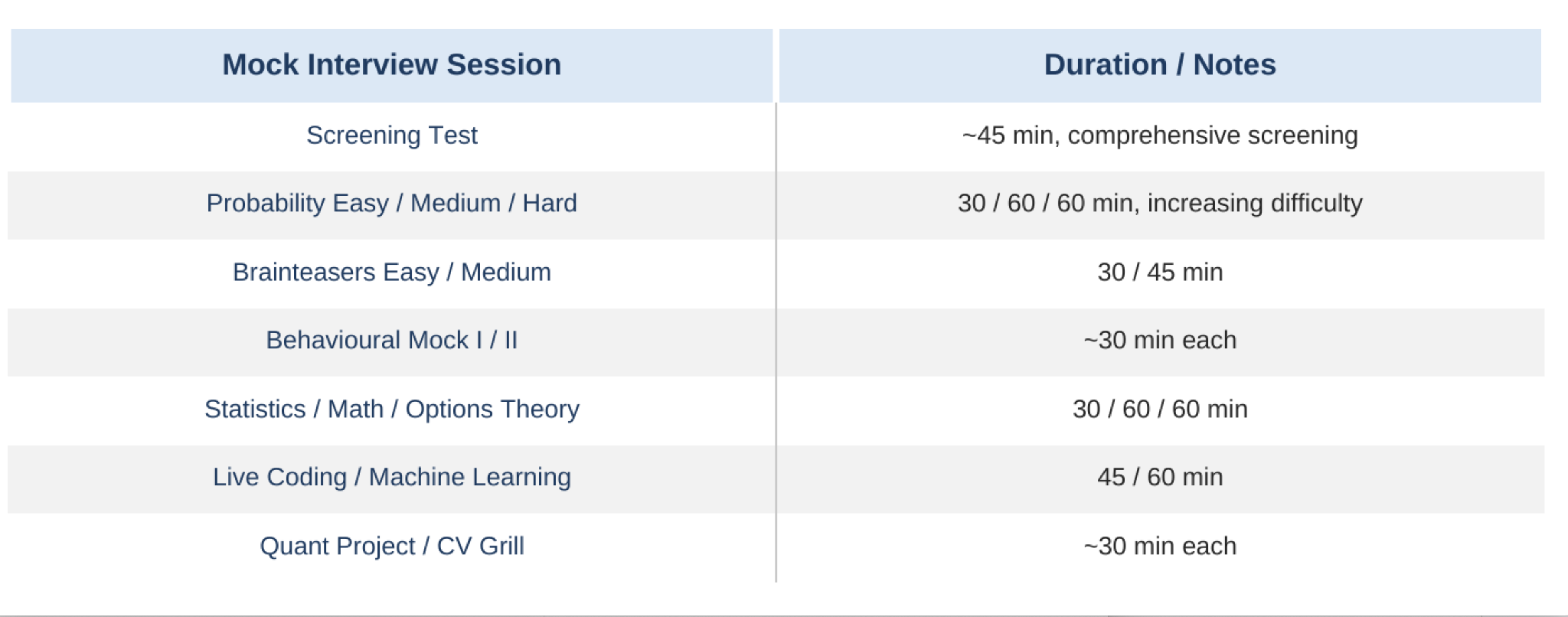
The purpose of using different interview formats is to identify where a student is struggling, rather than treating every incorrect answer the same way.
For example, consider three students who answer the same probability question incorrectly. One may not understand the underlying concept. Others may understand the math but miss an important assumption. A third may know how to solve the problem but struggle to explain the solution under time pressure.
The answer may be wrong in all three cases, but the preparation each student needs is different.
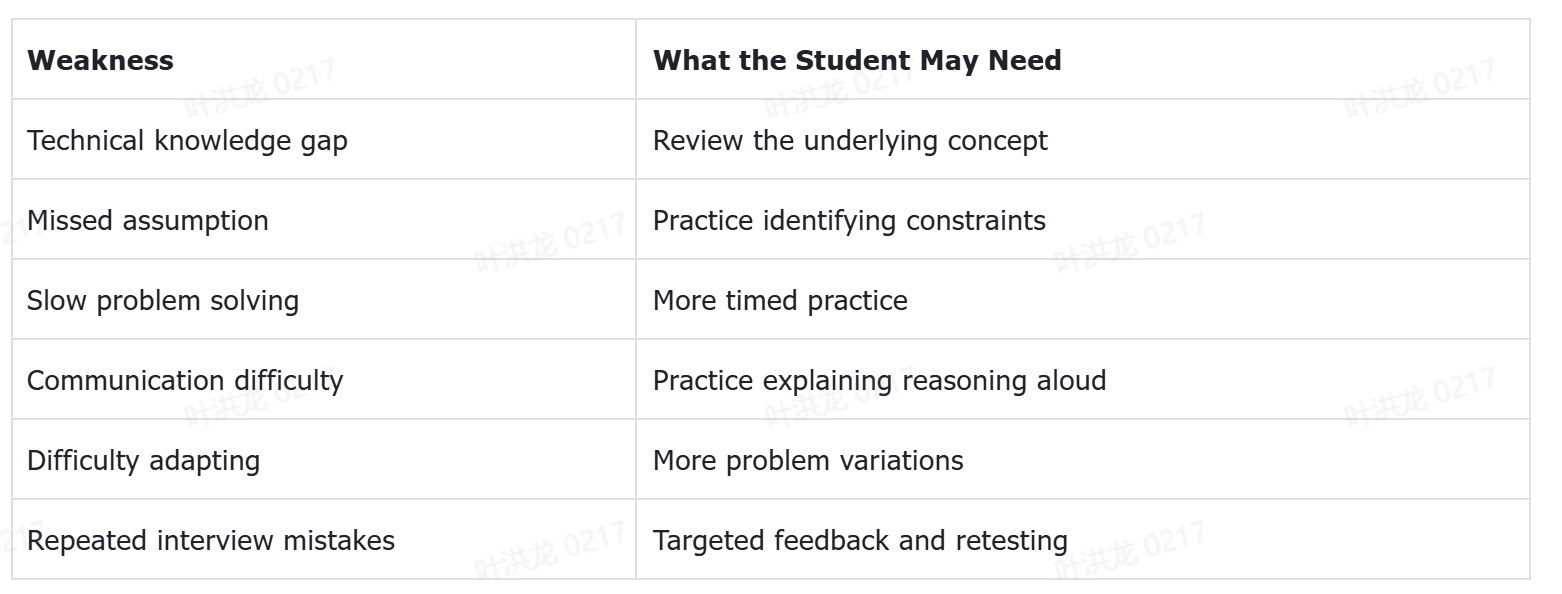
This makes the mock interviews useful as more than practice questions. They can help identify whether a student's main issue is technical knowledge, speed, communication, assumptions, or the ability to adapt when a problem changes.
Trading Game Training
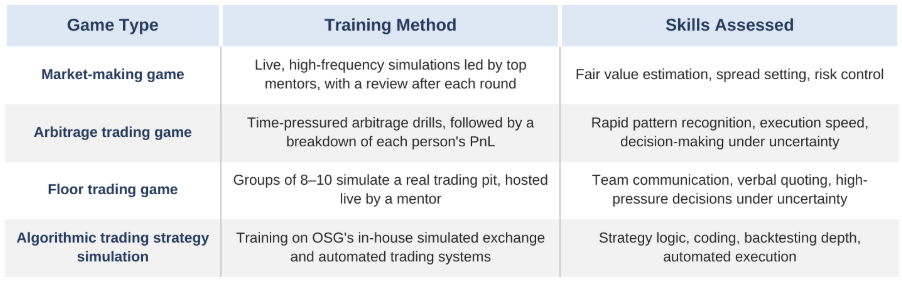
OSG uses four types of trading simulations to practice different parts of quantitative trading: market making, arbitrage, floor trading, and algorithmic trading.
Instead of using one general trading exercise, each simulation focuses on a different set of skills.
Market making games use live simulations and mentor review to practice fair value estimation, spread setting, and risk control. Arbitrage trading games introduce time pressure and post game PnL analysis, focusing on rapid pattern recognition, execution speed, and decision making under uncertainty.
Floor trading games place students in groups of 8 to 10 in a simulated trading pit. These exercises add communication to the decision making process, requiring students to practice verbal quoting and making decisions under pressure while interacting with others.
Algorithmic trading strategy simulations shift the focus toward strategy logic, coding, backtesting, and automated execution using OSG's simulated exchange and automated trading systems.
Quantitative Projects
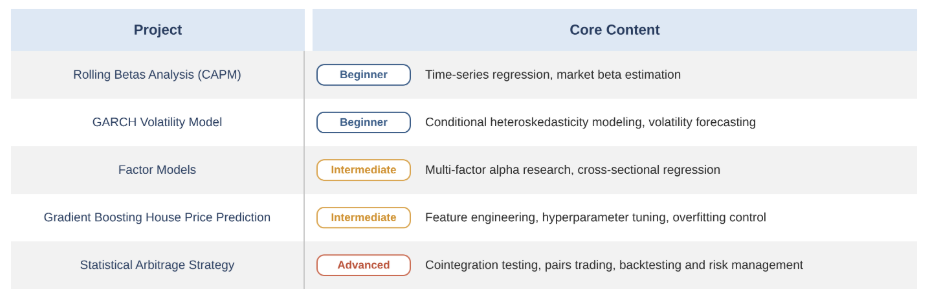
OSG's five quantitative projects give students opportunities to apply technical concepts to research problems that increase in difficulty.
The projects range from beginner exercises in time series analysis and volatility modeling to more advanced work involving factor research, machine learning, and statistical arbitrage.
Students can begin with projects such as Rolling Betas Analysis using CAPM, which focuses on time series regression and market beta estimation, and a GARCH Volatility Model, which introduces conditional variance modeling and volatility forecasting.
Intermediate projects include a Factor Model, covering multifactor alpha research and cross sectional regression, and Gradient Boosting for Housing Price Prediction, which focuses on feature engineering, model tuning, and controlling overfitting.
The advanced Statistical Arbitrage Strategy project brings several skills together through cointegration testing, pairs trading, backtesting, and risk management.
The value of these projects is not simply having another project to list on a resume. Students should be able to explain why they chose a particular approach, what assumptions the analysis depends on, how the model was tested, and what limitations could affect the results.
What Does Quant Recruiting Preparation Look Like in Practice?
The way students prepare for quant recruiting can look very different depending on their starting point, target role, and areas for improvement.
The technical training, mock interviews, trading simulations, and projects above show what preparation can include. But actual recruiting experiences also show why the same preparation process will not look identical for every student.
For example, one OSG student who is a STEM major skipped the PhD path to land a $700K Quant Trading offer at Optiver. His strong technical background gave him a foundation for quant recruiting, but preparing for Quant Trading required him to focus those skills toward a specific role and recruiting process.

His experience highlights an important part of quant preparation: students should not simply study everything equally. Preparation should depend on the skills they already have, the role they are targeting, and the areas they still need to improve.
For a student with a strong STEM background, that may mean spending less time rebuilding basic quantitative foundations and more time practicing trading specific problem solving, decision making, and interview performance. For another student, the biggest gap may be probability, programming, projects, or communication.
This is also why preparation should change over time. A student may begin by strengthening probability or programming, but later realize through practice interviews that their bigger weakness is explaining their reasoning or responding when an assumption changes. Preparation should become more targeted as these weaknesses become clearer.
The same idea applies to projects and trading simulations. Completing a project or understanding a market making exercise is only the first step. Students should also be able to explain why they made certain decisions, what assumptions they relied on, what could go wrong, and how they would respond if the situation changed. These are the types of questions that turn technical knowledge into interview preparation.
In practice, strong quant preparation is therefore less about completing the same checklist as everyone else and more about identifying the gap between where you are now and what your target role requires. The closer students get to recruiting, the more their preparation should shift from simply learning concepts to applying them under conditions that resemble an actual interview.
Conclusion: How to Approach Quant Recruiting in 2027
Preparing for quant recruiting requires more than being strong at math, coding, or completing hundreds of practice questions. Top quant firms want candidates who can apply their technical knowledge to unfamiliar problems, explain their reasoning clearly, and adjust when new information changes the problem.
The skills that matter most will also depend on the role. Quant Traders may need to focus more heavily on probability, market making, risk, and decision making under pressure, while Quant Researchers may spend more time on statistics, programming, modeling, and research. Quant Developers may face a greater emphasis on programming, algorithms, data structures, and systems.
For students preparing for recruiting, the goal should therefore be to first understand what their target role requires and then identify where their own gaps are.
Build Technical Foundations → Apply Them → Get Feedback → Identify Weaknesses → Improve → Retest
Ultimately, being interview ready is not just about how many questions you have completed. It is whether you can handle a problem you have not seen before, explain the assumptions behind your approach, respond to follow up questions, and recognize when you need to change direction.
Those abilities are much harder to memorize, which is exactly why they matter.
About OSG
One Strategy Group (OSG) helps students navigate competitive recruiting across consulting, finance, and other career paths. We provide career exploration, technical preparation, application support, networking guidance, and mock interviews.
Our mentors work with students throughout different stages of the recruiting process, from exploring career options and building a strong resume to preparing for applications and interviews.
Students can also explore our student cases to see how candidates from different backgrounds have approached recruiting.
Free Career Planning Session
Book a one-on-one conversation to discuss target roles, your recruiting stage, and preparation priorities.
Explore More Resources
What 76 Quant Interviews Taught Me About Picking the Right Offer
The Optiver Offer Came Before I Knew What I Was Trading For
Breaking Into Quant Trading: My Path to an IMC Trading Chicago Summer Offer

Free Career Planning Session
Book a free 1-on-1 session with an OSG mentor and map out your path to top firms!
Book Your Free Session →Ready to Write Your Own Success Story?
Book a free 1-on-1 session with an OSG mentor and map out your path to top firms!
Book Your Free Session →Explore More Resources



Frequently Asked Questions
Top quant firms generally look for strong quantitative reasoning, problem solving, programming, communication, and the ability to make decisions under uncertainty. The exact skills emphasized depend on whether the candidate is applying for Quant Trading, Quant Research, or Quant Development.
Quant Trading candidates commonly need strong probability and mathematical reasoning, fast problem solving, risk awareness, and decision making under uncertainty. Communication is also important because many interviews require candidates to explain their reasoning while responding to changing information.
Strong students can struggle because understanding technical concepts is different from applying them to unfamiliar problems under time pressure. Interviews may change assumptions, challenge an answer, or require candidates to explain why they chose a particular approach.